Department of Diagnostic and Interventional Neuroradiology, School of Medicine, Klinikum rechts der Isar, Technical University of Munich, Munich, Germany.
Department of Informatics, Technical University of Munich, Munich, Germany.
Eur Radiol. 2023 Aug;33(8):5882-5893. doi: 10.1007/s00330-023-09512-4. Epub 2023 Mar 16.
T2-weighted (w) fat sat (fs) sequences, which are important in spine MRI, require a significant amount of scan time. Generative adversarial networks (GANs) can generate synthetic T2-w fs images. We evaluated the potential of synthetic T2-w fs images by comparing them to their true counterpart regarding image and fat saturation quality, and diagnostic agreement in a heterogenous, multicenter dataset.
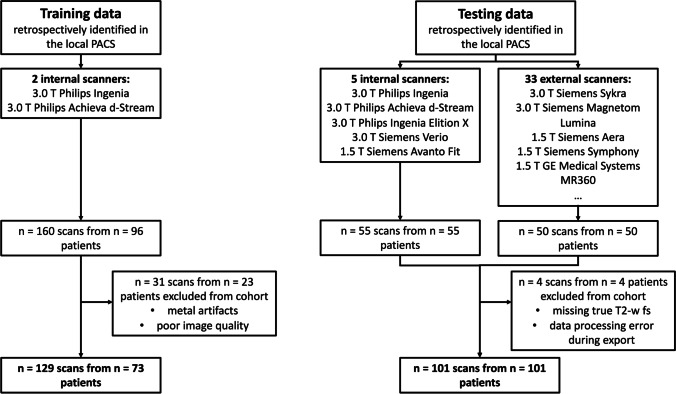
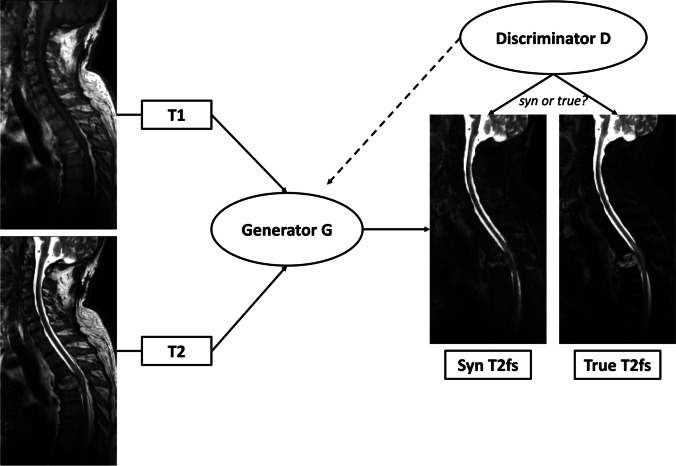
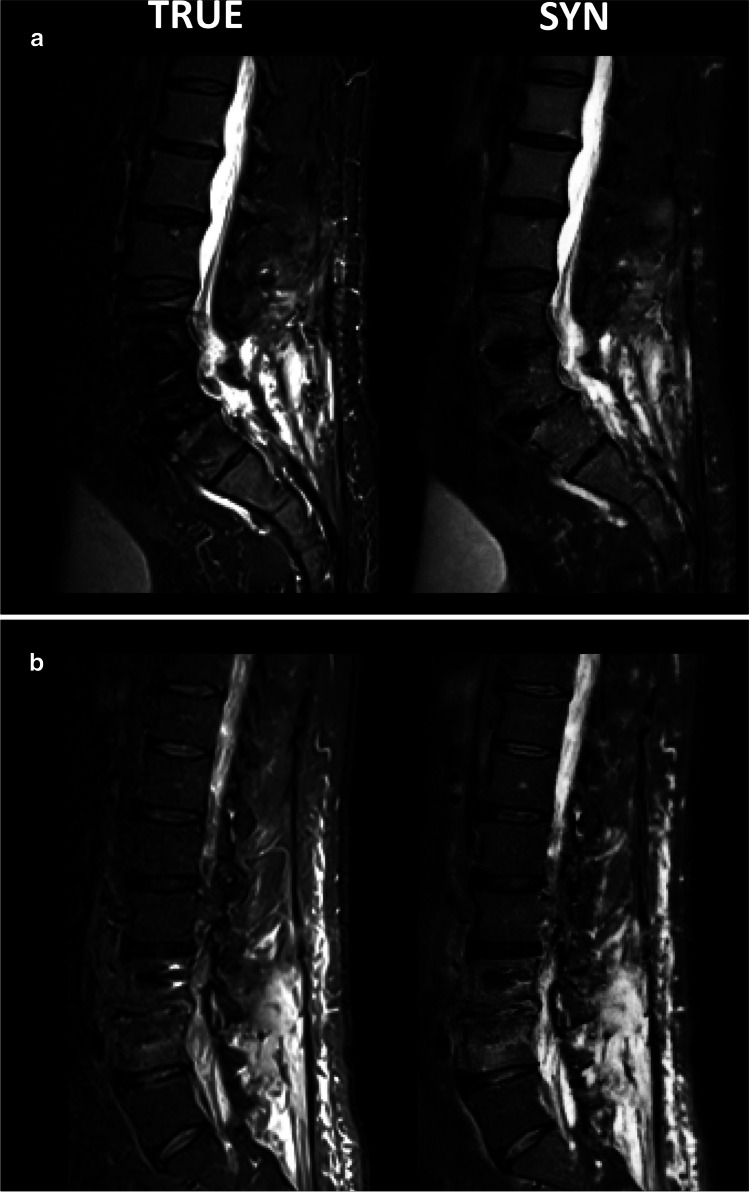
A GAN was used to synthesize T2-w fs from T1- and non-fs T2-w. The training dataset comprised scans of 73 patients from two scanners, and the test dataset, scans of 101 patients from 38 multicenter scanners. Apparent signal- and contrast-to-noise ratios (aSNR/aCNR) were measured in true and synthetic T2-w fs. Two neuroradiologists graded image (5-point scale) and fat saturation quality (3-point scale). To evaluate whether the T2-w fs images are indistinguishable, a Turing test was performed by eleven neuroradiologists. Six pathologies were graded on the synthetic protocol (with synthetic T2-w fs) and the original protocol (with true T2-w fs) by the two neuroradiologists.
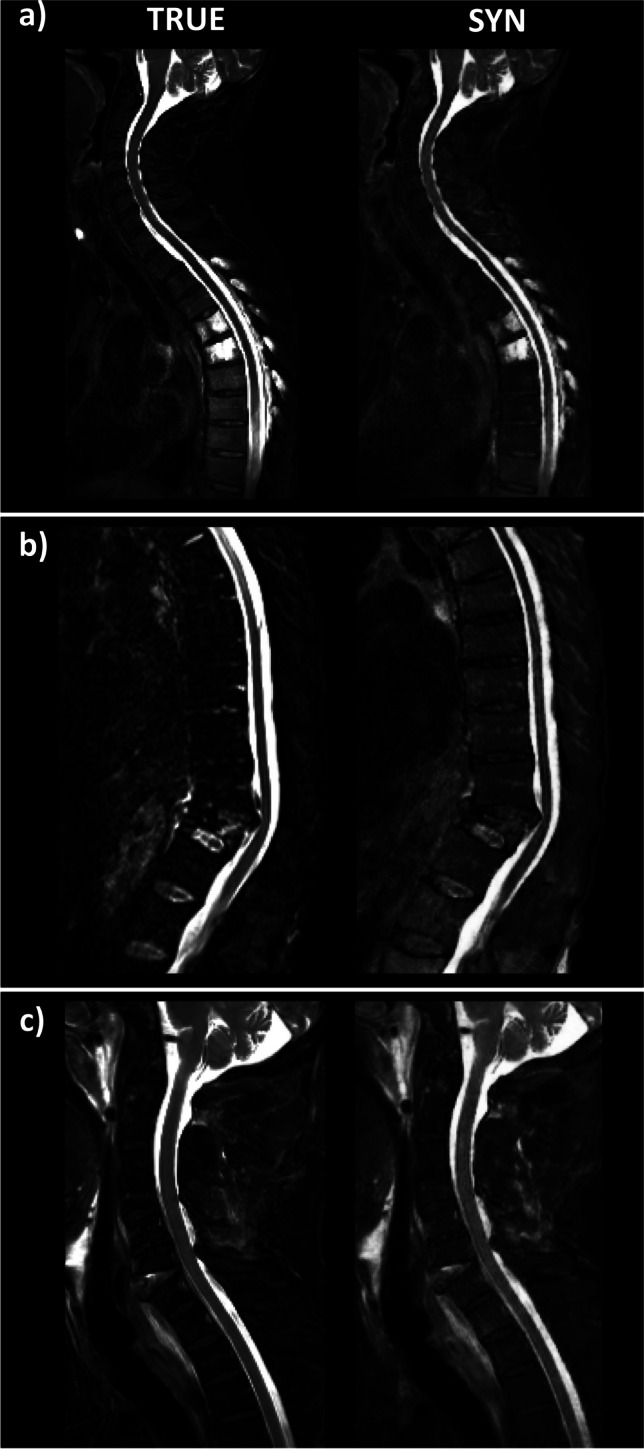
aSNR and aCNR were not significantly different between the synthetic and true T2-w fs images. Subjective image quality was graded higher for synthetic T2-w fs (p = 0.023). In the Turing test, synthetic and true T2-w fs could not be distinguished from each other. The intermethod agreement between synthetic and original protocol ranged from substantial to almost perfect agreement for the evaluated pathologies.
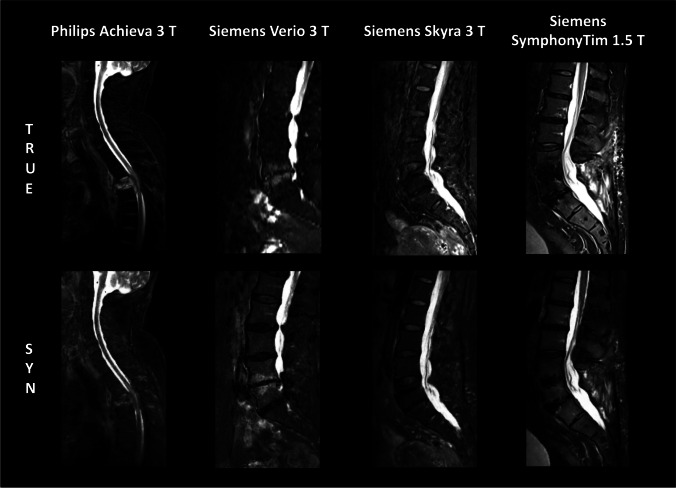
The synthetic T2-w fs might replace a physical T2-w fs. Our approach validated on a challenging, multicenter dataset is highly generalizable and allows for shorter scan protocols.
• Generative adversarial networks can be used to generate synthetic T2-weighted fat sat images from T1- and non-fat sat T2-weighted images of the spine. • The synthetic T2-weighted fat sat images might replace a physically acquired T2-weighted fat sat showing a better image quality and excellent diagnostic agreement with the true T2-weighted fat images. • The present approach validated on a challenging, multicenter dataset is highly generalizable and allows for significantly shorter scan protocols.
在脊柱 MRI 中,T2 加权(w)脂肪饱和(fs)序列非常重要,但需要大量的扫描时间。生成对抗网络(GAN)可以生成合成的 T2-w fs 图像。我们通过比较真实 T2-w fs 图像和合成 T2-w fs 图像的图像和脂肪饱和质量,以及在异质、多中心数据集的诊断一致性,评估了合成 T2-w fs 图像的潜力。
使用 GAN 从 T1 和非 fs T2-w 生成 T2-w fs。训练数据集由来自两台扫描仪的 73 例患者的扫描组成,测试数据集由来自 38 个多中心扫描仪的 101 例患者的扫描组成。在真实和合成的 T2-w fs 中测量了表观信噪比(aSNR/aCNR)。两名神经放射科医生对图像(5 分制)和脂肪饱和质量(3 分制)进行了评分。为了评估 T2-w fs 图像是否无法区分,由 11 名神经放射科医生进行了图灵测试。两名神经放射科医生根据合成方案(使用合成的 T2-w fs)和原始方案(使用真实的 T2-w fs)对六种病变进行了分级。
合成的 T2-w fs 和真实的 T2-w fs 之间的 aSNR 和 aCNR 没有显著差异。合成的 T2-w fs 的图像质量评分更高(p=0.023)。在图灵测试中,无法区分合成的和真实的 T2-w fs。对于评估的病变,合成方案与原始方案之间的方法间一致性从高度一致到几乎完美一致。
生成的 T2-w fs 可能会替代物理 T2-w fs。我们在具有挑战性的多中心数据集上验证的方法具有很强的通用性,并允许使用更短的扫描协议。
生成对抗网络可用于从脊柱的 T1 和非脂肪饱和 T2 加权图像生成合成的 T2 加权脂肪饱和图像。
合成的 T2 加权脂肪饱和图像可能会替代物理获取的 T2 加权脂肪饱和图像,显示出更好的图像质量和与真实 T2 加权脂肪饱和图像的极好的诊断一致性。
在具有挑战性的多中心数据集上验证的本方法具有很强的通用性,并允许使用更短的扫描协议。