Department of Pharmacology and Toxicology, NUTRIM School of Nutrition and Translational Research in Metabolism, Maastricht University, 6200, Maastricht, Netherlands.
Norgenotech AS, 64/66, Ullernchassern, Oslo, Norway.
Cell Biol Toxicol. 2023 Dec;39(6):2775-2786. doi: 10.1007/s10565-023-09801-0. Epub 2023 Mar 17.
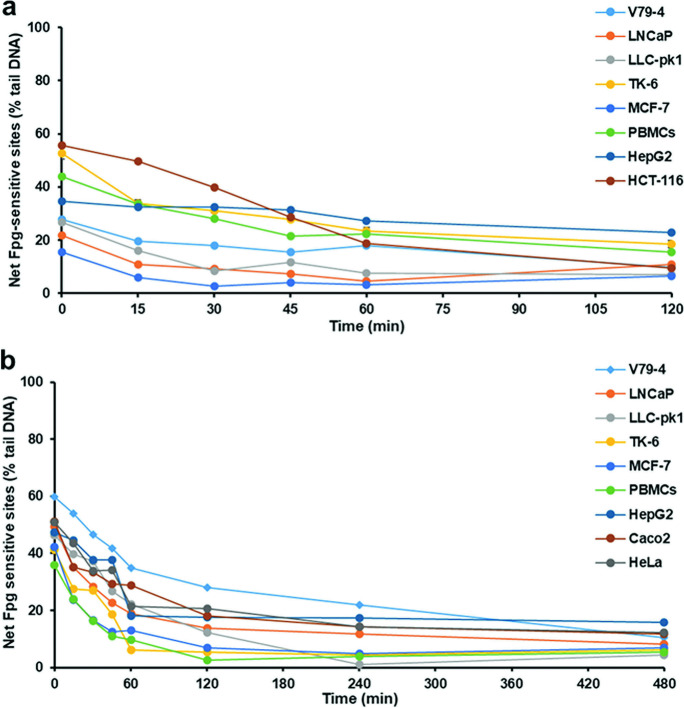
DNA repair is an essential agent in cancer development, progression, prognosis, and response to therapy. We have adapted a cellular repair assay based on the formamidopyrimidine DNA glycosylase (Fpg)-modified comet assay to assess DNA repair kinetics. The removal of oxidized nucleobases over time (0-480 min) was analyzed in peripheral blood mononuclear cells (PBMCs) and 8 cell lines. DNA damage was induced by exposure to either Ro19-8022 plus visible light or potassium bromate (KBrO). The initial amount of damage induced by Ro 19-8022 plus light varied between cell lines, and this was apparently associated with the rate of repair. However, the amount of DNA damage induced by KBrO varied less between cell types, so we used this agent to study the kinetics of DNA repair. We found an early phase of ca. 60 min with fast removal of Fpg-sensitive sites, followed by slower removal over the following 7 h. In conclusion, adjusting the initial damage at T to an equal level can be achieved by the use of KBrO, which allows for accurate analysis of subsequent cellular DNA repair kinetics in the first hour after exposure.
DNA 修复是癌症发展、进展、预后和对治疗反应的重要因素。我们基于基于 formamidopyrimidine DNA glycosylase(Fpg)修饰的彗星试验改编了一种细胞修复测定法,以评估 DNA 修复动力学。在外周血单核细胞(PBMC)和 8 种细胞系中,分析了氧化核苷碱基随时间(0-480 分钟)的去除情况。通过暴露于 Ro19-8022 加可见光或溴酸钾(KBrO)来诱导 DNA 损伤。Ro 19-8022 加光诱导的初始损伤量在细胞系之间有所不同,这显然与修复速率有关。然而,KBrO 诱导的 DNA 损伤量在细胞类型之间变化较小,因此我们使用该试剂来研究 DNA 修复的动力学。我们发现了一个大约 60 分钟的早期阶段,其中 Fpg 敏感位点快速去除,随后在接下来的 7 小时内缓慢去除。总之,通过使用 KBrO 可以将 T 时的初始损伤调整到相同水平,从而可以在暴露后第一小时内准确分析随后的细胞 DNA 修复动力学。