Department of Neurology, Wakayama Medical University, Wakayama, Japan.
Department of Neurology, Kindai University School of Medicine, Osaka-sayama, Japan.
Front Immunol. 2023 Mar 3;14:1090548. doi: 10.3389/fimmu.2023.1090548. eCollection 2023.
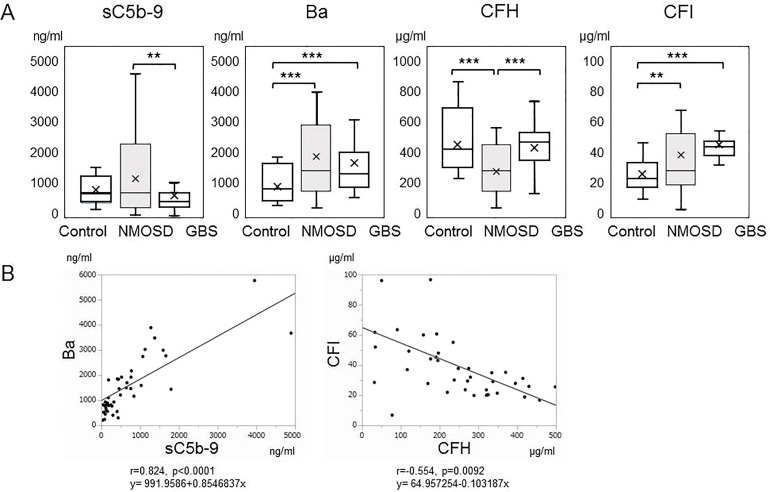
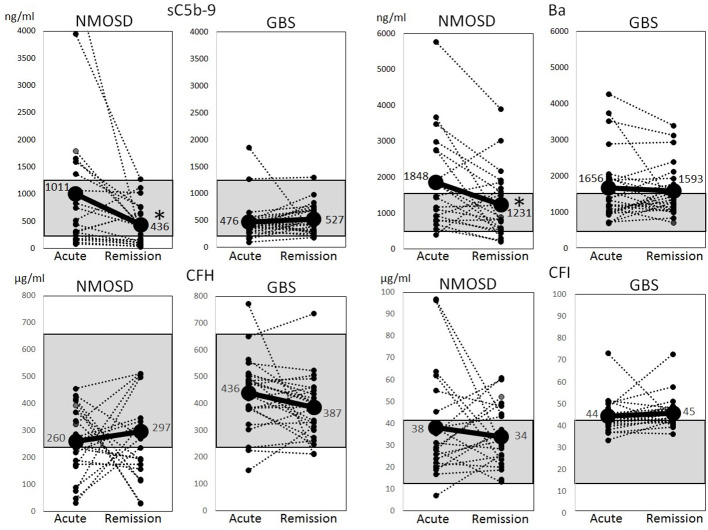
Complement is involved in the pathogenesis of neuroimmune disease, but the detailed pathological roles of the complement pathway remain incompletely understood. Recently, eculizumab, a humanized anti-C5 monoclonal antibody, has been clinically applied against neuroimmune diseases such as myasthenia gravis and neuromyelitis optica spectrum disorders (NMOSD). Clinical application of eculizumab is also being investigated for another neuroimmune disease, Guillain-Barré syndrome (GBS). However, while the effectiveness of eculizumab for NMOSD is extremely high in many cases, there are some cases of myasthenia gravis and GBS in which eculizumab has little or no efficacy. Development of effective biomarkers that reflect complement activation in these diseases is therefore important. To identify biomarkers that could predict disease status, we retrospectively analyzed serum levels of complement factors in 21 patients with NMOSD and 25 patients with GBS. Ba, an activation marker of the alternative complement pathway, was elevated in the acute phases of both NMOSD and GBS. Meanwhile, sC5b-9, an activation marker generated by the terminal complement pathway, was elevated in NMOSD but not in GBS. Complement factor H (CFH), a complement regulatory factor, was decreased in the acute phase as well as in the remission phase of NMOSD, but not in any phases of GBS. Together, these findings suggest that complement biomarkers, such as Ba, sC5b-9 and CFH in peripheral blood, have potential utility in understanding the pathological status of NMOSD.
补体参与神经免疫疾病的发病机制,但补体途径的详细病理作用仍不完全清楚。最近,一种人源化抗 C5 单克隆抗体依库珠单抗已被临床应用于治疗重症肌无力和视神经脊髓炎谱系疾病(NMOSD)等神经免疫疾病。依库珠单抗在另一种神经免疫疾病——格林-巴利综合征(GBS)中的临床应用也正在研究中。然而,虽然依库珠单抗对 NMOSD 的疗效在许多情况下非常高,但在一些重症肌无力和 GBS 病例中,依库珠单抗的疗效很小或没有。因此,开发反映这些疾病中补体激活的有效生物标志物非常重要。为了确定能够预测疾病状态的生物标志物,我们回顾性分析了 21 例 NMOSD 患者和 25 例 GBS 患者的血清补体因子水平。替代补体途径的激活标志物 Ba 在 NMOSD 和 GBS 的急性期均升高。同时,末端补体途径的激活标志物 sC5b-9 在 NMOSD 中升高,但在 GBS 中不升高。补体调节因子补体因子 H(CFH)在 NMOSD 的急性期和缓解期均降低,但在 GBS 的任何阶段均未降低。综上所述,这些发现表明,外周血中的补体生物标志物,如 Ba、sC5b-9 和 CFH,可能有助于了解 NMOSD 的病理状态。