Lai Xianjun, Wang Haiyan, Yan Junfeng, Zhang Yizheng, Yan Lang
Panxi Crops Research and Utilization Key Laboratory of Sichuan Province, College of Agriculture Science, Xichang University, Liangshan, China.
Sichuan Key Laboratory of Molecular Biology and Biotechnology, College of Life Sciences, Sichuan University, Chengdu, China.
Front Microbiol. 2023 Mar 2;14:1120027. doi: 10.3389/fmicb.2023.1120027. eCollection 2023.
BACKGROUND/OBJECTIVE: Silage characteristics of grass materials directly affect their silage qualities. To expand the source of silage raw materials and develop mixed silages underlined by exploring the positive interactions between forage grasses and legumes, three gramineous grasses, Napier grass (), king grass (), and forage maize () were separately mixed ensiled with a combination of four forage legumes including , , , and .
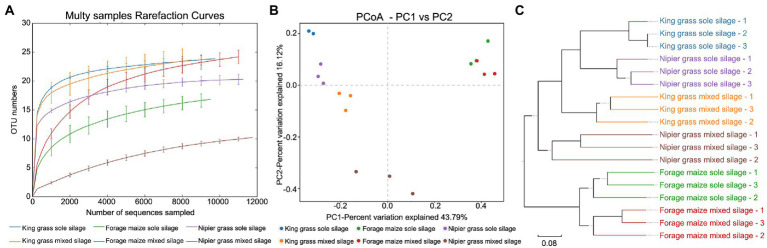
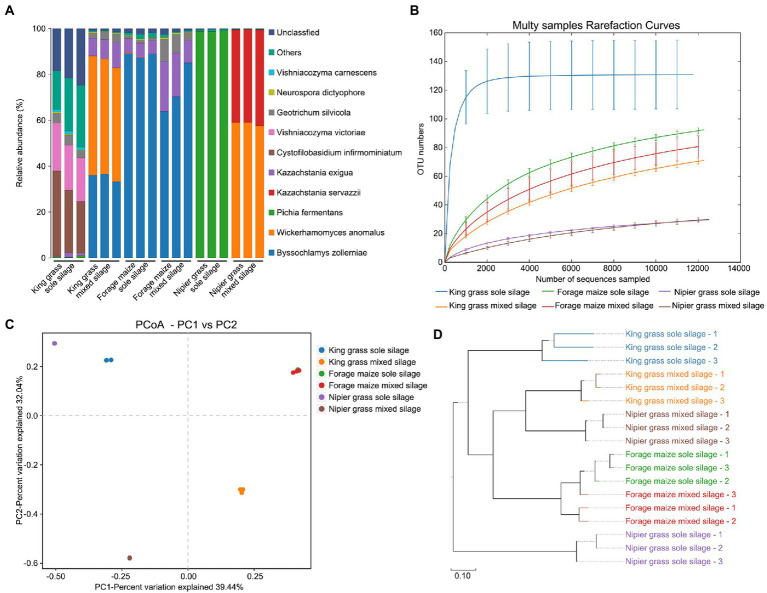
The chemical composition and fermentation quality of the mixed silages were analyzed and compared with those of the sole silages of these three grasses, as well as the diversity of microbial communities, through the 16S/ITS full-length sequencing.
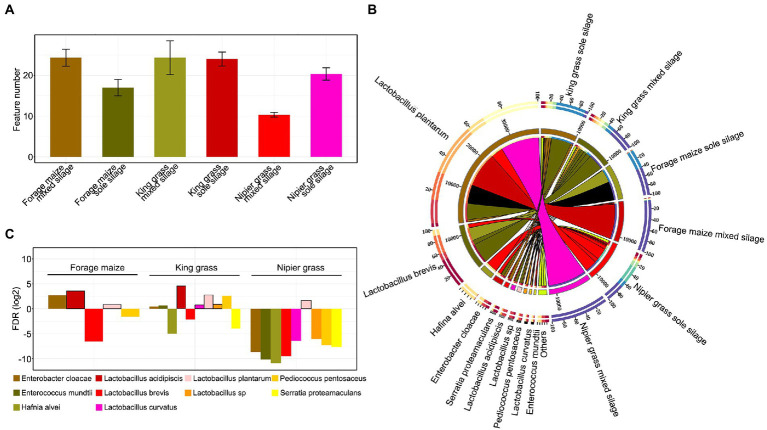
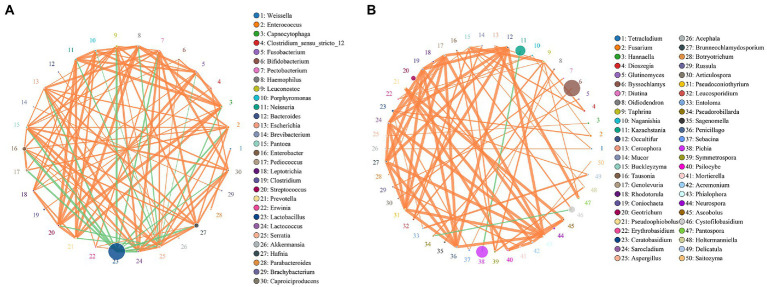
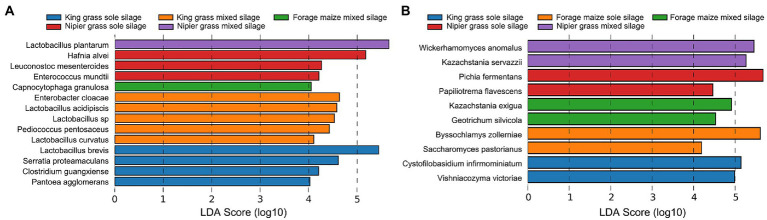
The results showed that the inclusion of forage legumes could somewhat improve the fermentation quality, as indicated by significantly ( < 0.05) higher crude protein and lactic acid contents while lower neutral detergent fiber, acid detergent fiber contents and pH values, compared with the sole silages. Among the three types of mixed silages, the mixed king grass had the highest dry matter and crude protein content as well as lowest neutral detergent fiber and acid detergent fiber content. Meanwhile, the bacterial and fungal communities in the mixed silages were influenced by increased the relative abundance of lactic acid bacteria, which inhibited the proliferation of undesirable bacteria, such as , , and . Co-occurrence networks identified 32 nodes with 164 positive and 18 negative correlations in bacteria and 80 nodes with two negative and 76 positive correlations in fungi during fermentation.
Inclusion of forage legume to grasses can improve the fermentation quality and optimize the structure of microbial community, which appears to be a feasible strategy to enhance the forage resource utilization.
背景/目的:草料的青贮特性直接影响其青贮品质。为扩大青贮原料来源并通过探索禾本科牧草与豆科牧草之间的积极相互作用来开发混合青贮饲料,将三种禾本科牧草,即象草()、皇草()和青贮玉米()分别与四种豆科牧草(包括、、和)的组合进行混合青贮。
分析混合青贮饲料的化学成分和发酵品质,并与这三种牧草的单一青贮饲料进行比较,同时通过16S/ITS全长测序分析微生物群落的多样性。
结果表明,与单一青贮饲料相比,添加豆科牧草能在一定程度上改善发酵品质,粗蛋白和乳酸含量显著更高(<0.05),而中性洗涤纤维、酸性洗涤纤维含量和pH值更低。在三种混合青贮饲料中,混合皇草的干物质和粗蛋白含量最高,中性洗涤纤维和酸性洗涤纤维含量最低。同时,混合青贮饲料中的细菌和真菌群落受到乳酸菌相对丰度增加的影响,这抑制了诸如、和等有害细菌的增殖。共现网络在发酵过程中鉴定出细菌中有32个节点,具有164个正相关和18个负相关,真菌中有80个节点,具有2个负相关和76个正相关。
在禾本科牧草中添加豆科牧草可以提高发酵品质并优化微生物群落结构,这似乎是提高草料资源利用率的可行策略。