School of Human Sciences (Exercise and Sport Science), University of Western Australia, 35 Stirling Highway, Crawley, Perth, WA, 6009, Australia.
HFRC Rehabilitation Clinic, Perth, WA, Australia.
Knee Surg Sports Traumatol Arthrosc. 2023 Jun;31(6):2131-2139. doi: 10.1007/s00167-023-07382-3. Epub 2023 Mar 20.
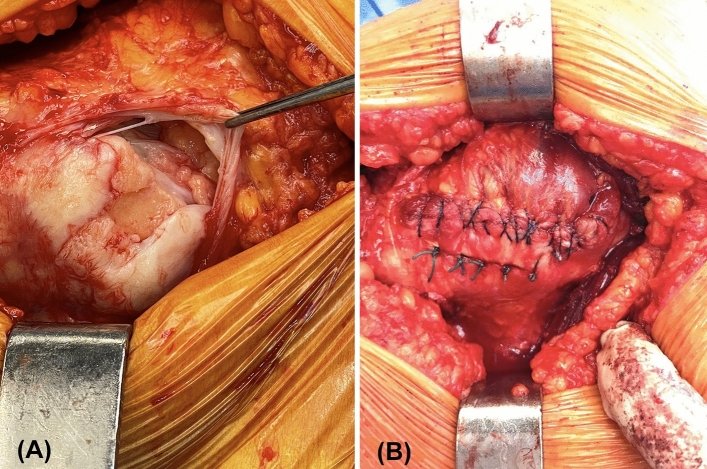
To investigate the clinical outcome, level of patient satisfaction, re-injury and re-operation rates of patients 7-10 years after augmented hip abductor tendon repair.
Between October 2012 and May 2015, 146 patients were referred to the senior author with symptomatic hip abductor tendon tears, of which 110 (101 female, 92%) were included in the current study and underwent hip abductor tendon repair augmented with LARS. Patients had a mean age of 63.2 years (range 43-82), body mass index of 27.8 (range 20.0-40.2) and duration of symptoms of 3.6 years (range 6 months-18 years). Patient-reported outcome measures (PROMs) were evaluated pre-operatively and at 3, 6, 12 and 24 months, as well as 7-10 years post-operatively, including the Oxford Hip Score (OHS), 12-item Short Form Health Survey (SF-12), a Visual Analogue Pain Scale (VAS) evaluating the frequency (VAS-F) and severity (VAS-S) of hip pain, and patient satisfaction. Adverse events, surgical failures, revisions and subsequent treatments on the ipsilateral hip were reported.
A significant improvement (p < 0.05) was observed for all PROMs and, while a mean deterioration was observed for all PROMs from 24 months to final review (7-10 years), these were not significant (n.s.). In the 90 patients retained and assessed at final review, 93% were satisfied with their hip pain relief and 89% with their ability to participate in recreational activities. Overall, 9 (of 110, 8.2%) surgical failures were observed over the 7-10-year follow-up period.
Good clinical scores, a high level of patient satisfaction and an acceptable re-injury rate were observed at 7-10 years after augmented hip abductor tendon repair, demonstrating satisfactory repair longevity.
IV.
探讨增强型髋关节外展肌腱修复后 7-10 年的临床疗效、患者满意度、再损伤和再手术率。
2012 年 10 月至 2015 年 5 月,共有 146 例因髋关节外展肌腱撕裂症状就诊的患者被转介至高级作者处,其中 110 例(101 例女性,92%)纳入本研究,并接受 LARS 增强的髋关节外展肌腱修复。患者平均年龄为 63.2 岁(范围 43-82 岁),体重指数为 27.8(范围 20.0-40.2),症状持续时间为 3.6 年(范围 6 个月-18 年)。患者术前及术后 3、6、12 和 24 个月以及术后 7-10 年进行了患者报告的结果测量(PROMs)评估,包括牛津髋关节评分(OHS)、12 项简短健康调查(SF-12)、评估髋关节疼痛频率(VAS-F)和严重程度(VAS-S)的视觉模拟疼痛量表(VAS)以及患者满意度。报告了同侧髋关节的不良事件、手术失败、翻修和后续治疗。
所有 PROMs 均有显著改善(p<0.05),而在 24 个月至最终随访(7-10 年)期间,所有 PROMs 均出现平均恶化,但无统计学意义(n.s.)。在最终随访时保留并评估的 90 例患者中,93%对髋关节疼痛缓解感到满意,89%对参与娱乐活动的能力感到满意。总的来说,在 7-10 年的随访期间,观察到 9 例(110 例中的 9 例,8.2%)手术失败。
增强型髋关节外展肌腱修复后 7-10 年,临床评分良好,患者满意度高,再损伤率可接受,表明修复具有较长的耐久性。
IV。