• 文献检索
  • 文档翻译
  • 深度研究
  • 学术资讯
  • Suppr Zotero 插件Zotero 插件
  • 邀请有礼
  • 套餐&价格
  • 历史记录
应用&插件
Suppr Zotero 插件Zotero 插件浏览器插件Mac 客户端Windows 客户端微信小程序
定价
高级版会员购买积分包购买API积分包
服务
文献检索文档翻译深度研究API 文档MCP 服务
关于我们
关于 Suppr公司介绍联系我们用户协议隐私条款
关注我们

Suppr 超能文献

核心技术专利:CN118964589B侵权必究
粤ICP备2023148730 号-1Suppr @ 2026

文献检索

告别复杂PubMed语法,用中文像聊天一样搜索,搜遍4000万医学文献。AI智能推荐,让科研检索更轻松。

立即免费搜索

文件翻译

保留排版,准确专业,支持PDF/Word/PPT等文件格式,支持 12+语言互译。

免费翻译文档

深度研究

AI帮你快速写综述,25分钟生成高质量综述,智能提取关键信息,辅助科研写作。

立即免费体验

小分子荧光配体用于趋化因子受体 CXCR4。

Small-Molecule Fluorescent Ligands for the CXCR4 Chemokine Receptor.

机构信息

Biodiscovery Institute, School of Pharmacy, University of Nottingham, Nottingham NG7 2RD, U.K.

Centre of Membrane Proteins and Receptors, University of Birmingham and University of Nottingham, The Midlands NG7 2UH, U.K.

出版信息

J Med Chem. 2023 Apr 13;66(7):5208-5222. doi: 10.1021/acs.jmedchem.3c00151. Epub 2023 Mar 21.

DOI:10.1021/acs.jmedchem.3c00151
PMID:36944083
原文链接:https://pmc.ncbi.nlm.nih.gov/articles/PMC10108349/
Abstract

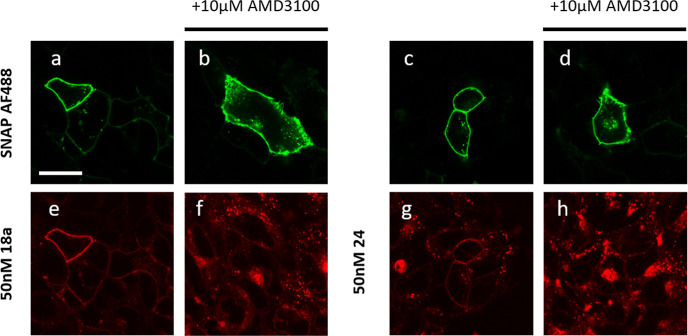
The C-X-C chemokine receptor type 4, or CXCR4, is a chemokine receptor found to promote cancer progression and metastasis of various cancer cell types. To investigate the pharmacology of this receptor, and to further elucidate its role in cancer, novel chemical tools are a necessity. In the present study, using classic medicinal chemistry approaches, small-molecule-based fluorescent probes were designed and synthesized based on previously reported small-molecule antagonists. Here, we report the development of three distinct chemical classes of fluorescent probes that show specific binding to the CXCR4 receptor in a novel fluorescence-based NanoBRET binding assay (p ranging 6.6-7.1). Due to their retained affinity at CXCR4, we furthermore report their use in competition binding experiments and confocal microscopy to investigate the pharmacology and cellular distribution of this receptor.

摘要

C-X-C 趋化因子受体 4(C-X-C chemokine receptor type 4,或 CXCR4)是一种趋化因子受体,被发现可促进多种癌症细胞类型的癌症进展和转移。为了研究该受体的药理学,并进一步阐明其在癌症中的作用,需要新型化学工具。在本研究中,我们使用经典的药物化学方法,基于先前报道的小分子拮抗剂设计并合成了基于小分子的荧光探针。在此,我们报告了三种不同化学类别的荧光探针的开发,这些探针在新型基于荧光的 NanoBRET 结合测定法(p 值为 6.6-7.1)中显示出与 CXCR4 受体的特异性结合。由于它们在 CXCR4 上保持亲和力,我们还报告了它们在竞争结合实验和共聚焦显微镜中的使用,以研究该受体的药理学和细胞分布。
https://cdn.ncbi.nlm.nih.gov/pmc/blobs/a398/10108349/f5b03e346d4f/jm3c00151_0008.jpg
https://cdn.ncbi.nlm.nih.gov/pmc/blobs/a398/10108349/bccf8f02e1ca/jm3c00151_0002.jpg
https://cdn.ncbi.nlm.nih.gov/pmc/blobs/a398/10108349/81d58cc8f847/jm3c00151_0003.jpg
https://cdn.ncbi.nlm.nih.gov/pmc/blobs/a398/10108349/3228189126a6/jm3c00151_0009.jpg
https://cdn.ncbi.nlm.nih.gov/pmc/blobs/a398/10108349/f412e390a73e/jm3c00151_0004.jpg
https://cdn.ncbi.nlm.nih.gov/pmc/blobs/a398/10108349/b6e064337255/jm3c00151_0010.jpg
https://cdn.ncbi.nlm.nih.gov/pmc/blobs/a398/10108349/7564d729cf8e/jm3c00151_0011.jpg
https://cdn.ncbi.nlm.nih.gov/pmc/blobs/a398/10108349/012d0bbddf57/jm3c00151_0005.jpg
https://cdn.ncbi.nlm.nih.gov/pmc/blobs/a398/10108349/f3d3e96c884c/jm3c00151_0006.jpg
https://cdn.ncbi.nlm.nih.gov/pmc/blobs/a398/10108349/bc5f27afe451/jm3c00151_0007.jpg
https://cdn.ncbi.nlm.nih.gov/pmc/blobs/a398/10108349/f5b03e346d4f/jm3c00151_0008.jpg
https://cdn.ncbi.nlm.nih.gov/pmc/blobs/a398/10108349/bccf8f02e1ca/jm3c00151_0002.jpg
https://cdn.ncbi.nlm.nih.gov/pmc/blobs/a398/10108349/81d58cc8f847/jm3c00151_0003.jpg
https://cdn.ncbi.nlm.nih.gov/pmc/blobs/a398/10108349/3228189126a6/jm3c00151_0009.jpg
https://cdn.ncbi.nlm.nih.gov/pmc/blobs/a398/10108349/f412e390a73e/jm3c00151_0004.jpg
https://cdn.ncbi.nlm.nih.gov/pmc/blobs/a398/10108349/b6e064337255/jm3c00151_0010.jpg
https://cdn.ncbi.nlm.nih.gov/pmc/blobs/a398/10108349/7564d729cf8e/jm3c00151_0011.jpg
https://cdn.ncbi.nlm.nih.gov/pmc/blobs/a398/10108349/012d0bbddf57/jm3c00151_0005.jpg
https://cdn.ncbi.nlm.nih.gov/pmc/blobs/a398/10108349/f3d3e96c884c/jm3c00151_0006.jpg
https://cdn.ncbi.nlm.nih.gov/pmc/blobs/a398/10108349/bc5f27afe451/jm3c00151_0007.jpg
https://cdn.ncbi.nlm.nih.gov/pmc/blobs/a398/10108349/f5b03e346d4f/jm3c00151_0008.jpg

相似文献

1
Small-Molecule Fluorescent Ligands for the CXCR4 Chemokine Receptor.小分子荧光配体用于趋化因子受体 CXCR4。
J Med Chem. 2023 Apr 13;66(7):5208-5222. doi: 10.1021/acs.jmedchem.3c00151. Epub 2023 Mar 21.
2
Multiplex Detection of Fluorescent Chemokine Binding to CXC Chemokine Receptors by NanoBRET.利用 NanoBRET 技术对 CXCL 趋化因子受体与荧光趋化因子配体的多元检测
Int J Mol Sci. 2024 May 4;25(9):5018. doi: 10.3390/ijms25095018.
3
A Flow Cytometry-based Assay to Identify Compounds That Disrupt Binding of Fluorescently-labeled CXC Chemokine Ligand 12 to CXC Chemokine Receptor 4.一种基于流式细胞术的检测方法,用于鉴定破坏荧光标记的CXC趋化因子配体12与CXC趋化因子受体4结合的化合物。
J Vis Exp. 2018 Mar 10(133):57271. doi: 10.3791/57271.
4
Fluorescent CXCL12AF647 as a novel probe for nonradioactive CXCL12/CXCR4 cellular interaction studies.荧光CXCL12AF647作为一种用于非放射性CXCL12/CXCR4细胞相互作用研究的新型探针。
Cytometry A. 2004 Oct;61(2):178-88. doi: 10.1002/cyto.a.20070.
5
Structural and Biological Characterizations of Novel High-Affinity Fluorescent Probes with Overlapped and Distinctive Binding Regions on CXCR4.新型高亲和力荧光探针在 CXCR4 上重叠且独特的结合区域的结构和生物学特性。
Molecules. 2019 Aug 13;24(16):2928. doi: 10.3390/molecules24162928.
6
Synthetic chemokines directly labeled with a fluorescent dye as tools for studying chemokine and chemokine receptor interactions.直接用荧光染料标记的合成趋化因子作为研究趋化因子和趋化因子受体相互作用的工具。
Eur Cytokine Netw. 2006 Mar;17(1):49-59.
7
Identification and profiling of CXCR3-CXCR4 chemokine receptor heteromer complexes.鉴定和分析 CXCR3-CXCR4 趋化因子受体异源二聚体复合物。
Br J Pharmacol. 2013 Apr;168(7):1662-74. doi: 10.1111/bph.12064.
8
Baclofen and other GABAB receptor agents are allosteric modulators of the CXCL12 chemokine receptor CXCR4.巴氯芬和其他 GABAB 受体激动剂是趋化因子受体 CXCR4 的别构调节剂。
J Neurosci. 2013 Jul 10;33(28):11643-54. doi: 10.1523/JNEUROSCI.6070-11.2013.
9
The chemokine receptors CXCR4/CXCR7 and their primary heterodimeric ligands CXCL12 and CXCL12/high mobility group box 1 in pancreatic cancer growth and development: finding flow.趋化因子受体CXCR4/CXCR7及其主要异二聚体配体CXCL12和CXCL12/高迁移率族蛋白盒1在胰腺癌生长和发展中的作用:探索进展
Pancreas. 2015 May;44(4):528-34. doi: 10.1097/MPA.0000000000000298.
10
Small Molecule Fluorescent Ligands for the Atypical Chemokine Receptor 3 (ACKR3).用于非典型趋化因子受体3(ACKR3)的小分子荧光配体
ACS Med Chem Lett. 2023 Dec 8;15(1):143-148. doi: 10.1021/acsmedchemlett.3c00469. eCollection 2024 Jan 11.

引用本文的文献

1
Design, Synthesis, and Evaluation of a New Fluorescent Ligand for the M Muscarinic Acetylcholine Receptor.M型毒蕈碱型乙酰胆碱受体新型荧光配体的设计、合成与评价
ACS Med Chem Lett. 2025 Mar 20;16(4):552-559. doi: 10.1021/acsmedchemlett.4c00592. eCollection 2025 Apr 10.
2
Multiplex Detection of Fluorescent Chemokine Binding to CXC Chemokine Receptors by NanoBRET.利用 NanoBRET 技术对 CXCL 趋化因子受体与荧光趋化因子配体的多元检测
Int J Mol Sci. 2024 May 4;25(9):5018. doi: 10.3390/ijms25095018.
3
Development of a Fluorescently Labeled Ligand for Rapid Detection of DAT in Human and Mouse Peripheral Blood Monocytes.

本文引用的文献

1
Kinetic Analysis of the Early Signaling Steps of the Human Chemokine Receptor CXCR4.人源趋化因子受体 CXCR4 的早期信号转导的动力学分析。
Mol Pharmacol. 2020 Aug;98(2):72-87. doi: 10.1124/mol.119.118448. Epub 2020 May 30.
2
CRISPR-Mediated Protein Tagging with Nanoluciferase to Investigate Native Chemokine Receptor Function and Conformational Changes.利用纳米荧光素酶进行CRISPR介导的蛋白质标记以研究天然趋化因子受体功能和构象变化
Cell Chem Biol. 2020 May 21;27(5):499-510.e7. doi: 10.1016/j.chembiol.2020.01.010. Epub 2020 Feb 12.
3
Development of a NanoBRET-Based Sensitive Screening Method for CXCR4 Ligands.
用于快速检测人和小鼠外周血单核细胞中多巴胺转运体的荧光标记配体的开发。
JACS Au. 2024 Jan 24;4(2):657-665. doi: 10.1021/jacsau.3c00719. eCollection 2024 Feb 26.
4
Small Molecule Fluorescent Ligands for the Atypical Chemokine Receptor 3 (ACKR3).用于非典型趋化因子受体3(ACKR3)的小分子荧光配体
ACS Med Chem Lett. 2023 Dec 8;15(1):143-148. doi: 10.1021/acsmedchemlett.3c00469. eCollection 2024 Jan 11.
5
Targeting CD24 in Cancer Immunotherapy.癌症免疫治疗中靶向CD24
Biomedicines. 2023 Nov 27;11(12):3159. doi: 10.3390/biomedicines11123159.
基于 NanoBRET 的 CXCR4 配体敏感筛选方法的建立。
Bioconjug Chem. 2019 May 15;30(5):1442-1450. doi: 10.1021/acs.bioconjchem.9b00182. Epub 2019 Apr 11.
4
Fluorescent probes for G-protein-coupled receptor drug discovery.用于 G 蛋白偶联受体药物发现的荧光探针。
Expert Opin Drug Discov. 2018 Oct;13(10):933-947. doi: 10.1080/17460441.2018.1518975. Epub 2018 Sep 24.
5
Current approaches to the discovery of novel inhaled medicines.目前新型吸入性药物的发现方法。
Drug Discov Today. 2018 Oct;23(10):1705-1717. doi: 10.1016/j.drudis.2018.05.017. Epub 2018 May 20.
6
Synthesis and Evaluation of the First Fluorescent Antagonists of the Human P2Y Receptor Based on AR-C118925.基于 AR-C118925 的人 P2Y 受体的首个荧光拮抗剂的合成与评价。
J Med Chem. 2018 Apr 12;61(7):3089-3113. doi: 10.1021/acs.jmedchem.8b00139. Epub 2018 Mar 28.
7
NanoBRET Approaches to Study Ligand Binding to GPCRs and RTKs.纳米 BRET 方法研究配体与 GPCRs 和 RTKs 的结合。
Trends Pharmacol Sci. 2018 Feb;39(2):136-147. doi: 10.1016/j.tips.2017.10.006. Epub 2017 Nov 10.
8
Drug design strategies focusing on the CXCR4/CXCR7/CXCL12 pathway in leukemia and lymphoma.聚焦于白血病和淋巴瘤中 CXCR4/CXCR7/CXCL12 通路的药物设计策略。
Expert Opin Drug Discov. 2016 Nov;11(11):1093-1109. doi: 10.1080/17460441.2016.1233176. Epub 2016 Sep 20.
9
CXCL12-CXCR4 Axis Promotes Proliferation, Migration, Invasion, and Metastasis of Ovarian Cancer.CXCL12-CXCR4轴促进卵巢癌的增殖、迁移、侵袭和转移。
Oncol Res. 2014;22(5-6):247-58. doi: 10.3727/096504015X14343704124430.
10
New AMD3100 derivatives for CXCR4 chemokine receptor targeted molecular imaging studies: synthesis, anti-HIV-1 evaluation and binding affinities.新型 AMD3100 衍生物用于 CXCR4 趋化因子受体靶向分子成像研究:合成、抗 HIV-1 评估和结合亲和力。
Dalton Trans. 2015 Mar 21;44(11):5004-16. doi: 10.1039/c4dt02972k.