Bull Caroline J, Hazelwood Emma, Bell Joshua A, Tan Vanessa Y, Constantinescu Andrei-Emil, Borges Maria Carolina, Legge Danny N, Burrows Kimberly, Huyghe Jeroen R, Brenner Hermann, Castellví-Bel Sergi, Chan Andrew T, Kweon Sun-Seog, Marchand Loic Le, Li Li, Cheng Iona, Pai Rish K, Figueiredo Jane C, Murphy Neil, Gunter Marc J, Timpson Nicholas J, Vincent Emma E
MRC Integrative Epidemiology Unit at the University of Bristol, Bristol, UK.
Population Health Sciences, Bristol Medical School, University of Bristol, Bristol, UK.
medRxiv. 2023 Nov 9:2023.03.10.23287084. doi: 10.1101/2023.03.10.23287084.
Recognizing the early signs of cancer risk is vital for informing prevention, early detection, and survival.
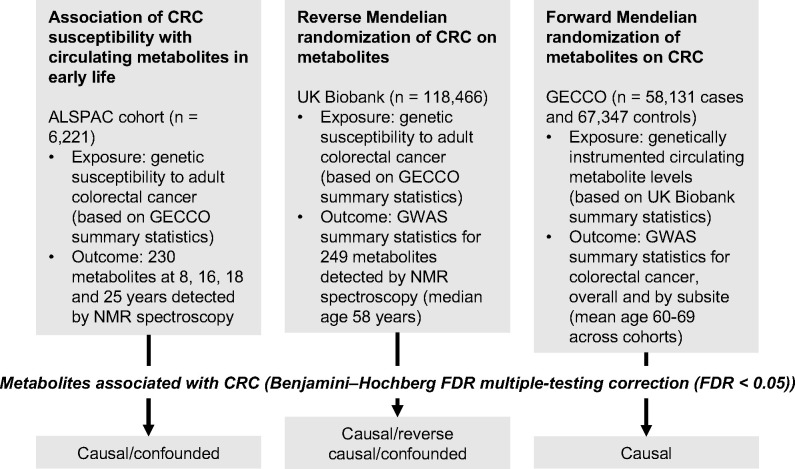
To investigate whether changes in circulating metabolites characterise the early stages of colorectal cancer (CRC) development, we examined associations between a genetic risk score (GRS) associated with CRC liability (72 single nucleotide polymorphisms) and 231 circulating metabolites measured by nuclear magnetic resonance spectroscopy in the Avon Longitudinal Study of Parents and Children (N=6,221). Linear regression models were applied to examine associations between genetic liability to colorectal cancer and circulating metabolites measured in the same individuals at age 8, 16, 18 and 25 years.
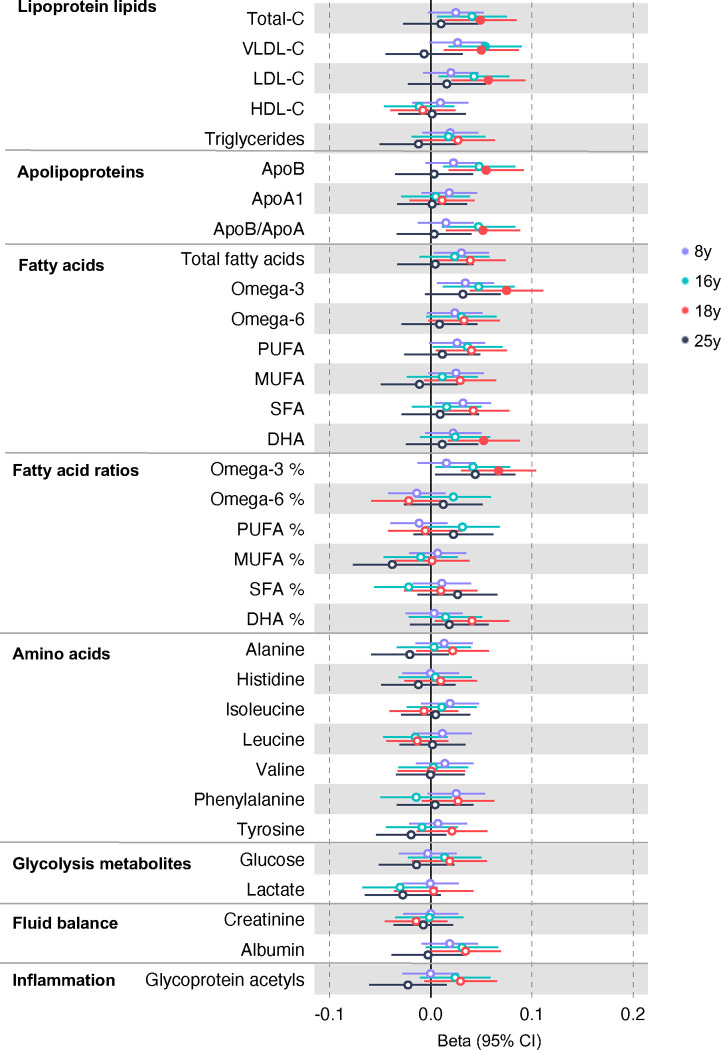
The GRS for CRC was associated with up to 28% of the circulating metabolites at FDR-P<0.05 across all time points, particularly with higher fatty acids and very-low- and low-density lipoprotein subclass lipids. Two-sample reverse Mendelian randomization (MR) analyses investigating CRC liability (52,775 cases, 45,940 controls) and metabolites measured in a random subset of UK Biobank participants (N=118,466, median age 58y) revealed broadly consistent effect estimates with the GRS analysis. In conventional (forward) MR analyses, genetically predicted polyunsaturated fatty acid concentrations were most strongly associated with higher CRC risk.
These analyses suggest that higher genetic liability to CRC can cause early alterations in systemic metabolism, and suggest that fatty acids may play an important role in CRC development.
This work was supported by the Elizabeth Blackwell Institute for Health Research, University of Bristol, the Wellcome Trust, the Medical Research Council, Diabetes UK, the University of Bristol NIHR Biomedical Research Centre, and Cancer Research UK. The funders had no role in study design, data collection and analysis, decision to publish, or preparation of the manuscript. This work used the computational facilities of the Advanced Computing Research Centre, University of Bristol - http://www.bristol.ac.uk/acrc/.
识别癌症风险的早期迹象对于预防、早期检测和提高生存率至关重要。
为了研究循环代谢物的变化是否能表征结直肠癌(CRC)发展的早期阶段,我们在雅芳亲子纵向研究(N = 6221)中,检测了与CRC易感性相关的遗传风险评分(GRS,72个单核苷酸多态性)和通过核磁共振波谱法测量的231种循环代谢物之间的关联。应用线性回归模型来检测在8岁、16岁、18岁和25岁时,同一批个体中结直肠癌遗传易感性与循环代谢物之间的关联。
在所有时间点上,FDR - P < 0.05时,CRC的GRS与高达28%的循环代谢物相关,特别是与高级脂肪酸以及极低密度和低密度脂蛋白亚类脂质相关。在两项样本反向孟德尔随机化(MR)分析中,研究CRC易感性(52775例病例,45940例对照)以及在英国生物银行参与者的一个随机子集中测量的代谢物(N = 118466,中位年龄58岁),其效应估计与GRS分析大致一致。在传统(正向)MR分析中,遗传预测的多不饱和脂肪酸浓度与较高的CRC风险关联最为强烈。
这些分析表明,较高的CRC遗传易感性可导致全身代谢的早期改变,并提示脂肪酸可能在CRC发展中起重要作用。
这项工作得到了布里斯托大学伊丽莎白·布莱克韦尔健康研究学院、惠康信托基金会、医学研究理事会、英国糖尿病协会、布里斯托大学NIHR生物医学研究中心以及英国癌症研究中心的支持。资助者在研究设计、数据收集和分析、决定发表或撰写稿件方面没有参与。这项工作使用了布里斯托大学高级计算研究中心的计算设施 - http://www.bristol.ac.uk/acrc/ 。