Hancock Zachary B, Toczydlowski Rachel H, Bradburd Gideon S
Department of Ecology and Evolutionary Biology, University of Michigan, Ann Arbor, MI 481103, USA.
Northern Research Station, United States Forest Service, Rhinelander, WI 54501, USA.
bioRxiv. 2023 Mar 12:2023.03.10.532094. doi: 10.1101/2023.03.10.532094.
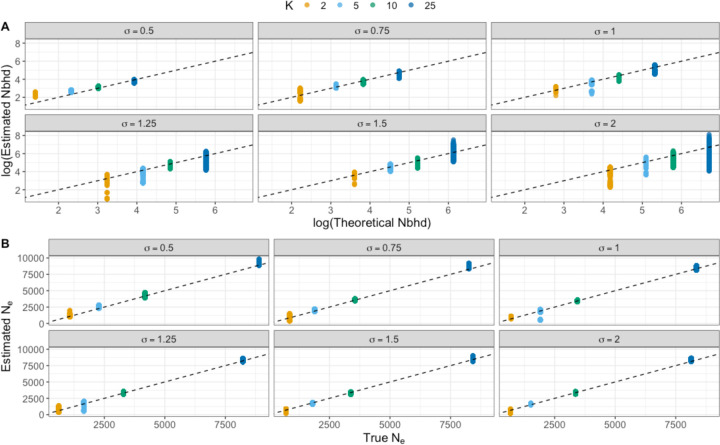
Spatially continuous patterns of genetic differentiation, which are common in nature, are often poorly described by existing population genetic theory or methods that assume panmixia or discrete, clearly definable populations. There is therefore a need for statistical approaches in population genetics that can accommodate continuous geographic structure, and that ideally use georeferenced individuals as the unit of analysis, rather than populations or subpopulations. In addition, researchers are often interested describing the diversity of a population distributed continuously in space, and this diversity is intimately linked to the dispersal potential of the organism. A statistical model that leverages information from patterns of isolation-by-distance to jointly infer parameters that control local demography (such as Wright's neighborhood size), and the long-term effective size () of a population would be useful. Here, we introduce such a model that uses individual-level pairwise genetic and geographic distances to infer Wright's neighborhood size and long-term . We demonstrate the utility of our model by applying it to complex, forward-time demographic simulations as well as an empirical dataset of the Red Sea clownfish (). The model performed well on simulated data relative to alternative approaches and produced reasonable empirical results given the natural history of clownfish. The resulting inferences provide important insights into the population genetic dynamics of spatially structure populations.
空间连续的遗传分化模式在自然界中很常见,但现有的群体遗传理论或方法(假设随机交配或离散、可明确界定的群体)往往难以对其进行充分描述。因此,群体遗传学需要能够适应连续地理结构的统计方法,理想情况下,这些方法应以地理定位的个体作为分析单位,而非群体或亚群体。此外,研究人员常常希望描述在空间上连续分布的群体的多样性,而这种多样性与生物体的扩散潜力密切相关。一个利用距离隔离模式信息来联合推断控制局部种群统计学参数(如赖特邻域大小)以及群体长期有效大小()的统计模型将会很有用。在此,我们介绍这样一个模型,它使用个体水平的成对遗传距离和地理距离来推断赖特邻域大小和长期有效大小。我们通过将模型应用于复杂的、正向时间的种群统计学模拟以及红海小丑鱼()的一个实证数据集,来证明我们模型的实用性。相对于其他方法,该模型在模拟数据上表现良好,并且根据小丑鱼的自然史得出了合理的实证结果。所得推断为空间结构化群体的群体遗传动态提供了重要见解。