Department of Endocrinology, Diabetology and Clinical Nutrition, University Hospital Zurich (USZ), and University of Zurich (UZH), CH-8091 Zurich, Switzerland.
Department of Pathology and Molecular Pathology, University Hospital Zurich, CH-8091 Zurich, Switzerland.
J Clin Endocrinol Metab. 2023 Sep 18;108(10):2676-2685. doi: 10.1210/clinem/dgad166.
Pheochromocytomas and paragangliomas (PPGLs) with pathogenic mutations in the succinate dehydrogenase subunit B (SDHB) are associated with a high metastatic risk. Somatostatin receptor 2 (SSTR2)-dependent imaging is the most sensitive imaging modality for SDHB-related PPGLs, suggesting that SSTR2 expression is a significant cell surface therapeutic biomarker of such tumors.
Exploration of the relationship between SSTR2 immunoreactivity and SDHB immunoreactivity, mutational status, and clinical behavior of PPGLs. Evaluation of SSTR-based therapies in metastatic PPGLs.
Retrospective analysis of a multicenter cohort of PPGLs at 6 specialized Endocrine Tumor Centers in Germany, The Netherlands, and Switzerland. Patients with PPGLs participating in the ENSAT registry were included. Clinical data were extracted from medical records, and immunohistochemistry (IHC) for SDHB and SSTR2 was performed in patients with available tumor tissue. Immunoreactivity of SSTR2 was investigated using Volante scores. The main outcome measure was the association of SSTR2 IHC positivity with genetic and clinical-pathological features of PPGLs.
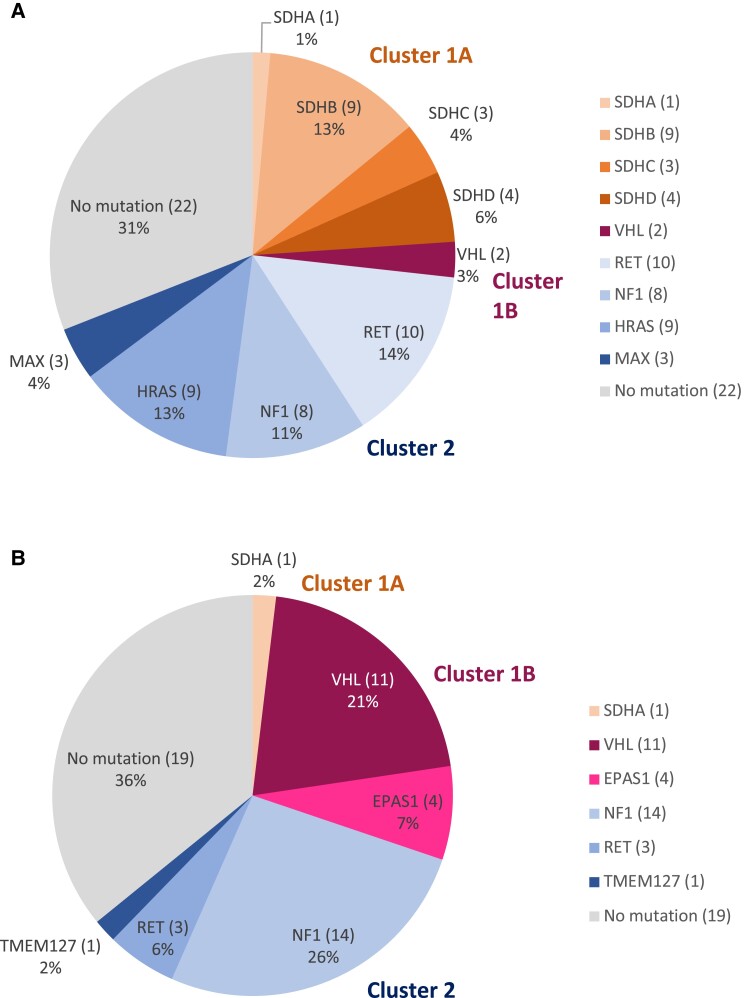
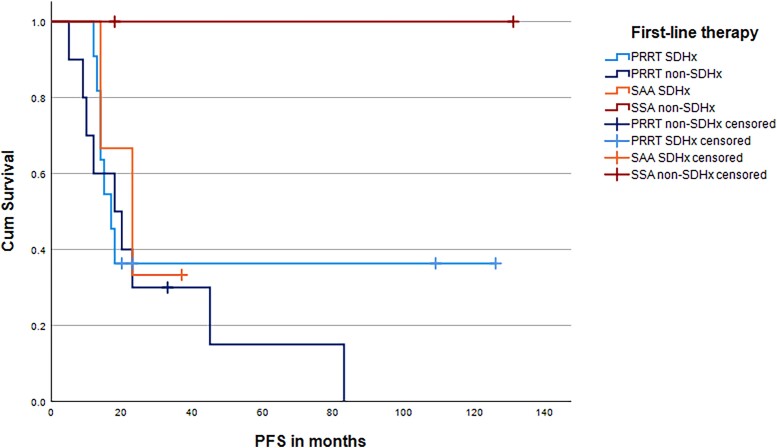
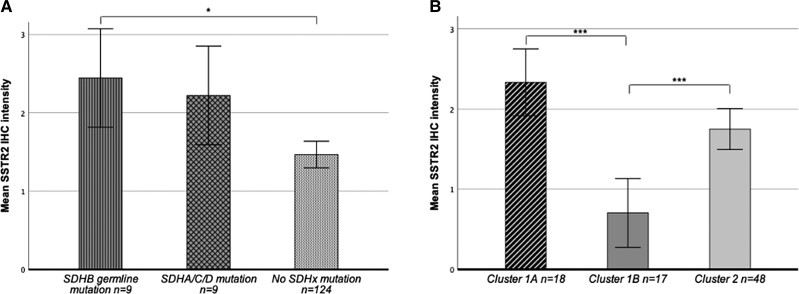
Of 202 patients with PPGLs, 50% were SSTR2 positive. SSTR2 positivity was significantly associated with SDHB- and SDHx-related PPGLs, with the strongest SSTR2 staining intensity in SDHB-related PPGLs (P = .01). Moreover, SSTR2 expression was significantly associated with metastatic disease independent of SDHB/SDHx mutation status (P < .001). In metastatic PPGLs, the disease control rate with first-line SSTR-based radionuclide therapy was 67% (n = 22, n = 11 SDHx), and with first-line "cold" somatostatin analogs 100% (n = 6, n = 3 SDHx).
SSTR2 expression was independently associated with SDHB/SDHx mutations and metastatic disease. We confirm a high disease control rate of somatostatin receptor-based therapies in metastatic PPGLs.
琥珀酸脱氢酶亚基 B(SDHB)的致病性突变与嗜铬细胞瘤和副神经节瘤(PPGL)相关,这些肿瘤具有较高的转移风险。生长抑素受体 2(SSTR2)依赖性成像技术是检测 SDHB 相关 PPGL 的最敏感的影像学方法,这表明 SSTR2 表达是此类肿瘤的重要细胞表面治疗生物标志物。
探讨 SSTR2 免疫反应性与 SDHB 免疫反应性、突变状态以及 PPGL 临床行为之间的关系。评估 SSTR 为基础的治疗在转移性 PPGL 中的应用。
对德国、荷兰和瑞士 6 个内分泌肿瘤中心的多中心队列的 PPGL 患者进行回顾性分析。纳入参与 ENSAT 登记研究的 PPGL 患者。从病历中提取临床数据,并对有肿瘤组织的患者进行 SDHB 和 SSTR2 的免疫组织化学(IHC)检测。使用 Volante 评分法评估 SSTR2 的免疫反应性。主要观察指标为 SSTR2 IHC 阳性与 PPGL 遗传和临床病理特征的相关性。
在 202 例 PPGL 患者中,有 50%的患者 SSTR2 阳性。SSTR2 阳性与 SDHB 和 SDHx 相关的 PPGL 显著相关,SDHB 相关的 PPGL 中 SSTR2 染色强度最强(P =.01)。此外,SSTR2 表达与转移性疾病显著相关,而与 SDHB/SDHx 突变状态无关(P <.001)。在转移性 PPGL 中,一线 SSTR 为基础的放射性核素治疗的疾病控制率为 67%(n = 22,n = 11 SDHx),一线“冷”生长抑素类似物的疾病控制率为 100%(n = 6,n = 3 SDHx)。
SSTR2 表达与 SDHB/SDHx 突变和转移性疾病独立相关。我们证实了基于生长抑素受体的治疗在转移性 PPGL 中具有较高的疾病控制率。