School of Medicine, University of North Carolina at Chapel Hill, Chapel Hill, NC.
Department of Surgery, Beth Israel Deaconess Medical Center, Boston, MA.
Ann Vasc Surg. 2023 Sep;95:80-86. doi: 10.1016/j.avsg.2023.03.002. Epub 2023 Mar 21.
Among patients with peripheral artery disease (PAD), depression is diagnosed in 17-25% and negatively impacts wound healing, quality of life, and survival. We hypothesized that depression is underdiagnosed in patients with PAD. Additionally, given the associations between depression and mortality in PAD patients, there is an increased need to investigate the strength of this relationship. The present analysis includes 2 studies to address the following aims: (1) Investigation of the prevalence of concomitant PAD and depression in a cohort from the Southeastern United States, and (2) Examination of the association between depression and all-cause mortality in a cohort of Canadian patients with PAD.
STUDY 1: From June-August 2022, the Patient Health Questionnaire Module 9 (PHQ-9) was administered to all patients seeking PAD-related care including medical, wound/podiatric, or vascular interventional/surgical treatment, in the University of North Carolina-Chapel Hill Vascular, Wound, and Podiatry clinics. The PHQ-9 assesses symptoms over 2 weeks and is scored 0-27, with higher scores indicating increasingly severe depression. Demographics, primary diagnosis, depression history, and antidepressant prescription were determined through chart review. We compared the proportion of positive depression screenings (PHQ-9 ≥ 5) to known depression. Among those treated for depression, the PHQ-9 score severity was evaluated. T-tests and χ tests were used to compare means and proportions. STUDY 2: From July 2015 to October 2016, the Geriatric Depression Scale Short Form was administered to adult patients with PAD undergoing revascularization. The Geriatric Depression Scale Short Form is a self-report measure of depression with a score >5 consistent with depression. The prevalence of depression was determined; primary outcome was all-cause mortality at 6 months.
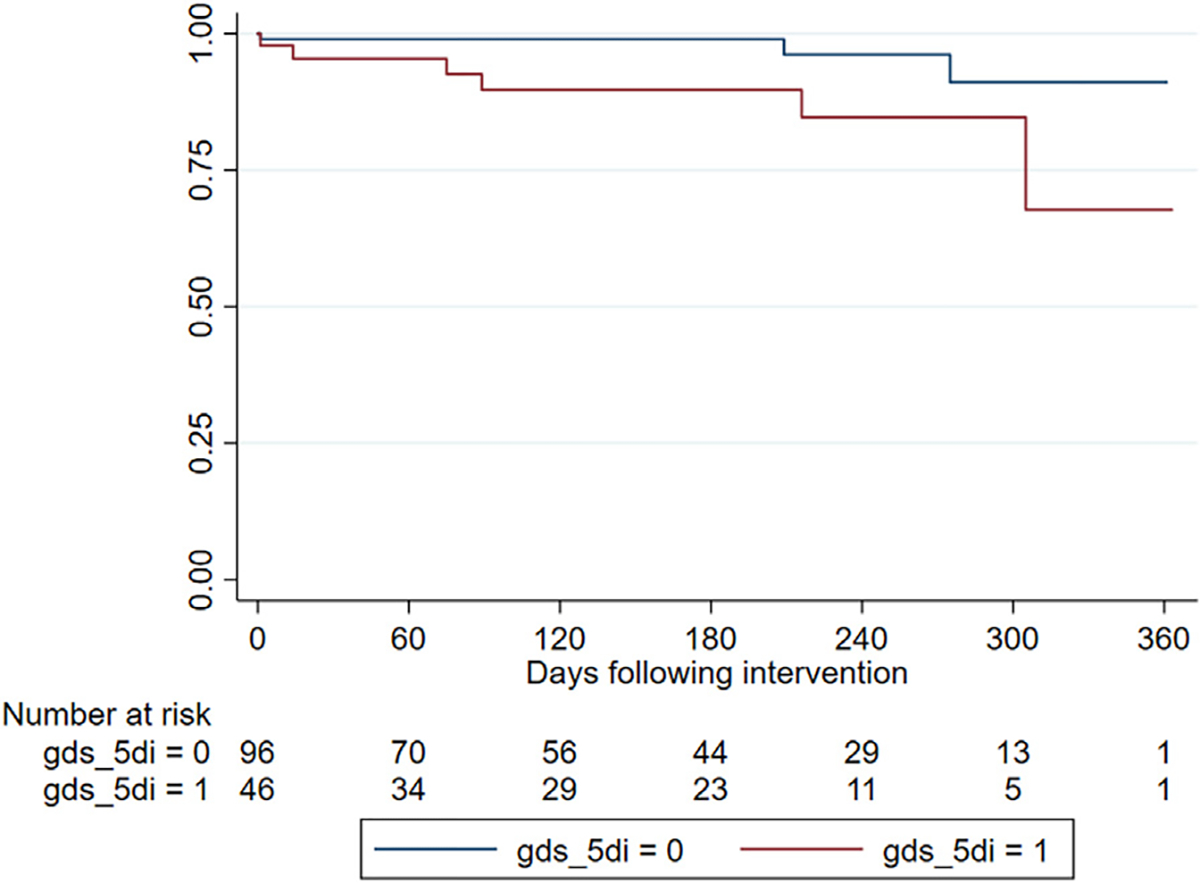
STUDY 1: In 104 PAD patients (mean age 66.6 ± 11.3 years, 37% female), 37% of respondents scored ≥5 on the PHQ-9 survey, indicating at least mild depression. Only 18% of PAD patients had a history of depression, demonstrating a significant difference between the PHQ-9 findings and documented medical history. While depression was underdiagnosed in both men and women, men were more likely to have unrecognized depression (chi-squared statistic = 35.117, df = 1, P < 0.001). Among those with a history of depression, 74% had a current prescription for antidepressant medication, but 57% still had an elevated PHQ-9 score indicating possible undertreatment. STUDY 2: In 148 patients (mean age 70.3 ± 11.0 years, 39% female) the prevalence of screened depression was 28.4%, but only 3.3% had a documented history of depression suggesting significant underdiagnosis. Patients with depression were significantly more likely to die within 6 months of revascularization (9.5% vs. 0.9%; odds ratio 1.48, 95% confidence interval: 1.08 to 2.29). There was no association between depression and risk of length of stay, reintervention, or readmission.
Depression is underdiagnosed and undertreated among patients with PAD, which has grave consequences as it is associated with 1.5 times the odds of mortality within 6 months of revascularization. There is a critical need for more robust screenings and comprehensive mental health treatment for patients with concomitant depression and PAD.
在患有外周动脉疾病 (PAD) 的患者中,17-25%被诊断患有抑郁症,这会对伤口愈合、生活质量和生存率产生负面影响。我们假设 PAD 患者中存在抑郁症的漏诊情况。此外,鉴于 PAD 患者的抑郁与死亡率之间存在关联,因此需要加强对此相关性的研究。本分析包括两项研究,旨在达到以下目的:(1) 调查美国东南部队列中 PAD 合并抑郁症的患病率;(2) 研究加拿大 PAD 患者队列中抑郁症与全因死亡率之间的关联。
研究 1:2022 年 6 月至 8 月期间,对在北卡罗来纳大学教堂山血管、伤口和足病诊所寻求 PAD 相关治疗的所有患者(包括医疗、伤口/足病或血管介入/手术治疗)进行了患者健康问卷模块 9(PHQ-9)评估。PHQ-9 评估过去 2 周的症状,评分范围为 0-27,分数越高表示抑郁症状越严重。通过病历回顾确定人口统计学特征、主要诊断、抑郁症病史和抗抑郁药处方。我们比较了阳性抑郁筛查(PHQ-9≥5)的比例与已知的抑郁症。对于接受抑郁症治疗的患者,评估了 PHQ-9 评分的严重程度。使用 t 检验和 χ 检验比较均值和比例。研究 2:2015 年 7 月至 2016 年 10 月期间,对接受血管重建术的 PAD 成年患者进行了老年抑郁量表简短形式评估。老年抑郁量表简短形式是一种自我报告的抑郁测量工具,评分>5 表示存在抑郁。确定了抑郁症的患病率;主要结局是 6 个月时的全因死亡率。
研究 1:在 104 名 PAD 患者(平均年龄 66.6±11.3 岁,37%为女性)中,37%的患者 PHQ-9 调查评分≥5,表明至少存在轻度抑郁。只有 18%的 PAD 患者有抑郁症病史,这表明 PHQ-9 调查结果与记录的病史之间存在显著差异。虽然男性和女性都存在抑郁症的漏诊情况,但男性更有可能存在未被识别的抑郁症(卡方统计量=35.117,自由度 df=1,P<0.001)。在有抑郁症病史的患者中,74%有当前抗抑郁药处方,但仍有 57%的患者 PHQ-9 评分升高,表明可能存在治疗不足的情况。研究 2:在 148 名患者(平均年龄 70.3±11.0 岁,39%为女性)中,筛查出的抑郁症患病率为 28.4%,但仅有 3.3%有记录的抑郁症病史,表明存在严重的漏诊情况。接受血管重建术的患者在 6 个月内死亡的风险明显更高(9.5%与 0.9%;比值比 1.48,95%置信区间:1.08 至 2.29)。抑郁症与住院时间、再干预或再入院之间没有关联。
PAD 患者中存在抑郁症的漏诊和治疗不足的情况,这会导致严重的后果,因为它与血管重建术后 6 个月内的死亡率增加 1.5 倍有关。因此,迫切需要对合并抑郁症和 PAD 的患者进行更有效的筛查和全面的心理健康治疗。
