Helmholtz Centre for Environmental Research-UFZ, Permoserstr. 15, E04318, Leipzig, Germany.
Environmental Toxicology, Department of Geosciences, Eberhard Karls University Tübingen, Schnarrenbergstr. 94-96, E72076, Tübingen, Germany.
Arch Toxicol. 2023 May;97(5):1267-1283. doi: 10.1007/s00204-023-03485-5. Epub 2023 Mar 23.
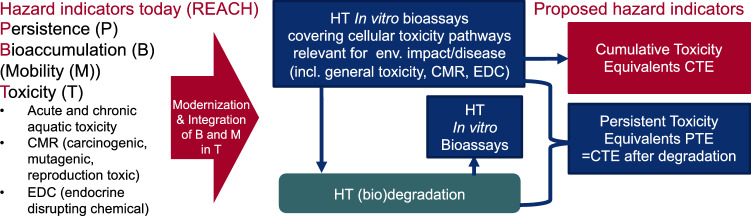
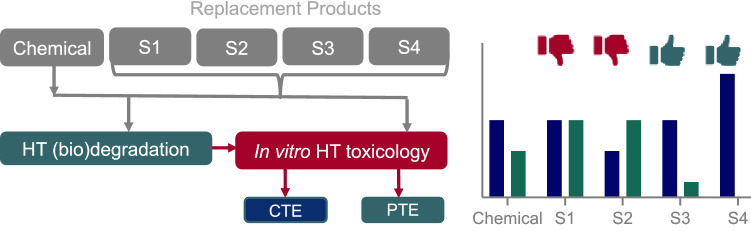
The assessment of persistence (P), bioaccumulation (B), and toxicity (T) of a chemical is a crucial first step at ensuring chemical safety and is a cornerstone of the European Union's chemicals regulation REACH (Registration, Evaluation, Authorization, and Restriction of Chemicals). Existing methods for PBT assessment are overly complex and cumbersome, have produced incorrect conclusions, and rely heavily on animal-intensive testing. We explore how new-approach methodologies (NAMs) can overcome the limitations of current PBT assessment. We propose two innovative hazard indicators, termed cumulative toxicity equivalents (CTE) and persistent toxicity equivalents (PTE). Together they are intended to replace existing PBT indicators and can also accommodate the emerging concept of PMT (where M stands for mobility). The proposed "toxicity equivalents" can be measured with high throughput in vitro bioassays. CTE refers to the toxic effects measured directly in any given sample, including single chemicals, substitution products, or mixtures. PTE is the equivalent measure of cumulative toxicity equivalents measured after simulated environmental degradation of the sample. With an appropriate panel of animal-free or alternative in vitro bioassays, CTE and PTE comprise key environmental and human health hazard indicators. CTE and PTE do not require analytical identification of transformation products and mixture components but instead prompt two key questions: is the chemical or mixture toxic, and is this toxicity persistent or can it be attenuated by environmental degradation? Taken together, the proposed hazard indicators CTE and PTE have the potential to integrate P, B/M and T assessment into one high-throughput experimental workflow that sidesteps the need for analytical measurements and will support the Chemicals Strategy for Sustainability of the European Union.
对化学品的持久性(P)、生物累积性(B)和毒性(T)进行评估,是确保化学品安全的关键第一步,也是欧盟化学品法规 REACH(注册、评估、授权和限制)的基石。现有的 PBT 评估方法过于复杂和繁琐,得出了错误的结论,并且严重依赖动物密集型测试。我们探讨了新方法(NAMs)如何克服当前 PBT 评估的局限性。我们提出了两个创新的危害指标,称为累积毒性当量(CTE)和持久性毒性当量(PTE)。它们旨在替代现有的 PBT 指标,也可以适应新兴的 PMT(其中 M 代表流动性)概念。所提出的“毒性当量”可以通过高通量的体外生物测定进行测量。CTE 是指在任何给定样品中直接测量的毒性效应,包括单一化学品、替代产品或混合物。PTE 是在模拟样品环境降解后测量的累积毒性当量的等效度量。通过适当的无动物或替代体外生物测定组合,CTE 和 PTE 构成了关键的环境和人类健康危害指标。CTE 和 PTE 不需要对转化产物和混合物成分进行分析鉴定,而是提出了两个关键问题:该化学品或混合物是否有毒,这种毒性是否持久,或者是否可以通过环境降解来减弱?总之,所提出的危害指标 CTE 和 PTE 有可能将 P、B/M 和 T 评估整合到一个高通量的实验工作流程中,从而避免对分析测量的需求,并支持欧盟的可持续性化学品战略。