Center for Vaccine Development and Global Health, University of Maryland School of Medicine, Baltimore, Maryland, United States of America.
Department of Medicine, University of Maryland School of Medicine, Baltimore, Maryland, United States of America.
PLoS Negl Trop Dis. 2023 Mar 23;17(3):e0011168. doi: 10.1371/journal.pntd.0011168. eCollection 2023 Mar.
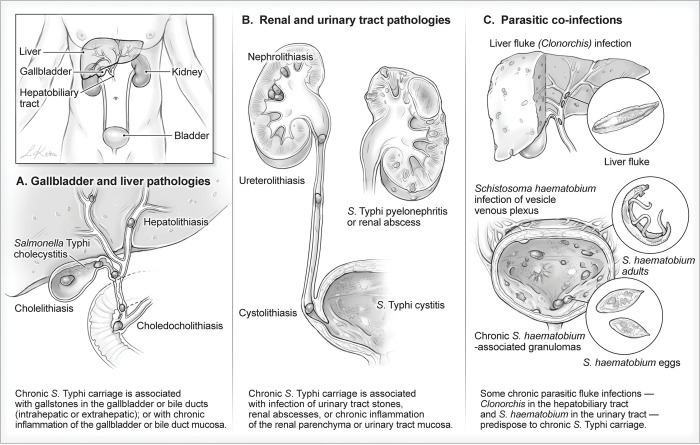
Typhoid fever caused by infection with Salmonella enterica subspecies enterica serotype Typhi (S. Typhi), an important public health problem in many low- and middle-income countries, is transmitted by ingestion of water or food contaminated by feces or urine from individuals with acute or chronic S. Typhi infection. Most chronic S. Typhi carriers (shedding for ≥12 months) harbor infection in their gallbladder wherein preexisting pathologies, particularly cholelithiasis, provide an environment that fosters persistence. Much less appreciated is the existence of non-gallbladder hepatobiliary chronic S. Typhi carriers and urinary carriers. The former includes parasitic liver flukes as a chronic carriage risk factor. Chronic urinary carriers typically have pathology of their urinary tract, with or without renal or bladder stones. Even as the prevalence of multidrug-resistant and extensively drug-resistant S. Typhi strains is rising, global implementation of highly effective typhoid vaccines is increasing. There is also renewed interest in identifying, monitoring, and (where possible) treating chronic carriers who comprise the long-term reservoir of S. Typhi.
伤寒由伤寒沙门氏菌亚种肠道血清型 Typhi(S. Typhi)感染引起,是许多低收入和中等收入国家的一个重要公共卫生问题,通过摄入被急性或慢性 S. Typhi 感染者的粪便或尿液污染的水或食物传播。大多数慢性 S. Typhi 携带者(持续排泄≥12 个月)在胆囊中携带感染,其中先前存在的病理,特别是胆石症,提供了促进持续存在的环境。不太被人注意的是存在非胆囊肝胆道慢性 S. Typhi 携带者和尿携带者。前者包括寄生虫性肝吸虫作为慢性携带的风险因素。慢性尿携带者通常存在尿路病理,伴有或不伴有肾或膀胱结石。尽管多药耐药和广泛耐药 S. Typhi 菌株的流行率正在上升,但全球对高效伤寒疫苗的实施正在增加。人们也重新关注识别、监测和(在可能的情况下)治疗慢性携带者,他们是 S. Typhi 的长期储存库。