Institute of Genetic Epidemiology, Medical University of Innsbruck, Innsbruck, Austria.
Institute of Epidemiology, Helmholtz Zentrum München, German Research Center for Environmental Health, Neuherberg, Germany.
Sci Rep. 2023 Mar 23;13(1):4805. doi: 10.1038/s41598-023-31496-w.
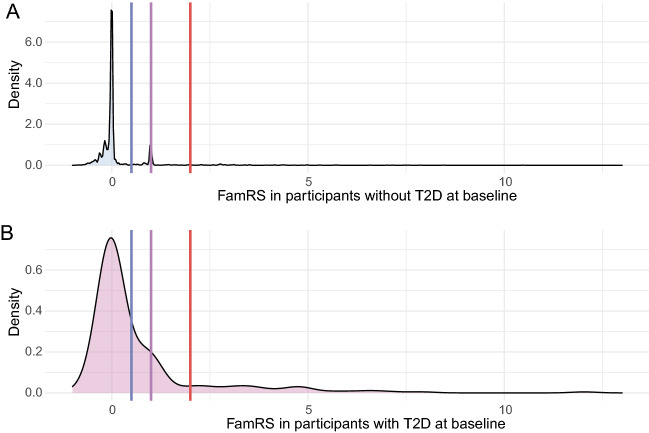
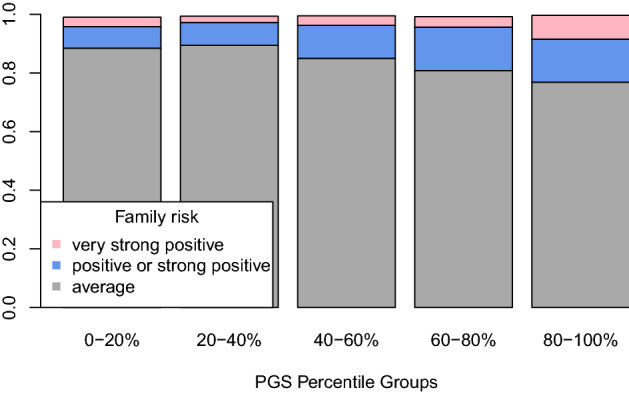
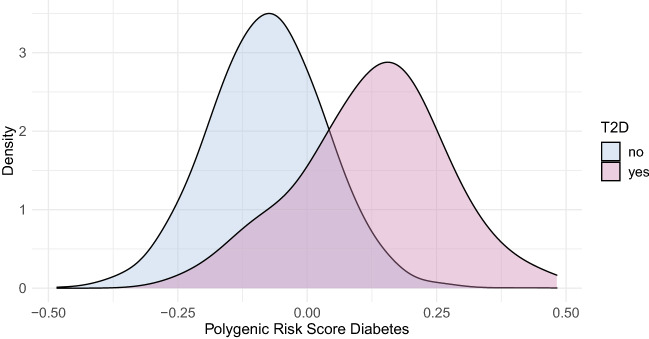
The availability of polygenic scores for type 2 diabetes (T2D) raises the question, whether assessing family history might become redundant. However, family history not only involves shared genetics, but also shared environment. It was the aim of this study to assess the independent and combined effects of one family risk score (FamRS) and a polygenic score (PGS) on prevalent and incident T2D risk in a population-based study from Germany (n = 3071). The study was conducted in 2004/2005 with up to 12 years of follow-up. The FamRS takes into account not only the number of diseased first grade relatives, but also age at onset of the relatives and age of participants. 256 prevalent and additional 163 incident T2D cases were recorded. Prevalence of T2D increased sharply for those within the top quantile of the PGS distribution resulting in an OR of 19.16 (p < 2 × 10) for the top 20% compared to the remainder of the population, independent of age, sex, BMI, physical activity and FamRS. On the other hand, having a very strong family risk compared to average was still associated with an OR of 2.78 (p = 0.001), independent of the aforementioned factors and the PGS. The PGS and FamRS were only slightly correlated (r = 0.018). The combined contribution of both factors varied with varying age-groups, though, with decreasing influence of the PGS with increasing age. To conclude, both, genetic information and family history are relevant for the prediction of T2D risk and might be used for identification of high risk groups to personalize prevention measures.
多基因评分可用于预测 2 型糖尿病(T2D),这引发了一个问题,即评估家族史是否可能变得多余。然而,家族史不仅涉及共享的遗传因素,还涉及共享的环境因素。本研究旨在评估基于德国人群的一项家族风险评分(FamRS)和多基因评分(PGS)对 T2D 现患和新发风险的独立和综合影响(n=3071)。该研究于 2004/2005 年进行,随访时间长达 12 年。FamRS 不仅考虑了患病一级亲属的数量,还考虑了亲属发病年龄和参与者年龄。共记录了 256 例现患 T2D 病例和另外 163 例新发 T2D 病例。PGS 分布最高分位数的个体 T2D 患病率急剧增加,与人群其余部分相比,最高 20%的个体 T2D 患病风险的 OR 为 19.16(p<2×10),与年龄、性别、BMI、身体活动和 FamRS 无关。另一方面,与平均水平相比,家族风险非常高的个体仍然与 OR 为 2.78(p=0.001)相关,与上述因素和 PGS 无关。PGS 和 FamRS 仅略有相关性(r=0.018)。然而,两者的综合作用随年龄组而变化,随着年龄的增加,PGS 的影响逐渐降低。总之,遗传信息和家族史都与 T2D 风险的预测相关,可用于识别高危人群,以便实施个性化预防措施。