Sotio Biotech, Prague, Czech Republic.
Department of Immunology, Charles University, 2nd Faculty of Medicine and University Hospital Motol, Prague, Czech Republic.
Cell Death Dis. 2023 Mar 24;14(3):209. doi: 10.1038/s41419-023-05728-w.
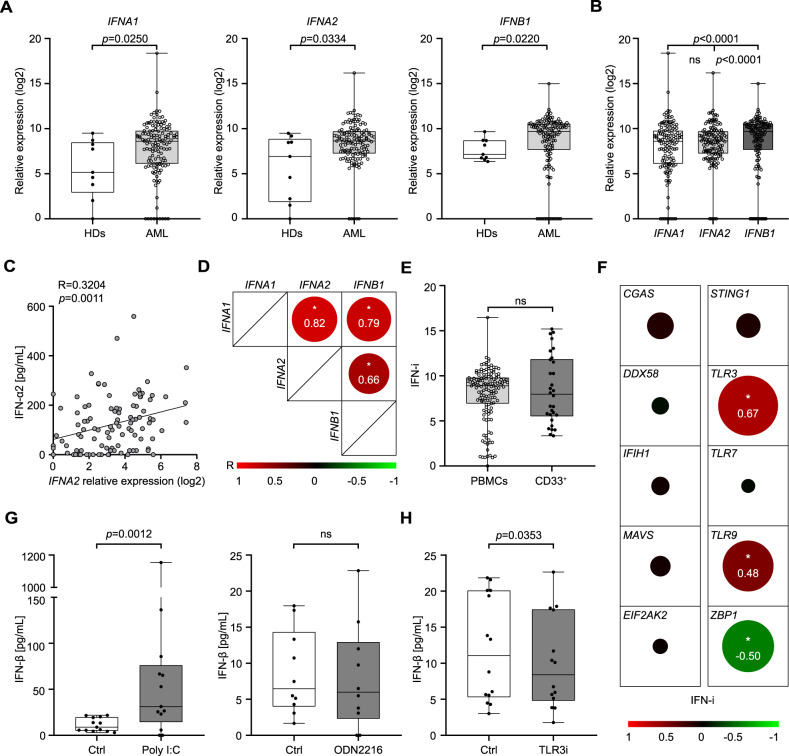
While type I interferon (IFN) is best known for its key role against viral infection, accumulating preclinical and clinical data indicate that robust type I IFN production in the tumor microenvironment promotes cancer immunosurveillance and contributes to the efficacy of various antineoplastic agents, notably immunogenic cell death inducers. Here, we report that malignant blasts from patients with acute myeloid leukemia (AML) release type I IFN via a Toll-like receptor 3 (TLR3)-dependent mechanism that is not driven by treatment. While in these patients the ability of type I IFN to stimulate anticancer immune responses was abolished by immunosuppressive mechanisms elicited by malignant blasts, type I IFN turned out to exert direct cytostatic, cytotoxic and chemosensitizing activity in primary AML blasts, leukemic stem cells from AML patients and AML xenograft models. Finally, a genetic signature of type I IFN signaling was found to have independent prognostic value on relapse-free survival and overall survival in a cohort of 132 AML patients. These findings delineate a clinically relevant, therapeutically actionable and prognostically informative mechanism through which type I IFN mediates beneficial effects in patients with AML.
虽然 I 型干扰素 (IFN) 因其在对抗病毒感染方面的关键作用而闻名,但越来越多的临床前和临床数据表明,肿瘤微环境中强烈的 I 型 IFN 产生促进了癌症免疫监视,并有助于各种抗肿瘤药物的疗效,特别是免疫原性细胞死亡诱导剂。在这里,我们报告称,急性髓系白血病 (AML) 患者的恶性细胞通过 TLR3 依赖性机制释放 I 型 IFN,而这种机制不是由治疗引起的。虽然在这些患者中,I 型 IFN 刺激抗癌免疫反应的能力被恶性细胞引发的免疫抑制机制所抑制,但 I 型 IFN 对原发性 AML 细胞、AML 患者的白血病干细胞和 AML 异种移植模型表现出直接的细胞抑制、细胞毒性和化疗增敏活性。最后,在 132 名 AML 患者的队列中发现,I 型 IFN 信号的遗传特征对无复发生存和总生存具有独立的预后价值。这些发现描绘了一种临床相关、具有治疗作用和预后信息的机制,通过该机制,I 型 IFN 在 AML 患者中发挥有益作用。