Faculty of Health and Medical Sciences, School of Biosciences and Medicine, University of Surrey, Guildford, United Kingdom.
Centre for Endocrinology, William Harvey Research Institute, Barts and the London School of Medicine, Queen Mary, University of London, Charterhouse Square, London, United Kingdom.
J Biol Chem. 2023 May;299(5):104649. doi: 10.1016/j.jbc.2023.104649. Epub 2023 Mar 24.
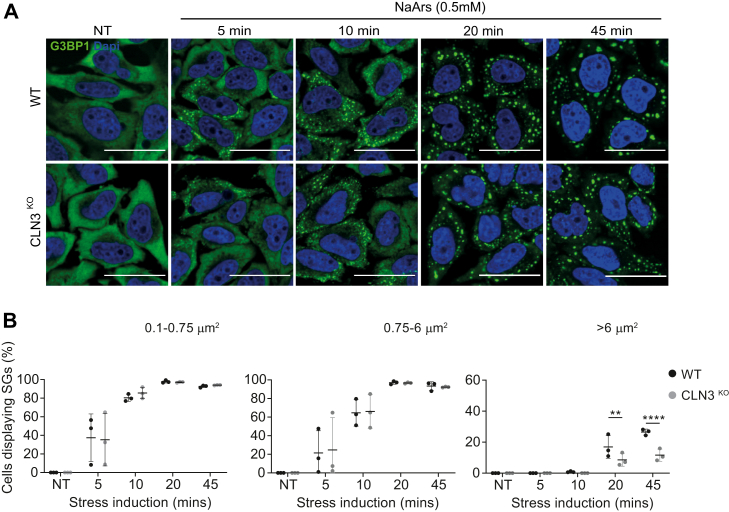
The assembly of membrane-less organelles such as stress granules (SGs) is emerging as central in helping cells rapidly respond and adapt to stress. Following stress sensing, the resulting global translational shutoff leads to the condensation of stalled mRNAs and proteins into SGs. By reorganizing cytoplasmic contents, SGs can modulate RNA translation, biochemical reactions, and signaling cascades to promote survival until the stress is resolved. While mechanisms for SG disassembly are not widely understood, the resolution of SGs is important for maintaining cell viability and protein homeostasis. Mutations that lead to persistent or aberrant SGs are increasingly associated with neuropathology and a hallmark of several neurodegenerative diseases. Mutations in CLN3 are causative of juvenile neuronal ceroid lipofuscinosis, a rare neurodegenerative disease affecting children also known as Batten disease. CLN3 encodes a transmembrane lysosomal protein implicated in autophagy, endosomal trafficking, metabolism, and response to oxidative stress. Using a HeLa cell model lacking CLN3, we now show that CLN3 is associated with an altered metabolic profile, reduced global translation, and altered stress signaling. Furthermore, loss of CLN3 function results in perturbations in SG dynamics, resulting in assembly and disassembly defects, and altered expression of the key SG nucleating factor G3BP1. With a growing interest in SG-modulating drugs for the treatment of neurodegenerative diseases, novel insights into the molecular basis of CLN3 Batten disease may reveal avenues for disease-modifying treatments for this debilitating childhood disease.
无膜细胞器的组装,如应激颗粒(SGs),在帮助细胞快速应对和适应压力方面变得越来越重要。在感知压力后,导致全局翻译关闭,使停滞的 mRNA 和蛋白质浓缩成 SGs。通过重新组织细胞质内容,SGs 可以调节 RNA 翻译、生化反应和信号级联,以促进存活,直到压力得到解决。虽然 SG 解体的机制尚未得到广泛理解,但 SG 的解决对于维持细胞活力和蛋白质平衡非常重要。导致持续或异常 SG 的突变与神经病理学的关系越来越密切,也是几种神经退行性疾病的标志。CLN3 突变导致青少年神经元蜡样脂褐质沉积症,这是一种罕见的影响儿童的神经退行性疾病,也称为巴滕病。CLN3 编码一种跨膜溶酶体蛋白,与自噬、内体运输、代谢和对氧化应激的反应有关。使用缺乏 CLN3 的 HeLa 细胞模型,我们现在表明 CLN3 与代谢谱改变、全局翻译减少和应激信号改变有关。此外,CLN3 功能的丧失导致 SG 动力学的扰动,导致组装和拆卸缺陷,并改变关键 SG 成核因子 G3BP1 的表达。随着人们对治疗神经退行性疾病的 SG 调节药物的兴趣日益浓厚,对 CLN3 巴滕病分子基础的新认识可能为这种使人衰弱的儿童疾病的治疗方法提供新的途径。