Zhang Xinyuan, Zhao Longgang, Ducatman Alan, Deng Chuanjie, von Stackelberg Katherine Ellen, Danford Christopher J, Zhang Xuehong
Channing Division of Network Medicine, Brigham and Women's Hospital and Harvard Medical School, Boston, MA, USA.
Department of Epidemiology and Biostatistics, Arnold School of Public Health, University of South Carolina, Columbia, SC, USA.
JHEP Rep. 2023 Feb 3;5(5):100694. doi: 10.1016/j.jhepr.2023.100694. eCollection 2023 May.
BACKGROUND & AIMS: Per- and polyfluoroalkyl substances (PFAS) are widespread pollutants with demonstrated hepatotoxicity. Few studies have examined the association between PFAS and fatty liver disease (FLD) risk in an adult population.
In this cross-sectional study of participants from the 2017-2018 National Health and Nutrition Examination Survey, serum PFAS were measured, and FLD cases were ascertained by vibration-controlled transient elastography. Logistic regression models were used to examine the association between circulating PFAS levels and FLD risk. Analyses were stratified into non-alcoholic FLD and alcoholic FLD risk groups by alcohol intake status, as well as controlling for other risk factors, including personal demographics, lifestyle factors, and related health factors.
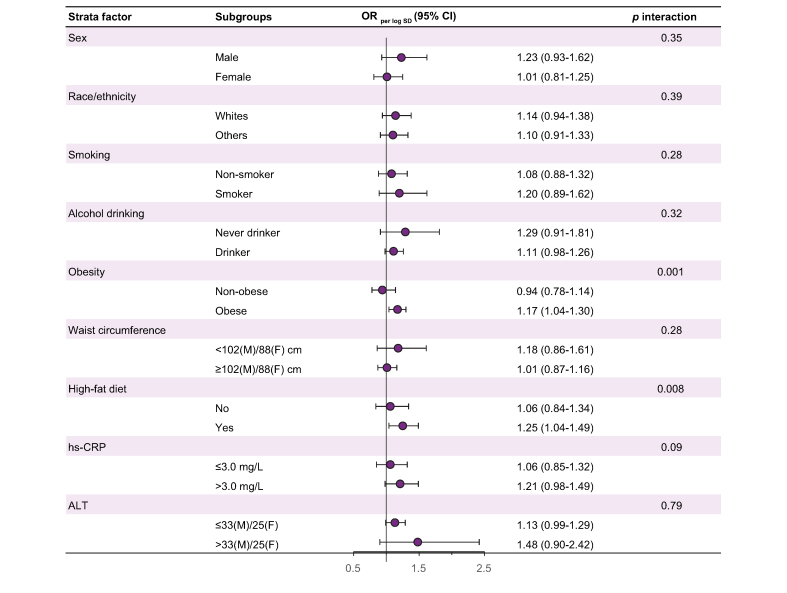
Among 1,135 eligible participants, 446 had FLD. For FLD risk, the multivariable-adjusted odds ratio per log-transformed SD increase (OR) in perfluorohexane sulfonate (PFHxS) was 1.13 (95% CI 1.01-1.26). The association between PFHxS and FLD appeared stronger among individuals with obesity or high-fat diets (both <0.05). When limiting the analysis to 212 heavy drinkers (≥2 drinks/day for women and ≥3 drinks/day for men), significantly higher risk of alcoholic FLD was found for higher levels of perfluorooctanoic acid (OR 1.79; 95% CI 1.07-2.99), PFHxS (OR 2.06; 95% CI 1.17-3.65), and perfluoroheptane sulfonic acid (OR 1.44; 95% CI 1.00-2.07), and marginally significant higher risk for total PFAS (OR 2.12; 95% CI 0.99-4.54). In never or light drinkers, we did not observe any significant association between PFAS and non-alcoholic FLD. Significant positive associations were found for PFAS with aspartate aminotransferase, gamma-glutamyl transaminase, total bilirubin, and albumin (β ranged from 0.008 to 0.101, all <0.05).
Higher serum PFAS was moderately associated with FLD risk and worse liver function in the general population, and among those with independent risk factors, including heavy alcohol intake, obesity, or high-fat diets, PFAS increased the risk. These results suggest synergistic effects on hepatic steatosis between PFAS exposures as measured through biomonitoring data and lifestyle risk factors in a nationally representative US population.
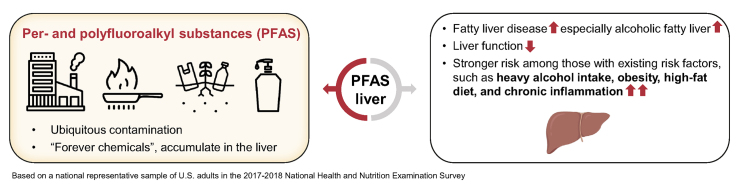
The per- and polyfluoroalkyl substances (PFAS) may convey higher risk for chronic liver disease in humans. Among 1,135 US adults in the 2017-2018 National Health and Nutrition Examination Survey, we found that higher serum PFAS was associated with higher fatty liver disease risk and worse liver function, especially among those with liver disease risk factors, including heavy alcohol intake, obesity, or high-fat diets. Continuously monitoring PFAS in the population and examining how they potentiate risk to the liver are essential.
全氟和多氟烷基物质(PFAS)是广泛存在的污染物,已证实具有肝毒性。很少有研究探讨PFAS与成年人群脂肪肝疾病(FLD)风险之间的关联。
在这项对2017 - 2018年全国健康与营养检查调查参与者的横断面研究中,测量了血清PFAS,并通过振动控制瞬时弹性成像确定FLD病例。使用逻辑回归模型来检验循环PFAS水平与FLD风险之间的关联。分析按饮酒状况分层为非酒精性FLD和酒精性FLD风险组,并控制其他风险因素,包括个人人口统计学特征、生活方式因素和相关健康因素。
在1135名符合条件的参与者中,446人患有FLD。对于FLD风险,全氟己烷磺酸(PFHxS)每增加一个对数转换标准差(OR),多变量调整后的比值比为1.13(95%CI 1.01 - 1.26)。在肥胖或高脂肪饮食人群中,PFHxS与FLD之间的关联似乎更强(两者P均<0.05)。当将分析限制在212名重度饮酒者(女性≥2杯/天,男性≥3杯/天)时,发现全氟辛酸(OR 1.79;95%CI 1.07 - 2.99)、PFHxS(OR 2.06;95%CI 1.17 - 3.65)和全氟庚烷磺酸(OR 1.44;95%CI 1.00 - 2.07)水平较高时,酒精性FLD风险显著更高,总PFAS风险略高(OR 2.12;95%CI 0.99 - 4.54)。在从不饮酒或轻度饮酒者中,未观察到PFAS与非酒精性FLD之间有任何显著关联。发现PFAS与天冬氨酸转氨酶、γ-谷氨酰转移酶、总胆红素和白蛋白之间存在显著正相关(β范围为0.008至0.101,均P<0.05)。
在一般人群中,较高的血清PFAS与FLD风险及较差的肝功能呈中度相关,在那些具有独立风险因素(包括大量饮酒、肥胖或高脂肪饮食)的人群中,PFAS会增加风险。这些结果表明,在美国具有全国代表性的人群中,通过生物监测数据测量的PFAS暴露与生活方式风险因素之间对肝脂肪变性具有协同作用。
全氟和多氟烷基物质(PFAS)可能给人类带来更高的慢性肝病风险。在2017 - 2018年全国健康与营养检查调查的1135名美国成年人中,我们发现较高的血清PFAS与较高的脂肪肝疾病风险及较差的肝功能相关,尤其是在那些具有肝病风险因素(包括大量饮酒、肥胖或高脂肪饮食)的人群中。持续监测人群中的PFAS并研究它们如何增强肝脏风险至关重要。