Postgraduate program in Physiology Science, Immunology Laboratory of Infectious Diseases, Department of Cellular and Molecular Biology, Federal University of Paraiba, João Pessoa, Paraíba, Brazil.
Postgraduate program in Natural and Synthetic Bioactive Products, Immunology Laboratory of Infectious Diseases, Federal University of Paraiba, João Pessoa, Paraíba, Brazil.
Front Immunol. 2023 Mar 8;14:1078922. doi: 10.3389/fimmu.2023.1078922. eCollection 2023.
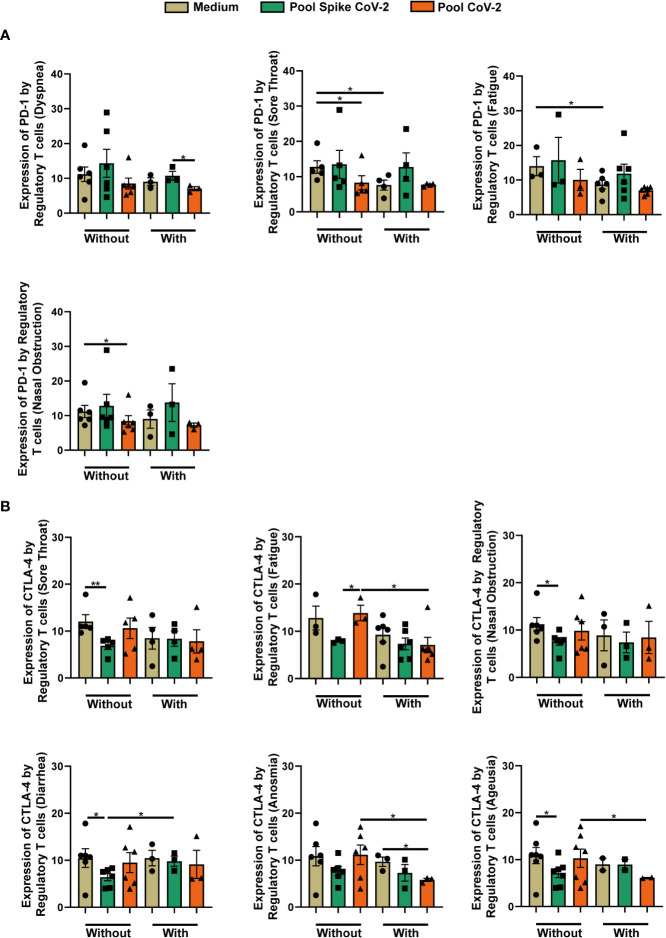
Severe acute respiratory syndrome coronavirus 2 (SARS-CoV-2) is characterized by a range of symptoms in which host immune response have been associated with disease progression. However, the putative role of regulatory T cells (Tregs) in determining COVID-19 outcomes has not been thoroughly investigated. Here, we compared peripheral Tregs between volunteers not previously infected with SARS-CoV-2 (healthy control [HC]) and volunteers who recovered from mild (Mild Recovered) and severe (Severe Recovered) COVID-19. Peripheral blood mononuclear cells (PBMC) were stimulated with SARS-CoV-2 synthetic peptides (Pool Spike CoV-2 and Pool CoV-2) or staphylococcal enterotoxin B (SEB). Results of a multicolor flow cytometric assay showed higher Treg frequency and expression of IL-10, IL-17, perforin, granzyme B, PD-1, and CD39/CD73 co-expression in Treg among the PBMC from the Mild Recovered group than in the Severe Recovered or HC groups for certain SARS-CoV-2 related stimulus. Moreover, Mild Recovered unstimulated samples presented a higher Tregs frequency and expression of IL-10 and granzyme B than did that of HC. Compared with Pool CoV-2 stimuli, Pool Spike CoV-2 reduced IL-10 expression and improved PD-1 expression in Tregs from volunteers in the Mild Recovered group. Interestingly, Pool Spike CoV-2 elicited a decrease in Treg IL-17 frequency in the Severe Recovered group. In HC, the expression of latency-associated peptide (LAP) and cytotoxic granule co-expression by Tregs was higher in Pool CoV-2 stimulated samples. While Pool Spike CoV-2 stimulation reduced the frequency of IL-10 and CTLA-4 Tregs in PBMC from volunteers in the Mild Recovered group who had not experienced certain symptoms, higher levels of perforin and perforingranzyme B co-expression by Tregs were found in the Mild Recovered group in volunteers who had experienced dyspnea. Finally, we found differential expression of CD39 and CD73 among volunteers in the Mild Recovered group between those who had and had not experienced musculoskeletal pain. Collectively, our study suggests that changes in the immunosuppressive repertoire of Tregs can influence the development of a distinct COVID-19 clinical profile, revealing that a possible modulation of Tregs exists among volunteers of the Mild Recovered group between those who did and did not develop certain symptoms, leading to mild disease.
严重急性呼吸综合征冠状病毒 2(SARS-CoV-2)的特征是一系列症状,其中宿主免疫反应与疾病进展有关。然而,调节性 T 细胞(Tregs)在确定 COVID-19 结局中的作用尚未得到充分研究。在这里,我们比较了未感染 SARS-CoV-2 的志愿者(健康对照组[HC])和从轻度(轻度恢复)和重度(重度恢复)COVID-19 中康复的志愿者之间的外周血 Tregs。外周血单核细胞(PBMC)用 SARS-CoV-2 合成肽(Pool Spike CoV-2 和 Pool CoV-2)或葡萄球菌肠毒素 B(SEB)刺激。多色流式细胞术检测结果显示,在轻度恢复组的 PBMC 中,Treg 频率较高,在某些与 SARS-CoV-2 相关的刺激物中,Treg 表达的 IL-10、IL-17、穿孔素、颗粒酶 B、PD-1 和 CD39/CD73 共表达较高。此外,与 HC 相比,轻度恢复未刺激样本的 Tregs 频率更高,表达的 IL-10 和颗粒酶 B 也更高。与 Pool CoV-2 刺激相比,Pool Spike CoV-2 降低了轻度恢复组志愿者 Tregs 中 IL-10 的表达并改善了 PD-1 的表达。有趣的是,Pool Spike CoV-2 导致重度恢复组 Treg 中 IL-17 频率下降。在 HC 中,Tregs 在 Pool CoV-2 刺激的样本中表达潜伏相关肽(LAP)和细胞毒性颗粒的共表达更高。虽然 Pool Spike CoV-2 刺激降低了轻度恢复组志愿者中未经历某些症状的 PBMC 中 IL-10 和 CTLA-4 Tregs 的频率,但在经历呼吸困难的轻度恢复组志愿者中,Tregs 的穿孔素和颗粒酶 B 共表达水平更高。最后,我们发现轻度恢复组志愿者中,经历过肌肉骨骼疼痛和未经历过肌肉骨骼疼痛的志愿者之间,Tregs 中 CD39 和 CD73 的表达存在差异。总之,我们的研究表明,Tregs 免疫抑制谱的变化可能会影响 COVID-19 临床特征的发展,表明轻度恢复组志愿者之间存在 Tregs 的可能调节,这些志愿者之间存在某些症状的发展和不发展,导致疾病较轻。