Hu Yong, Jiang Yong, Cheong Kin-Pang
State Key Laboratory of Fire Science, University of Science and Technology of China, Hefei, Anhui 230027, China.
School of Aeronautics and Astronautics, Sichuan University, Chengdu, 610065, China.
ACS Omega. 2023 Mar 6;8(11):10288-10302. doi: 10.1021/acsomega.2c07850. eCollection 2023 Mar 21.
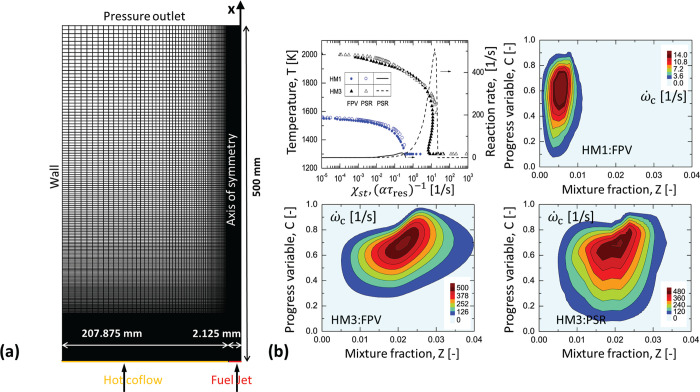
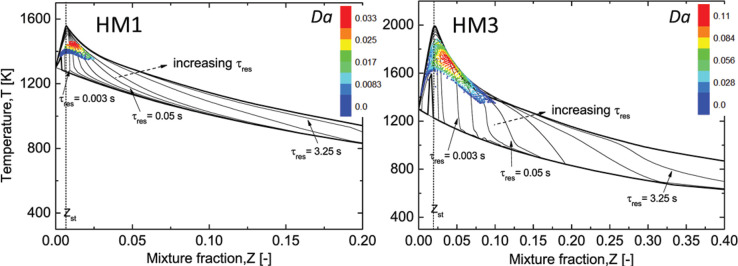
MILD (moderate and intense low-oxygen dilution) combustion is a highly promising technology to deliver clean and efficient thermal energy. However, because of its unconventional reaction nature, the optimization of the MILD combustion in various industrial burners is still challenging, for which the design tool based on accurate and cost-effective numerical simulation is most desirable. To this end, the tabulated chemistry approach (TCA) is thoroughly assessed for the modeling of MILD combustion by simulations of the Adelaide Jet in Hot Coflow (JHC) burner. The sensitivities to the submodel accounting for the scalar micromixing and the canonical flame configurations (i.e., flamelet and PSR-based reactors), being relevant for MILD regime characterization in TCA, are studied. It is found that the scalar mixing enhanced through the dynamic adjustment of model parameter leads to an improved prediction, and the optimal value of = 8 is identified for the current flames. The proper parametrization of the detailed chemical structures in TCA is found to affect the accurate prediction of the MILD flame profiles, especially the mass fraction of minor species (e.g., OH, CO). Furthermore, the endothermic reaction path of O + CH ⇒ CO + CH is indicated as the main contributing step to the disparities in the CO predictions. This implies that the multiple reaction regimes in complex MILD burning should be accounted for by the use of either flamelet or PSR structures, depending on the local microscale diffusion/chemistry competitions. Overall, the results highlight the influential role of multiscale mixing and its intercoupling with the finite-rate chemistry, the accurate determination of which is important for MILD combustion modeling.
轻度(中度和强烈低氧稀释)燃烧是一种极具前景的技术,可提供清洁高效的热能。然而,由于其非常规的反应性质,在各种工业燃烧器中优化轻度燃烧仍然具有挑战性,为此,基于准确且经济高效的数值模拟的设计工具是最为理想的。为此,通过对阿德莱德热共流射流(JHC)燃烧器进行模拟,对列表化学反应方法(TCA)在轻度燃烧建模方面进行了全面评估。研究了对TCA中与轻度燃烧状态表征相关的标量微混合子模型和典型火焰构型(即小火焰和基于PSR的反应器)的敏感性。研究发现,通过动态调整模型参数增强标量混合可改善预测效果,并且针对当前火焰确定了最佳值( = 8)。发现TCA中详细化学结构的适当参数化会影响对轻度火焰轮廓的准确预测,尤其是次要物种(例如OH、CO)的质量分数。此外,(O + CH ⇒ CO + CH)的吸热反应路径被指出是导致CO预测存在差异的主要贡献步骤。这意味着在复杂的轻度燃烧中,应根据局部微观尺度的扩散/化学反应竞争,使用小火焰或PSR结构来考虑多种反应状态。总体而言,结果突出了多尺度混合及其与有限速率化学反应的相互耦合的影响作用,准确确定这些对于轻度燃烧建模很重要。