Department of Clinical Oncology and Palliative Care, Zealand University Hospital, Copenhagen, Denmark.
Department of Clinical Medicine, Faculty of Health and Medical Sciences, University of Copenhagen, Copenhagen, Denmark.
Cancer Res Commun. 2022 Oct 13;2(10):1174-1187. doi: 10.1158/2767-9764.CRC-22-0258. eCollection 2022 Oct.
The clinical potential of liquid biopsy in patients with advanced cancer is real-time monitoring for early detection of treatment failure. Our study aimed to investigate the clinical validity of circulating tumor DNA (ctDNA) treatment monitoring in a real-life cohort of patients with advanced non-small cell lung cancer (NSCLC).
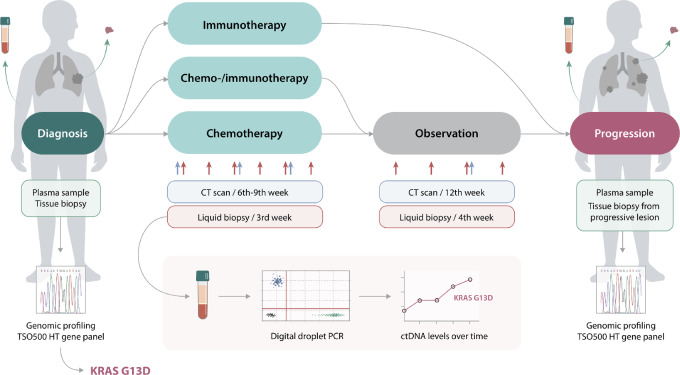
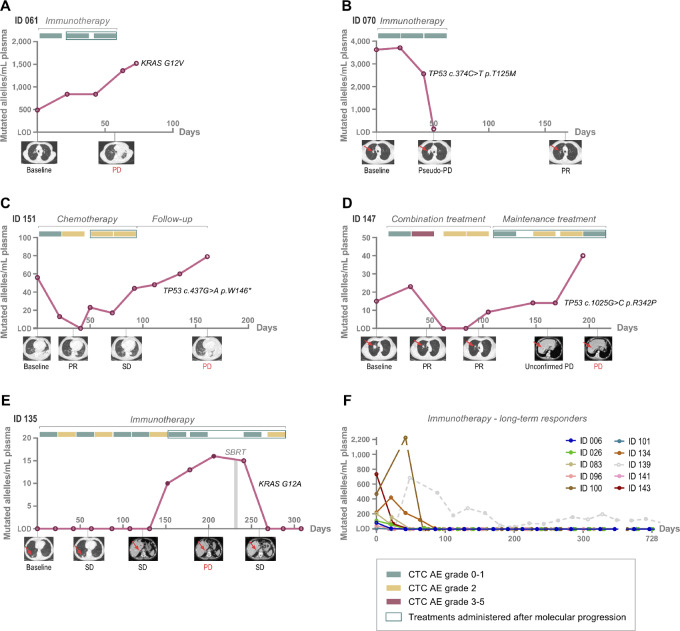
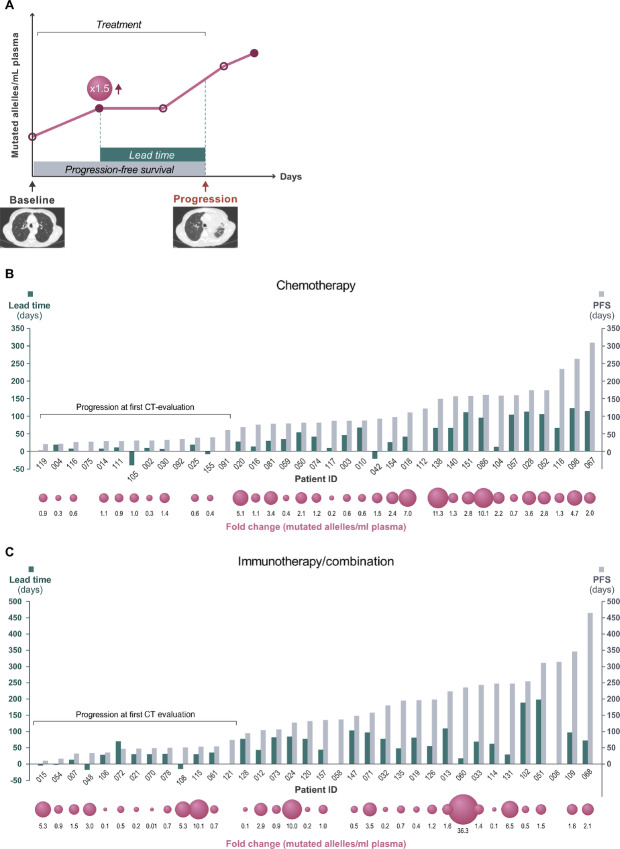
Patients with advanced or noncurative locally advanced NSCLC were prospectively included in an exploratory study (NCT03512847). Selected cancer-specific mutations were measured in plasma by standard or uniquely designed droplet digital PCR assays before every treatment cycle during first-line treatment until progressive disease (PD). Correlation between an increase in ctDNA (= molecular progression) and radiologic PD was investigated, defined as lead time, and the corresponding numbers of likely futile treatment cycles were determined. Utility of ctDNA measurements in clarifying the results of nonconclusive radiologic evaluation scans was evaluated.
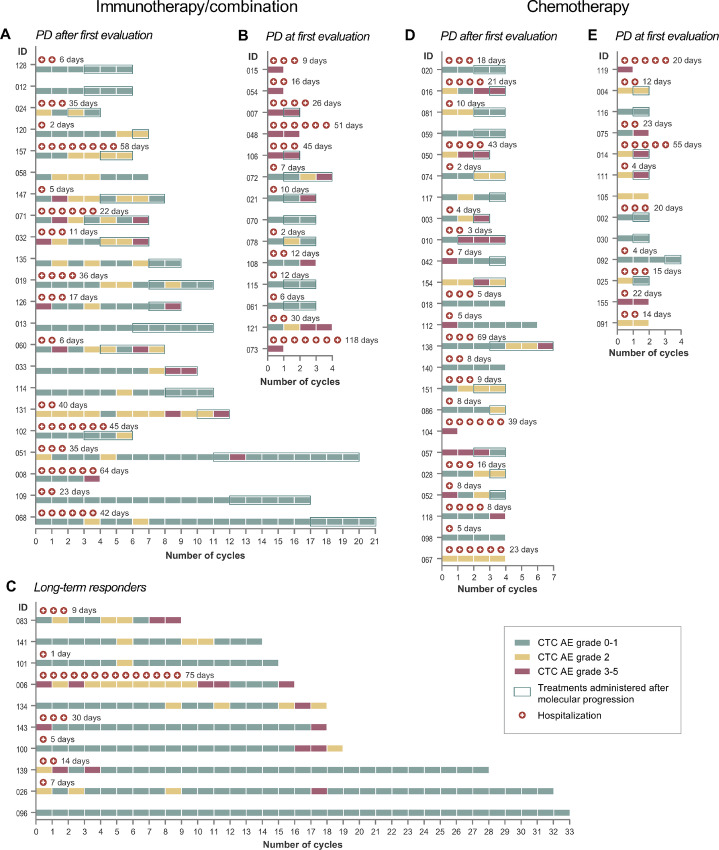
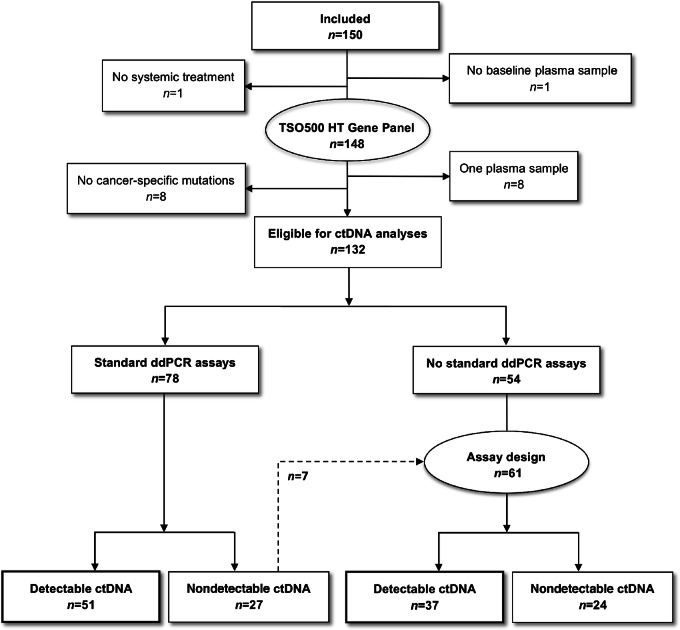
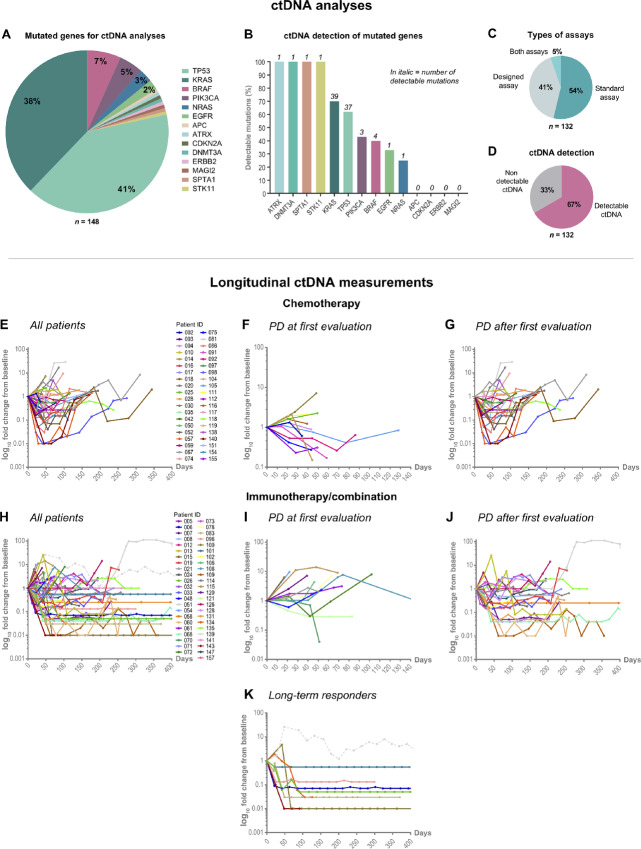
Cancer-specific mutations and longitudinal plasma sampling were present in 132 of 150 patients. ctDNA was detectable in 88 (67%) of 132 patients treated by respectively chemotherapy ( = 41), immunotherapy ( = 43), or combination treatment ( = 4). In 66 (90%) of 73 patients experiencing PD, a ctDNA increase was observed with a median lead time of 1.5 months before radiologic PD. Overall, 119 (33%) of 365 treatment cycles were administered after molecular progression. In addition, ctDNA measurements could clarify the results in 38 (79%) of 48 nonconclusive radiologic evaluations.
ctDNA monitoring leads to earlier detection of treatment failure, and clarifies the majority of nonconclusive radiologic evaluations, giving the potential of sparing patients from likely futile treatments and needless adverse events.
Treatment monitoring by ctDNA has the clinical potential to reveal PD before radiologic evaluation and consequently spare patients with advanced cancer from likely ineffective, costly cancer treatments and adverse events.
液体活检在晚期癌症患者中的临床潜力在于实时监测以早期发现治疗失败。本研究旨在探讨循环肿瘤 DNA(ctDNA)治疗监测在晚期非小细胞肺癌(NSCLC)真实患者队列中的临床有效性。
前瞻性纳入晚期或不可治愈的局部晚期 NSCLC 患者进行探索性研究(NCT03512847)。在一线治疗期间的每个治疗周期前,通过标准或专门设计的液滴数字 PCR 检测分析血浆中选定的癌症特异性突变,直至疾病进展(PD)。研究了 ctDNA 增加(=分子进展)与影像学 PD 的相关性,定义为领先时间,并确定了可能无效的治疗周期数。评估了 ctDNA 测量在澄清不确定的影像学评估扫描结果方面的作用。
150 例患者中有 132 例存在癌症特异性突变和纵向血浆采样。在分别接受化疗(=41)、免疫治疗(=43)或联合治疗(=4)的 132 例患者中,88 例(67%)可检测到 ctDNA。在 73 例出现 PD 的患者中,有 66 例(90%)观察到 ctDNA 增加,影像学 PD 前的中位领先时间为 1.5 个月。总体而言,在分子进展后进行了 365 个治疗周期中的 119 个(33%)。此外,ctDNA 测量可澄清 48 次不确定影像学评估中的 38 次(79%)结果。
ctDNA 监测可更早地发现治疗失败,并澄清大多数不确定的影像学评估结果,使患者有潜力避免可能无效的治疗和不必要的不良事件。
ctDNA 治疗监测具有在影像学评估之前揭示 PD 的临床潜力,从而使晚期癌症患者免受可能无效、昂贵的癌症治疗和不良事件的影响。