Nightingale Madison, Mody Manali, Rickard Alexander H, Cassone Marco
Division of Geriatric & Palliative Medicine, Michigan Medicine, Ann Arbor, Michigan.
Department of Epidemiology, University of Michigan School of Public Health, Ann Arbor, Michigan.
Antimicrob Steward Healthc Epidemiol. 2023 Mar 15;3(1):e54. doi: 10.1017/ash.2023.130. eCollection 2023.
Since the beginning of the COVID-19 pandemic, face masks have been worn by many in public areas and for prolonged periods by healthcare workers (HCWs). This may facilitate bacterial contamination and transmission to and from patients in nursing homes where clinical care areas with strict precautions and residential and activity areas are interconnected. We assessed and compared bacterial mask colonization in HCWs belonging to different demographic categories and professions (clinical and nonclinical) and among HCWs who had worn the mask for different periods of time.
We conducted a point-prevalence study of 69 HCW masks at the end of a typical work shift in a 105-bed nursing home serving postacute care and rehabilitation patients. Information collected about the mask user included profession, age, sex, length of time the mask was worn, and known exposure to patients with colonization.
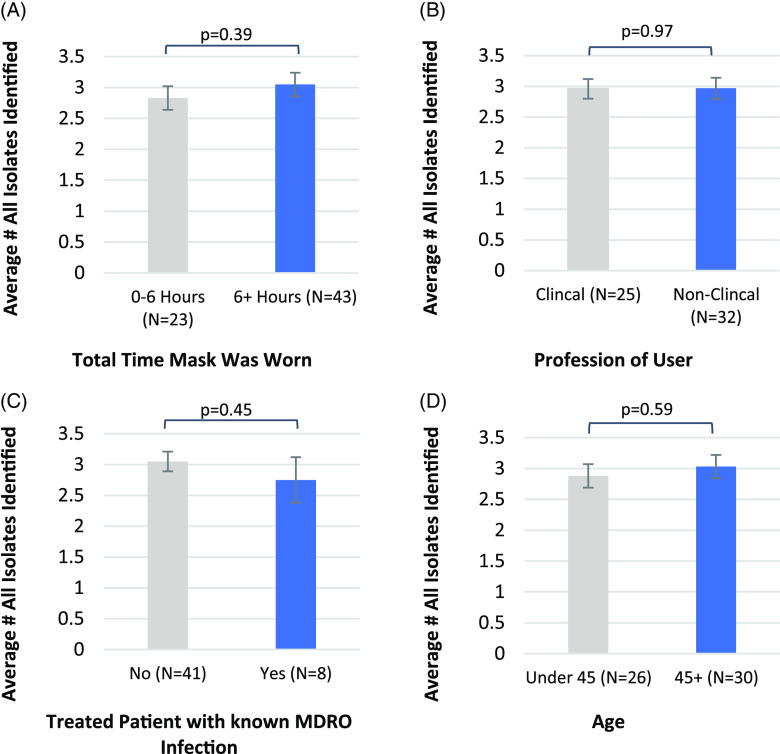
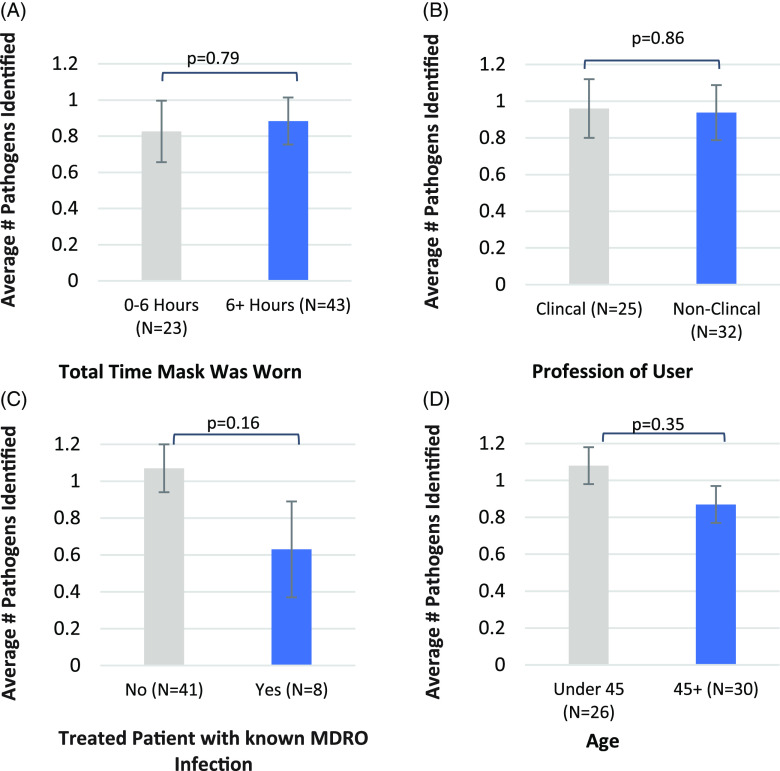
In total, 123 distinct bacterial isolates were recovered (1-5 isolates per mask), including from 11 masks (15.9%) and gram-negative bacteria of clinical importance from 22 masks (31.9%). Antibiotic resistance rates were low. There were no significant differences in the number of clinically important bacteria among masks worn more or less than 6 hours, and there were no significant differences among HCWs with different job functions or exposure to colonized patients.
Bacterial mask contamination was not associated with HCW profession or exposure and did not increase after 6 hours of mask wearing in our nursing home setting. Bacteria contaminating HCW masks may differ from those colonizing patients.
自新冠疫情开始以来,许多人在公共场所佩戴口罩,医护人员更是长时间佩戴。在疗养院中,临床护理区域与住宿和活动区域相互连通,这可能会促进细菌污染并在医护人员与患者之间传播。我们评估并比较了不同人口统计学类别和职业(临床和非临床)的医护人员以及佩戴口罩不同时长的医护人员的口罩细菌定植情况。
设计、场所与参与者:我们在一家拥有105张床位、为急性后期护理和康复患者服务的疗养院,在一个典型工作日结束时,对69名医护人员的口罩进行了现况调查。收集的关于口罩使用者的信息包括职业、年龄、性别、口罩佩戴时长以及已知的与定植患者的接触情况。
总共分离出123种不同的细菌菌株(每个口罩1 - 5种菌株),其中11个口罩(15.9%)分离出革兰氏阳性菌,22个口罩(31.9%)分离出具有临床意义的革兰氏阴性菌。抗生素耐药率较低。佩戴口罩时长超过或少于6小时的医护人员,其口罩上具有临床意义的细菌数量无显著差异;不同工作职能或接触定植患者的医护人员之间也无显著差异。
在我们的疗养院环境中,口罩细菌污染与医护人员的职业或接触情况无关,且佩戴口罩6小时后细菌污染并未增加。污染医护人员口罩的细菌可能与定植在患者身上的细菌不同。