Department of Biology, The Catholic University of America, Washington, District of Columbia, USA.
Research Service, VA Nebraska-Western Iowa Health Care System, Omaha, Nebraska, USA.
Hepatol Commun. 2023 Mar 24;7(4). doi: 10.1097/HC9.0000000000000103. eCollection 2023 Apr 1.
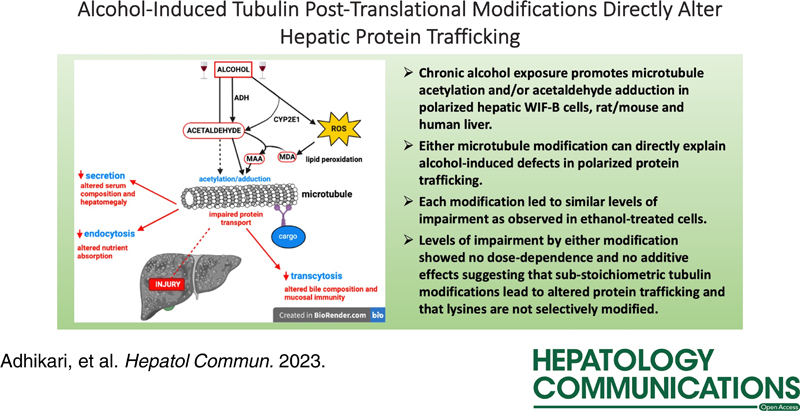
Chronic ethanol exposure leads to enhanced protein acetylation and acetaldehyde adduction. Of the multitude of proteins that are modified on ethanol administration, tubulin is among the best studied. However, an open question is whether these modifications are observed in patient samples. Both modifications have also been implicated in promoting alcohol-induced defects in protein trafficking, but whether they do so directly is also unanswered.
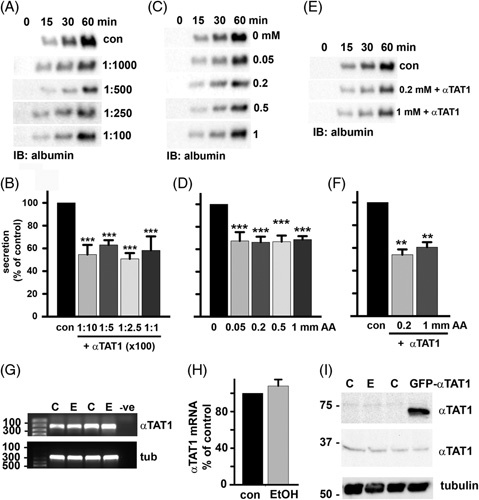
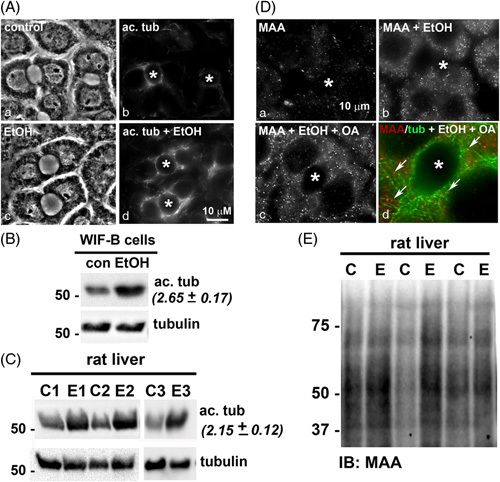
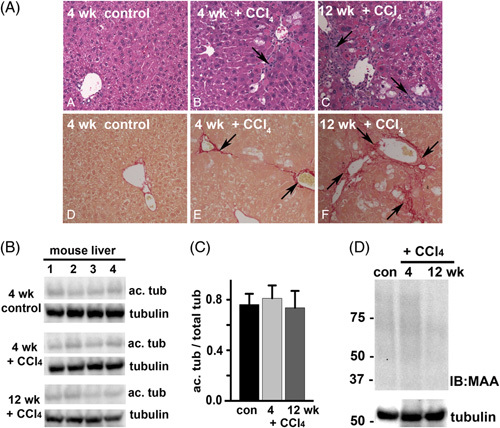
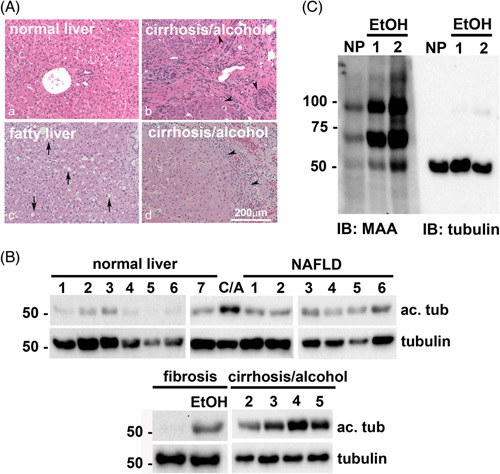
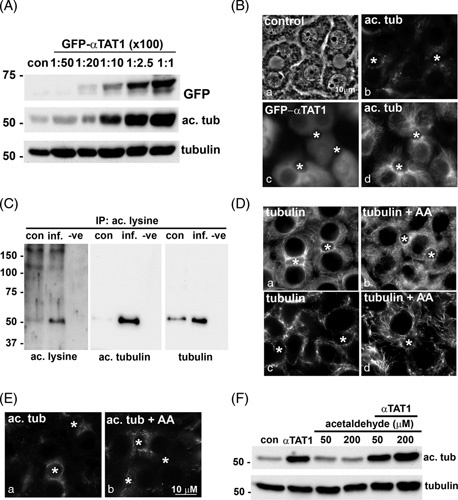
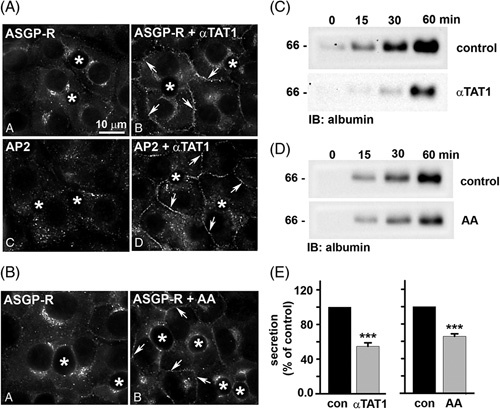
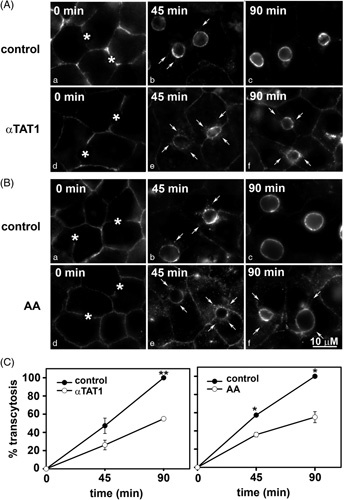
We first confirmed that tubulin was hyperacetylated and acetaldehyde-adducted in the livers from ethanol-exposed individuals to a similar extent as observed in the livers from ethanol-fed animals and hepatic cells. Livers from individuals with nonalcohol-associated fatty liver showed modest increases in tubulin acetylation, whereas nonalcohol-associated fibrotic human and mouse livers showed virtually no tubulin modifications. We also asked whether tubulin acetylation or acetaldehyde adduction can directly explain the known alcohol-induced defects in protein trafficking. Acetylation was induced by overexpressing the α-tubulin-specific acetyltransferase, αTAT1, whereas adduction was induced by directly adding acetaldehyde to cells. Both αTAT1 overexpression and acetaldehyde treatment significantly impaired plus-end (secretion) and minus-end (transcytosis)-directed microtubule-dependent trafficking and clathrin-mediated endocytosis. Each modification led to similar levels of impairment as observed in ethanol-treated cells. The levels of impairment by either modification showed no dose dependence or no additive effects suggesting that substoichiometric tubulin modifications lead to altered protein trafficking and that lysines are not selectively modified.
These results not only confirm that enhanced tubulin acetylation is observed in human livers but that it is most relevant to alcohol-induced injury. Because these tubulin modifications are associated with altered protein trafficking that alters proper hepatic function, we propose that changing the cellular acetylation levels or scavenging free aldehydes are feasible strategies for treating alcohol-associated liver disease.
慢性乙醇暴露会导致蛋白质乙酰化和乙醛加合物增加。在乙醇给药后修饰的众多蛋白质中,微管蛋白是研究最多的蛋白质之一。然而,一个悬而未决的问题是这些修饰是否在患者样本中观察到。这两种修饰都被认为可以促进酒精引起的蛋白质运输缺陷,但它们是否直接这样做还没有答案。
我们首先证实,在乙醇暴露个体的肝脏中,微管蛋白被高度乙酰化和乙醛加合物修饰,其程度与在乙醇喂养的动物和肝细胞中观察到的相似。非酒精性相关脂肪性肝病患者的肝脏中微管蛋白乙酰化略有增加,而非酒精性相关纤维化的人类和小鼠肝脏几乎没有微管蛋白修饰。我们还询问了微管蛋白乙酰化或乙醛加合物是否可以直接解释已知的酒精引起的蛋白质运输缺陷。通过过表达α-微管蛋白特异性乙酰转移酶αTAT1 诱导乙酰化,而通过直接向细胞中添加乙醛诱导加合物。αTAT1 过表达和乙醛处理均显著损害了正端(分泌)和负端(转胞吞)定向微管依赖性运输和网格蛋白介导的内吞作用。每种修饰导致的损伤程度与在乙醇处理的细胞中观察到的相似。修饰的任何一种修饰都没有表现出剂量依赖性或没有相加效应,这表明亚化学计量的微管蛋白修饰导致蛋白质运输改变,并且赖氨酸不是选择性修饰的。
这些结果不仅证实了增强的微管蛋白乙酰化在人类肝脏中观察到,而且与酒精引起的损伤最相关。由于这些微管蛋白修饰与改变蛋白质运输有关,改变适当的肝功能,我们提出改变细胞乙酰化水平或清除游离醛是治疗酒精相关肝病的可行策略。