Department of Nutritional Sciences, Faculty of Health and Medical Sciences, University of Surrey, Guildford, GU2 7XH, UK.
The Generation R Study Group, Erasmus University Medical Centre, Rotterdam, The Netherlands.
Eur J Nutr. 2023 Aug;62(5):2139-2154. doi: 10.1007/s00394-023-03131-x. Epub 2023 Mar 27.
Urinary iodine-to-creatinine ratio (UI/Creat) reflects recent iodine intake but has limitations for assessing habitual intake. Thyroglobulin (Tg) concentration, which increases with thyroid size, appears to be an indicator of longer-term iodine status in children and adults, however, less is known in pregnancy. This study investigated the determinants of serum-Tg in pregnancy and its use as an iodine-status biomarker in settings of iodine-sufficiency and mild-to-moderate deficiency.
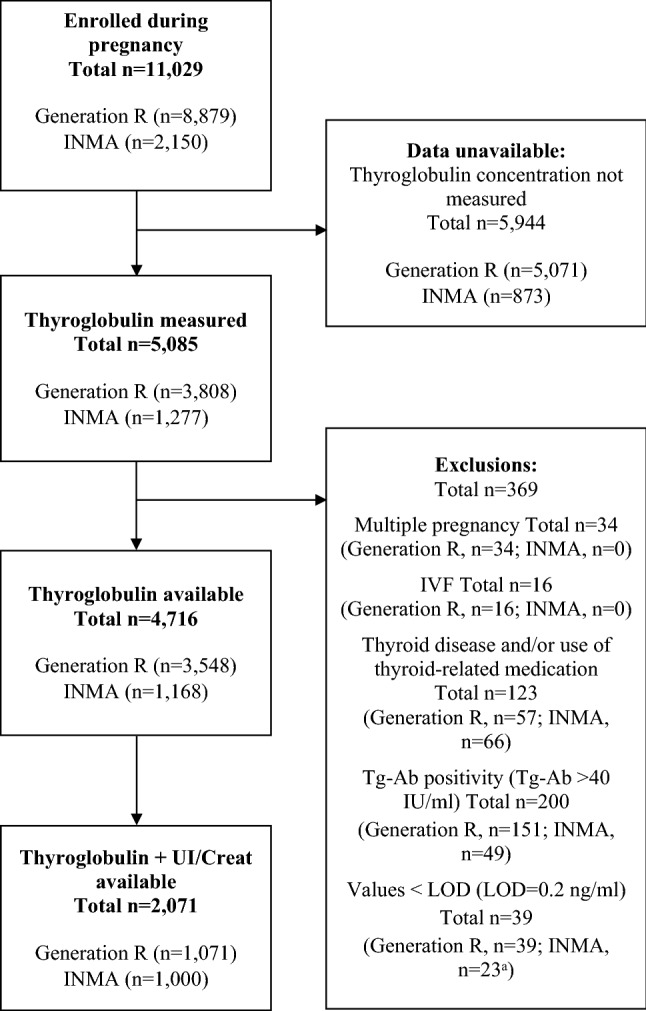
Stored blood samples and existing data from pregnant women from the Netherlands-based Generation R (iodine-sufficient) and the Spain-based INMA (mildly-to-moderately iodine-deficient) cohorts were used. Serum-Tg and iodine status (as spot-urine UI/Creat) were measured at median 13 gestational weeks. Using regression models, maternal socio-demographics, diet and iodine-supplement use were investigated as determinants of serum-Tg, as well as the association between UI/Creat and serum-Tg.
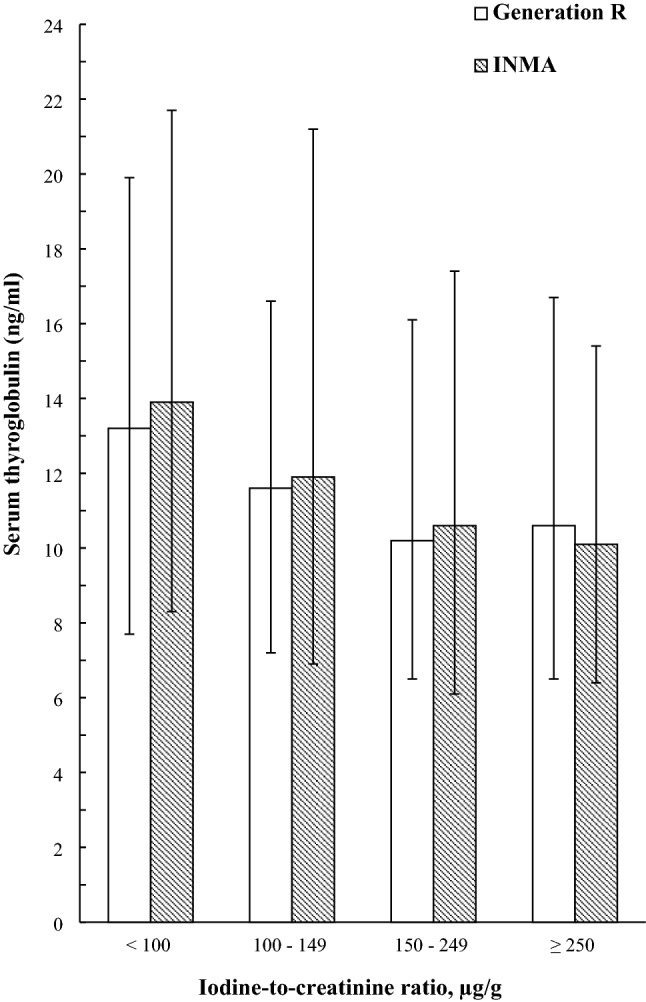
Median serum-Tg was 11.1 ng/ml in Generation R (n = 3548) and 11.5 ng/ml in INMA (n = 1168). When using 150 µg/g threshold for iodine deficiency, serum-Tg was higher in women with UI/Creat < 150 vs ≥ 150 µg/g (Generation R, 12.0 vs 10.4 ng/ml, P = 0.010; INMA, 12.8 vs 10.4 ng/ml, P < 0.001); after confounder adjustment, serum-Tg was still higher when UI/Creat < 150 µg/g (regression coefficients: Generation R, B = 0.111, P = 0.050; INMA, B = 0.157, P = 0.010). Iodine-supplement use and milk intake were negatively associated with serum-Tg, whereas smoking was positively associated.
The association between iodine status and serum-Tg was stronger in the iodine-deficient cohort, than in the iodine-sufficient cohort. Serum-Tg might be a complementary (to UI/Creat) biomarker of iodine status in pregnancy but further evidence is needed.
尿碘/肌酐比值(UI/Creat)反映近期碘摄入量,但评估习惯性摄入量时有其局限性。甲状腺球蛋白(Tg)浓度随甲状腺大小而增加,似乎是儿童和成人碘状况的长期指标,但在妊娠中了解较少。本研究探讨了妊娠期间血清-Tg 的决定因素及其在碘充足和轻度至中度缺乏的情况下作为碘状态生物标志物的用途。
使用荷兰出生队列 Generation R(碘充足)和西班牙 INMA 队列(轻度至中度碘缺乏)中储存的血液样本和现有数据。妊娠中位数 13 周时测量血清-Tg 和碘状态(尿碘/肌酐比值)。使用回归模型,研究了母体社会人口统计学、饮食和碘补充剂使用情况对血清-Tg 的影响,以及 UI/Creat 和血清-Tg 之间的关系。
Generation R(n=3548)中血清-Tg 的中位数为 11.1ng/ml,INMA(n=1168)中为 11.5ng/ml。当使用 150μg/g 碘缺乏阈值时,UI/Creat<150μg/g 与 UI/Creat≥150μg/g 的妇女相比,血清-Tg 更高(Generation R,12.0 vs 10.4ng/ml,P=0.010;INMA,12.8 vs 10.4ng/ml,P<0.001);在调整混杂因素后,当 UI/Creat<150μg/g 时,血清-Tg 仍然更高(回归系数:Generation R,B=0.111,P=0.050;INMA,B=0.157,P=0.010)。碘补充剂使用和牛奶摄入与血清-Tg 呈负相关,而吸烟则呈正相关。
碘状态与血清-Tg 之间的关联在碘缺乏队列中比在碘充足队列中更强。血清-Tg 可能是妊娠碘状态的补充(UI/Creat)生物标志物,但需要进一步的证据。