Stem Cell Program at Division of Hematology, Brown Cancer Center, University of Louisville, 500 S. Floyd Street, Rm. 107, Louisville, KY, 40202, USA.
Laboratory of Regenerative Medicine, Medical University of Warsaw, Warsaw, Poland.
Stem Cell Rev Rep. 2023 Jul;19(5):1177-1184. doi: 10.1007/s12015-023-10533-1. Epub 2023 Mar 28.
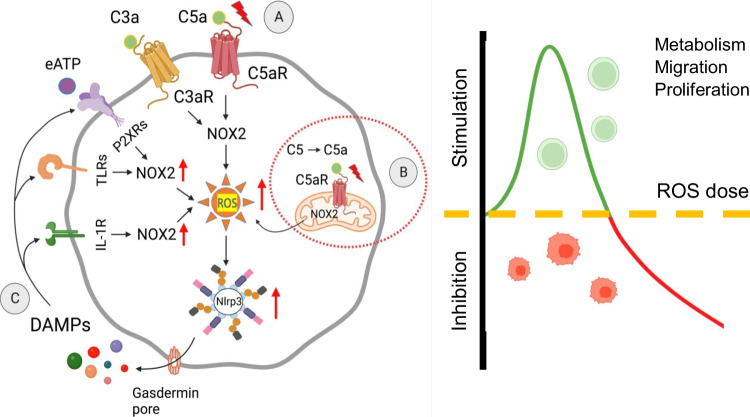
Hematopoietic stem/progenitor cells (HSPCs) express receptors for complement cascade (ComC) cleavage fragments C3a and C5a and may respond to inflammation-related cues by sensing pathogen-associated molecular pattern molecules (PAMPs) released by pathogens as well as non-infectious danger associated molecular pattern molecules (DAMPs) or alarmin generated during stress/tissue damage sterile inflammation. To facilitate this HSPCs are equipped with C3a and C5a receptors, C3aR and C5aR, respectively, and express on the outer cell membrane and in cytosol pattern recognition receptors (PPRs) that sense PAMPs and DAMPs. Overall, danger-sensing mechanisms in HSPCs mimic those seen in immune cells, which should not surprise as hematopoiesis and the immune system develop from the same common stem cell precursor. This review will focus on the role of ComC-derived C3a and C5a that trigger nitric oxide synthetase-2 (Nox2) complex to release reactive oxygen species (ROS) that activate important cytosolic PRRs-Nlrp3 inflammasome, which orchestrates responsiveness of HSPCs to stress. Moreover, recent data indicate that in addition to circulating in peripheral blood (PB) activated liver-derived ComC proteins, a similar role plays ComC expressed and intrinsically activated in HSPCs known as "complosome". We postulate that ComC triggered Nox2-ROS-Nlrp3 inflammasome responses, if they occur within non-toxic to cells' "hormetic range of activation", positively regulate HSCs migration, metabolism, and proliferation. This sheds a new light on the immune-metabolic regulation of hematopoiesis.
造血干细胞/祖细胞(HSPCs)表达补体级联(ComC)裂解片段 C3a 和 C5a 的受体,并且可以通过感测病原体相关分子模式分子(PAMPs)以及非感染性相关危险分子模式分子(DAMPs)或应激/组织损伤无菌炎症期间产生的警报素来响应与炎症相关的线索。为了促进这一点,HSPCs 配备了 C3a 和 C5a 受体,分别为 C3aR 和 C5aR,并在外细胞膜和细胞质中表达模式识别受体(PPRs),这些受体可以感测 PAMPs 和 DAMPs。总的来说,HSPCs 中的危险感应机制类似于免疫细胞中的机制,这并不奇怪,因为造血和免疫系统是由相同的共同干细胞前体发展而来的。本综述将重点介绍 ComC 衍生的 C3a 和 C5a 的作用,它们触发一氧化氮合酶-2(Nox2)复合物释放活性氧物种(ROS),激活重要的细胞质 PPRs-Nlrp3 炎性体,从而协调 HSPCs 对应激的反应。此外,最近的数据表明,除了在周围血液(PB)中循环的激活的肝脏来源的 ComC 蛋白之外,ComC 在 HSPCs 中表达并内在激活,起到类似的作用,被称为“complosome”。我们假设,如果 ComC 触发的 Nox2-ROS-Nlrp3 炎性体反应发生在细胞“激活的有益范围”内,即不会对细胞造成毒性,那么它们将正向调节 HSCs 的迁移、代谢和增殖。这为造血的免疫代谢调控提供了新的视角。