Yang Xinyi, Liu Xu, Li Weibin, Shi Lin, Zeng Yingchao, Xia Haohai, Huang Qixian, Li Jia, Li Xiaojie, Hu Bo, Yang Lianping
School of Public Health, Sun Yat-sen University, Guangzhou 510080, China.
Department of Infectious Disease, The Fifth Affiliated Hospital, Sun Yat-sen University, Zhuhai 519000, China.
Antibiotics (Basel). 2023 Feb 22;12(3):431. doi: 10.3390/antibiotics12030431.
To investigate the epidemiological characteristics and resistance changes of carbapenem-resistant organisms (CROs) under the COVID-19 outbreak to provide evidence for precise prevention and control measures against hospital-acquired infections during the pandemic.
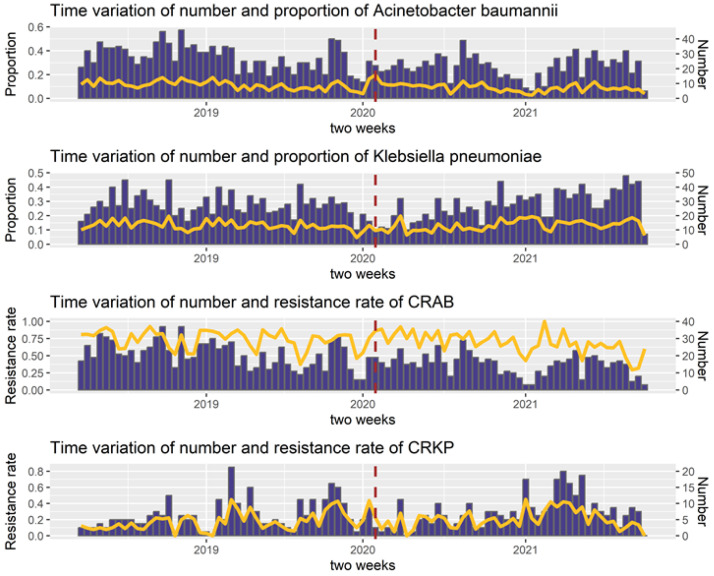
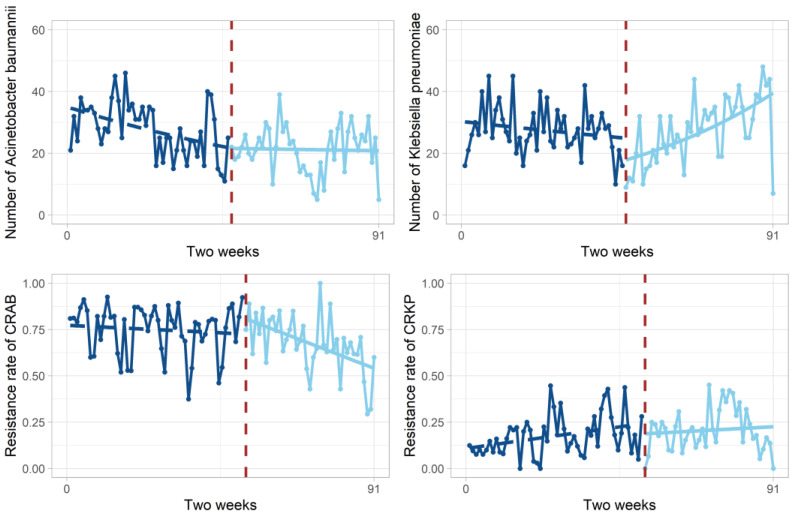
The distribution characteristics of CROs (i.e., carbapenem-resistant and ) were analyzed by collecting the results of the antibiotic susceptibility tests of diagnostic isolates from all patients. Using interrupted time series analysis, we applied Poisson and linear segmented regression models to evaluate the effects of COVID-19 on the numbers and drug resistance of CROs. We also conducted a stratified analysis using the Cochran-Mantel-Haenszel test.
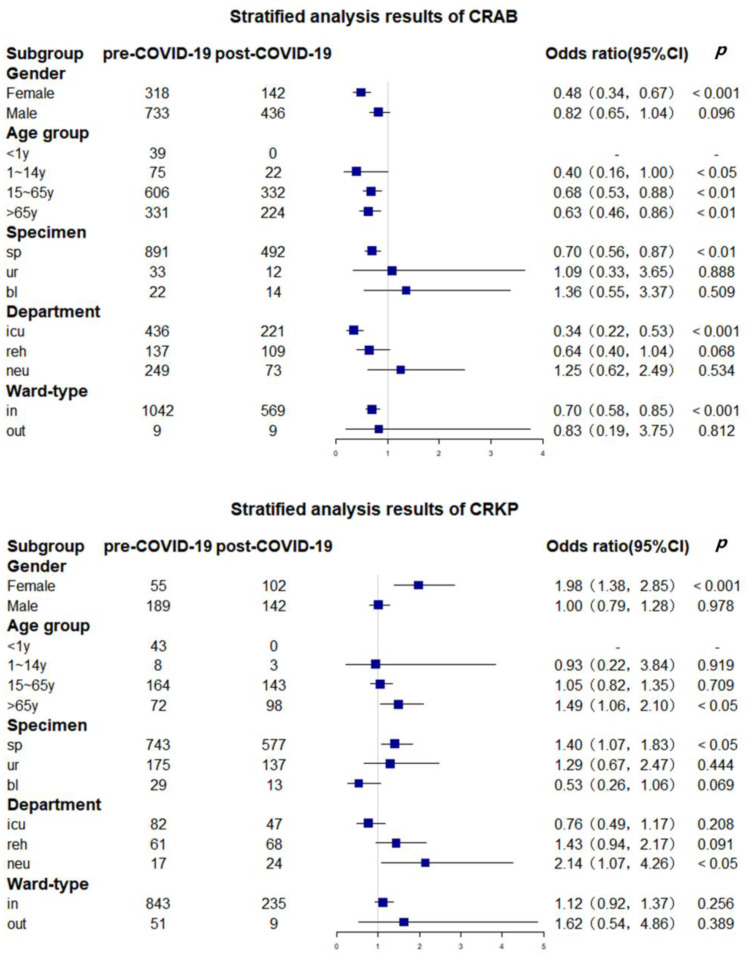
The resistance rate of carbapenem-resistant (CRAB) was 38.73% higher after the COVID-19 outbreak compared with before ( < 0.05). In addition, the long-term effect indicated that the prevalence of CRAB had a decreasing trend ( < 0.05). However, the overall resistance rate of did not significantly change after the COVID-19 outbreak. Stratified analysis revealed that the carbapenem-resistant (CRKP) rate increased in females (OR = 1.98, < 0.05), those over 65 years old (OR = 1.49, < 0.05), those with sputum samples (OR = 1.40, < 0.05), and those in the neurology group (OR = 2.14, < 0.05).
The COVID-19 pandemic has affected the change in nosocomial infections and resistance rates in CROs, highlighting the need for hospitals to closely monitor CROs, especially in high-risk populations and clinical departments. It is possible that lower adherence to infection control in crowded wards and staffing shortages may have contributed to this trend during the COVID-19 pandemic, which warrants further research.
调查新冠疫情期间耐碳青霉烯类病原体(CROs)的流行病学特征及耐药性变化,为疫情期间医院感染的精准防控措施提供依据。
通过收集所有患者诊断分离株的药敏试验结果,分析CROs(即耐碳青霉烯类 和 )的分布特征。采用间断时间序列分析,应用泊松和线性分段回归模型评估新冠疫情对CROs数量及耐药性的影响。我们还使用 Cochr an - Mantel - Haenszel检验进行分层分析。
新冠疫情暴发后,耐碳青霉烯类 (CRAB)的耐药率比之前高38.73%( < 0.05)。此外,长期效应表明CRAB的流行率呈下降趋势( < 0.05)。然而,新冠疫情暴发后 的总体耐药率没有显著变化。分层分析显示,女性(OR = 1.98, < 0.05)、65岁以上人群(OR = 1.49, < 0.05)、有痰标本者(OR = 1.40, < 0.05)以及神经科患者(OR = 2.14, < 0.05)中耐碳青霉烯类 (CRKP)率升高。
新冠疫情影响了医院感染的变化及CROs的耐药率,凸显医院密切监测CROs的必要性,尤其是在高危人群和临床科室。在新冠疫情期间,拥挤病房中感染控制措施依从性降低和人员短缺可能促成了这一趋势,这值得进一步研究。