de Cubas Laura, Mallor Jorge, Herrera-Fernández Víctor, Ayté José, Vicente Rubén, Hidalgo Elena
Oxidative Stress and Cell Cycle Group, Universitat Pompeu Fabra, C/ Doctor Aiguader 88, 08003 Barcelona, Spain.
Laboratory of Molecular Physiology, Universitat Pompeu Fabra, C/ Doctor Aiguader 88, 08003 Barcelona, Spain.
Antioxidants (Basel). 2023 Mar 13;12(3):706. doi: 10.3390/antiox12030706.
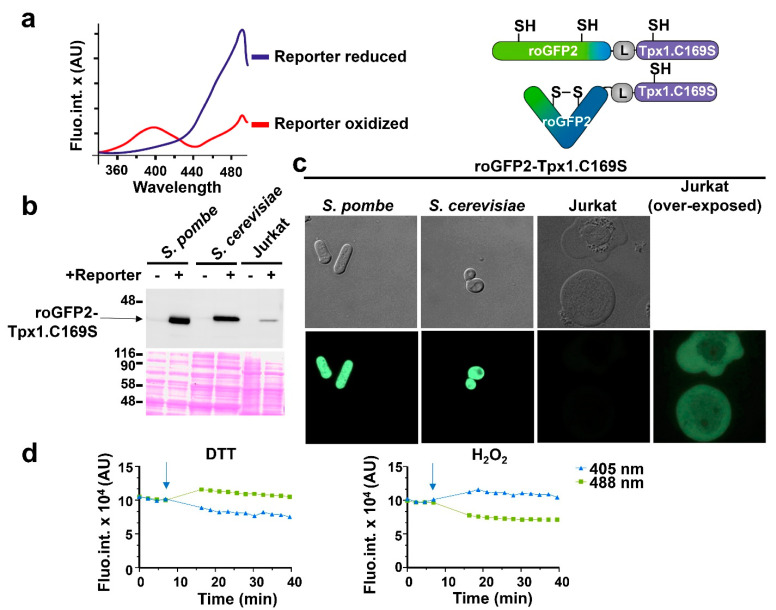
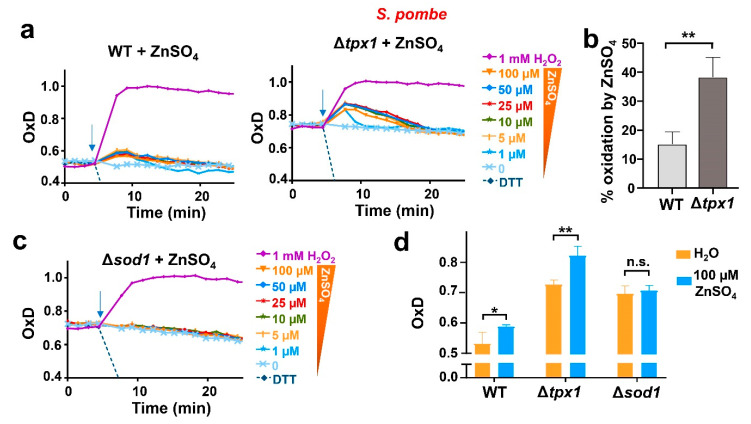
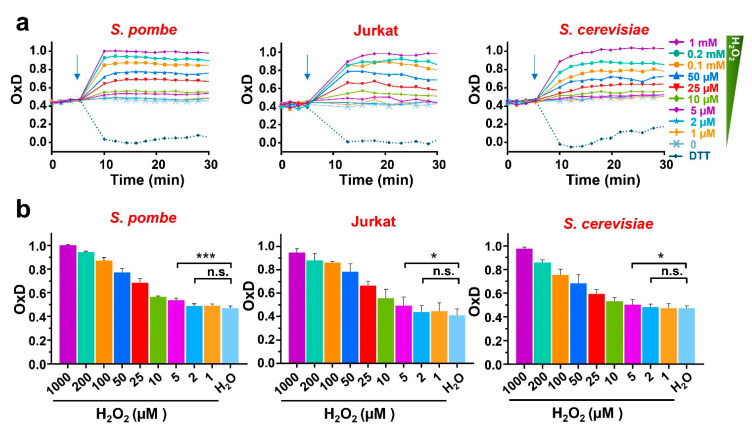
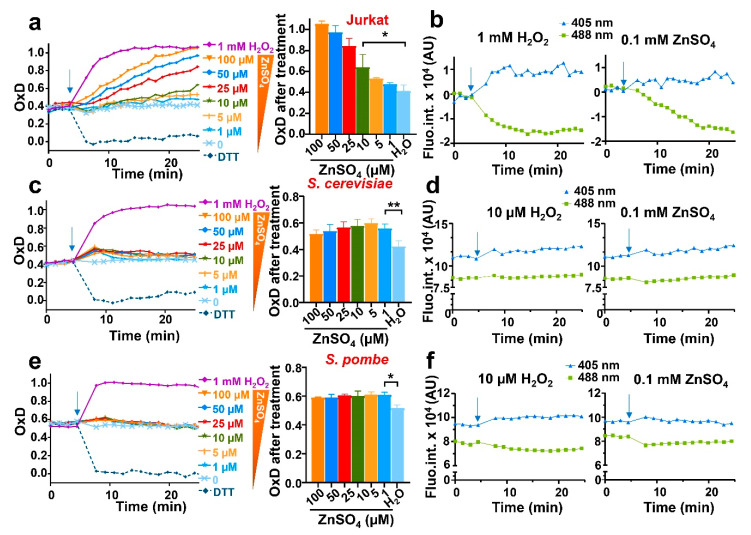
Intracellular hydrogen peroxide (HO) levels can oscillate from low, physiological concentrations, to intermediate, signaling ones, and can participate in toxic reactions when overcoming certain thresholds. Fluorescent protein-based reporters to measure intracellular HO have been developed in recent decades. In particular, the redox-sensitive green fluorescent protein (roGFP)-based proteins fused to peroxiredoxins are among the most sensitive HO biosensors. Using fission yeast as a model system, we recently demonstrated that the gradient of extracellular-to-intracellular peroxides through the plasma membrane is around 300:1, and that the concentration of physiological HO is in the low nanomolar range. Here, we have expressed the very sensitive probe roGFP2-Tpx1.C169S in two other model systems, budding yeast and human Jurkat cells. As in fission yeast, the biosensor is ~40-50% oxidized in these cell types, suggesting similar peroxide steady-state levels. Furthermore, probe oxidation upon the addition of extracellular peroxides is also quantitatively similar, suggesting comparable plasma membrane HO gradients. Finally, as a proof of concept, we have applied different concentrations of zinc to all three model systems and have detected probe oxidation, demonstrating that an excess of this metal can cause fluctuations of peroxides, which are moderate in yeasts and severe in mammalian cells. We conclude that the principles governing HO fluxes are very similar in different model organisms.
细胞内过氧化氢(H₂O₂)水平可在低生理浓度到中等信号浓度之间波动,当超过特定阈值时可参与毒性反应。近几十年来,已开发出基于荧光蛋白的报告基因来测量细胞内H₂O₂。特别是,与过氧化物还原酶融合的基于氧化还原敏感绿色荧光蛋白(roGFP)的蛋白是最敏感的H₂O₂生物传感器之一。我们最近以裂殖酵母为模型系统,证明了通过质膜的细胞外到细胞内过氧化物梯度约为300:1,且生理H₂O₂浓度处于低纳摩尔范围。在此,我们在另外两个模型系统——芽殖酵母和人Jurkat细胞中表达了非常敏感的探针roGFP2-Tpx1.C169S。与裂殖酵母一样,该生物传感器在这些细胞类型中约40%-50%被氧化,表明过氧化物稳态水平相似。此外,添加细胞外过氧化物后探针的氧化在数量上也相似,表明质膜H₂O₂梯度相当。最后,作为概念验证,我们将不同浓度的锌应用于所有三个模型系统,并检测到探针氧化,证明这种金属过量会导致过氧化物波动,在酵母中波动适中,在哺乳动物细胞中波动严重。我们得出结论,不同模型生物中控制H₂O₂通量的原理非常相似。