Torales Julio, González-Urbieta Israel, Barrios Iván, Waisman-Campos Marcela, Terrazas-Landivar Alexandra, Viola Laura, Caycho-Rodríguez Tomás, Melgarejo Osvaldo, Navarro Rodrigo, García Oscar, Almirón-Santacruz José, Castaldelli-Maia João Mauricio, Ventriglio Antonio
Department of Medical Psychology, School of Medical Sciences, National University of Asunción, San Lorenzo 001511, Paraguay.
Department of Psychiatry, School of Medical Sciences, National University of Asunción, San Lorenzo 001511, Paraguay.
Brain Sci. 2023 Mar 4;13(3):444. doi: 10.3390/brainsci13030444.
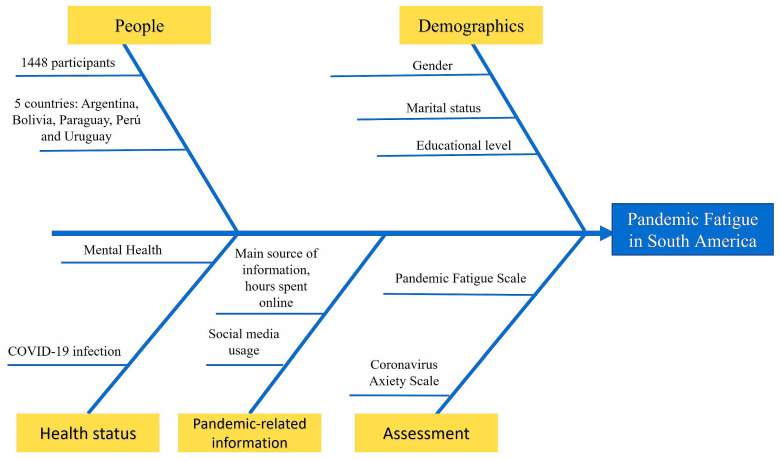
The COVID-19 pandemic has had a heavy impact on daily life, leading to physical and psychosocial consequences. Nowadays, clinicians and health researchers are particularly interested in describing and facing the long-term effects of COVID-19, also known as "long-COVID syndrome". Pandemic fatigue has been defined as a cluster of demotivation, tiredness, and psychological effects that emerge gradually over time after the infection or through the adoption of the recommended measures to combat it. In this study, we report the findings of a large survey conducted in South America involving 1448 participants (mean age: 33.9 ± 11.2 years old) from Argentina, Bolivia, Uruguay, Peru, and Paraguay. An online survey was launched through the common social media based on a specific assessment aimed to detect the prevalence of pandemic fatigue and associated factors. Socio-demographic characteristics, medical, and personal information were collected; the Pandemic Fatigue Scale (PFS) and the Coronavirus Anxiety Scale (CAS) were also administered. We found mid-levels of pandemic fatigue among respondents (21.7 ± 7.95 score at PFS) as well as significant anxiety related to the COVID-19 pandemic (1.56 ± 2.76 score at CAS). In addition, pandemic fatigue was significantly associated with the experience of the loss of a relative/friend due to COVID-19, anxiety related to the infection, and reliance on social media as a primary source of information on the pandemic. Vaccination significantly reduced the levels of fatigue among respondents. Our findings may add to the international debate regarding the long-term health consequences of the COVID-19 pandemic and strategies to manage them in the general population of South America.
新冠疫情对日常生活产生了重大影响,导致了身体和心理社会方面的后果。如今,临床医生和健康研究人员对描述和应对新冠疫情的长期影响(即“长新冠综合征”)尤为关注。疫情疲劳被定义为一组在感染后或通过采取推荐的抗疫措施后随时间逐渐出现的消极怠工、疲惫和心理影响。在本研究中,我们报告了在南美洲进行的一项大型调查的结果,该调查涉及来自阿根廷、玻利维亚、乌拉圭、秘鲁和巴拉圭的1448名参与者(平均年龄:33.9±11.2岁)。通过常见社交媒体发起了一项在线调查,该调查基于一项特定评估,旨在检测疫情疲劳的患病率及相关因素。收集了社会人口学特征、医疗和个人信息;还使用了疫情疲劳量表(PFS)和新冠焦虑量表(CAS)。我们发现受访者存在中等程度的疫情疲劳(PFS评分为21.7±7.95)以及与新冠疫情相关的显著焦虑(CAS评分为1.56±2.76)。此外,疫情疲劳与因新冠疫情失去亲人/朋友的经历、对感染的焦虑以及将社交媒体作为疫情主要信息来源的依赖显著相关。接种疫苗显著降低了受访者的疲劳程度。我们的研究结果可能会为关于新冠疫情对南美洲普通人群长期健康影响及应对策略的国际辩论增添内容。