Ozpolat Zeynep, Karabatak Murat
Department of Software Engineering, Firat University, 23119 Elazig, Turkey.
Diagnostics (Basel). 2023 Mar 14;13(6):1099. doi: 10.3390/diagnostics13061099.
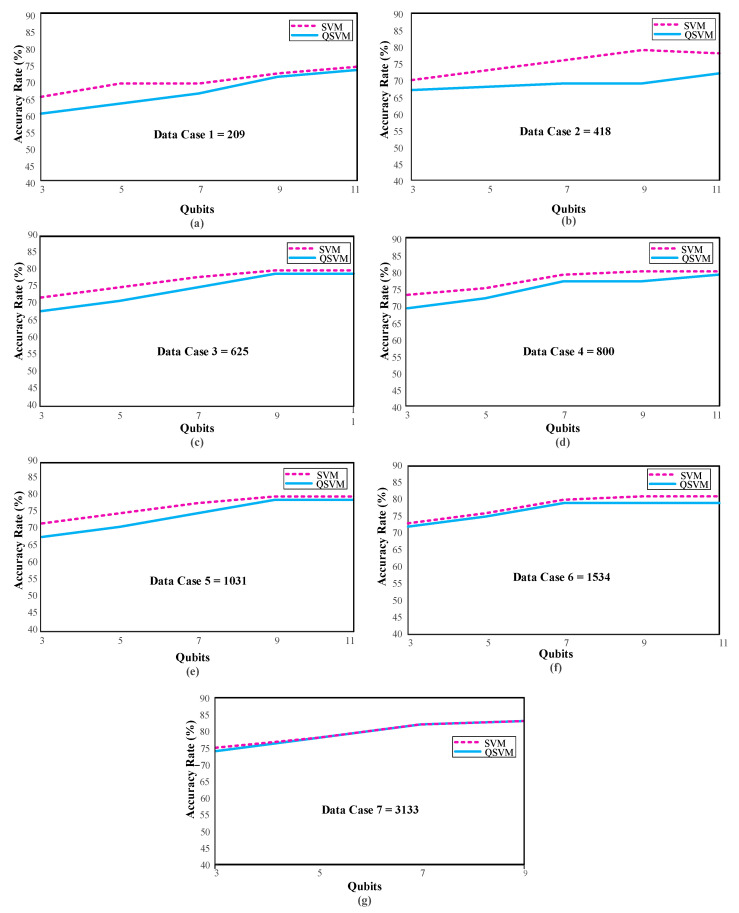
The electrocardiogram (ECG) is the most common technique used to diagnose heart diseases. The electrical signals produced by the heart are recorded by chest electrodes and by the extremity electrodes placed on the limbs. Many diseases, such as arrhythmia, cardiomyopathy, coronary heart disease, and heart failure, can be diagnosed by examining ECG signals. The interpretation of these signals by experts may take a long time, and there may be differences between expert interpretations. Since technological developments are intertwined with the medical sciences, computer-assisted diagnostic methods have recently come forward. In computer science, machine learning techniques are often preferred for automatic detection. Quantum-based structures have emerged to increase the machine learning algorithm's speed and classification performance. In this study, a quantum-based machine learning algorithm is applied to classify heart rhythms. The ECG properties were converted to qubit structure using principal component analysis (PCA). The resulting qubits are classified using the quantum support vector machine (QSVM) algorithm. Quantum computer simulation over Qiskit was used for classification studies. Within the scope of experimental studies, comparisons between classical SVM and QSVM were made using different data amounts and qubit numbers. In the results of the analysis, classical SVM achieved 86.96% accuracy, and QSVM achieved 84.64% accuracy. Despite the fact that the entire dataset was not used due to various limitations, these successful performances were achieved. Classification of medical data such as that from ECG has shown that quantum-based machine learning frameworks perform well despite current resource constraints. In this respect, the study includes essential contributions to the use of quantum-based machine learning methods on signal data in medicine.
心电图(ECG)是诊断心脏病最常用的技术。心脏产生的电信号由胸部电极和置于四肢的肢体电极记录。许多疾病,如心律失常、心肌病、冠心病和心力衰竭,都可以通过检查心电图信号来诊断。专家对这些信号的解读可能需要很长时间,而且专家解读之间可能存在差异。由于技术发展与医学科学相互交织,计算机辅助诊断方法最近应运而生。在计算机科学中,机器学习技术通常被用于自动检测。基于量子的结构已经出现,以提高机器学习算法的速度和分类性能。在本研究中,应用基于量子的机器学习算法对心律进行分类。使用主成分分析(PCA)将心电图特性转换为量子比特结构。使用量子支持向量机(QSVM)算法对得到的量子比特进行分类。使用Qiskit进行量子计算机模拟以进行分类研究。在实验研究范围内,使用不同的数据量和量子比特数对经典支持向量机和QSVM进行了比较。在分析结果中,经典支持向量机的准确率达到86.96%,QSVM的准确率达到84.64%。尽管由于各种限制未使用整个数据集,但仍取得了这些成功的表现。对心电图等医学数据的分类表明,尽管目前存在资源限制,但基于量子的机器学习框架表现良好。在这方面,该研究对基于量子机器学习方法在医学信号数据中的应用做出了重要贡献。