Facciorusso Antonio, Chandan Saurabh, Gkolfakis Paraskevas, Ramai Daryl, Mohan Babu P, Lisotti Andrea, Conti Bellocchi Maria Cristina, Papanikolaou Ioannis S, Mangiavillano Benedetto, Triantafyllou Konstantinos, Manthopoulou Eleni, Mare Ruxandra, Fusaroli Pietro, Crinò Stefano Francesco
Gastroenterology Unit, Department of Surgical and Medical Sciences, University of Foggia, 71122 Foggia, Italy.
Gastroenterology Unit, CHI Health Creighton University Medical Center, Omaha, NE 68007, USA.
Cancers (Basel). 2023 Mar 15;15(6):1789. doi: 10.3390/cancers15061789.
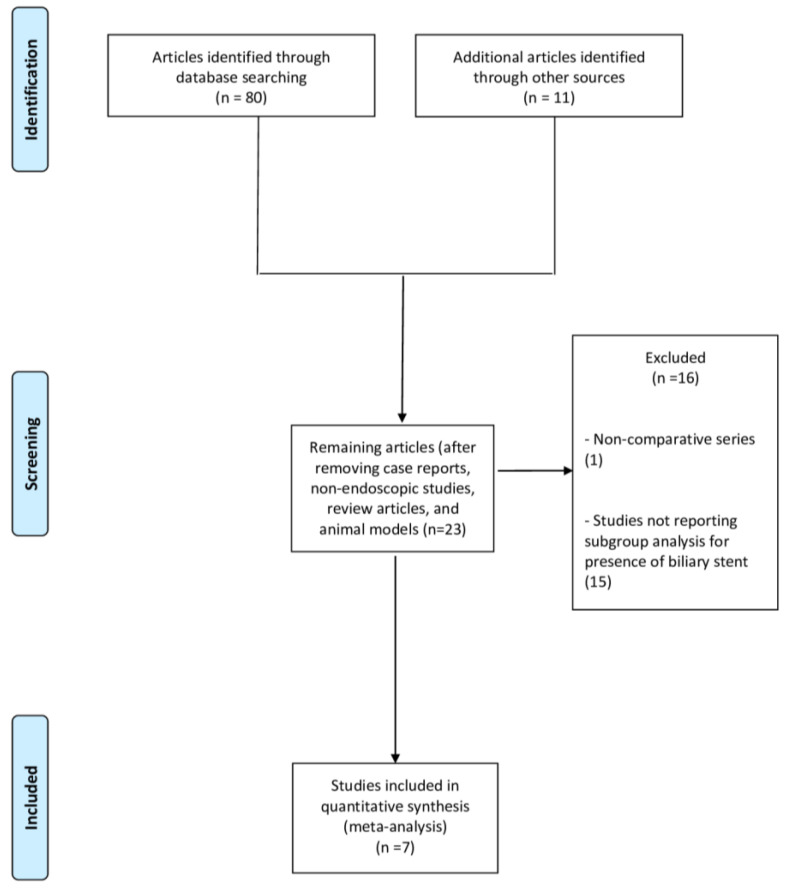
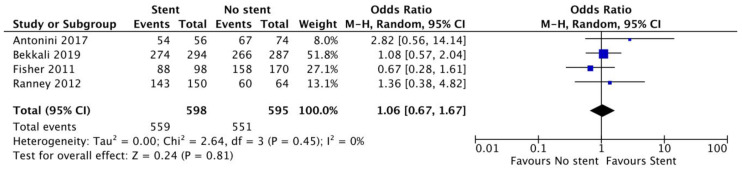
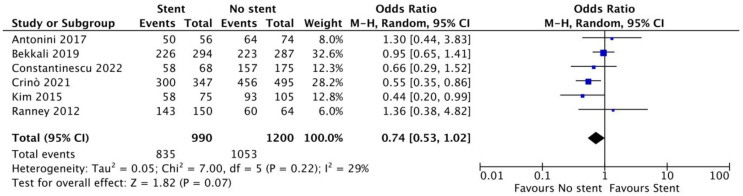
There is a paucity of evidence regarding whether biliary stents influence endoscopic ultrasound-guided tissue acquisition using either fine-needle biopsy (EUS-FNB) or fine-needle aspiration (EUS-FNA), among patients with head of pancreas (HOP) lesions. We aimed at assessing the diagnostic accuracy of endoscopic ultrasound-guided tissue sampling in patients with or without bile duct stents. A total of seven studies with 2458 patients were included. The main aim was to assess overall pooled diagnostic accuracy. A pairwise meta-analysis was performed using a random effects model. Outcomes were expressed as odds ratios (ORs) with 95% confidence intervals (CIs). We found that pooled accuracy was 85.4% (CI 78.8-91.9) and 88.1% (CI 83.3-92.9) in patients with and without stents, respectively. There was no statistically significant difference between the two (OR 0.74; = 0.07). Furthermore, patients with metal stents demonstrated a significant difference (OR 0.54, 0.17-0.97; = 0.05), which was not seen with plastic stents. EUS-FNB showed poorer diagnostic accuracy with concurrent biliary stenting (OR 0.64, 0.43-0.95; = 0.03); however, the same was not observed with EUS-FNA. Compared to plastic stents, metal biliary stenting further impacted the diagnostic accuracy of EUS-guided tissue acquisition for pancreatic head lesions. There was no difference in the rate of procedure-related adverse events between the stent and no-stent groups.
对于胰腺头部(HOP)病变患者,关于胆管支架是否会影响内镜超声引导下细针活检(EUS-FNB)或细针穿刺抽吸(EUS-FNA)获取组织的证据很少。我们旨在评估有无胆管支架患者的内镜超声引导下组织采样的诊断准确性。总共纳入了7项研究,涉及2458例患者。主要目的是评估总体合并诊断准确性。使用随机效应模型进行成对荟萃分析。结果以比值比(OR)和95%置信区间(CI)表示。我们发现,有支架和无支架患者的合并准确率分别为85.4%(CI 78.8-91.9)和88.1%(CI 83.3-92.9)。两者之间无统计学显著差异(OR 0.74;P = 0.07)。此外,金属支架患者存在显著差异(OR 0.54,0.17-0.97;P = 0.05),而塑料支架患者未出现此情况。EUS-FNB在同时进行胆管支架置入时诊断准确性较差(OR 0.64,0.43-0.95;P = 0.03);然而,EUS-FNA未观察到同样情况。与塑料支架相比,金属胆管支架置入进一步影响了EUS引导下胰腺头部病变组织获取的诊断准确性。支架组和无支架组之间与操作相关的不良事件发生率无差异。