
花发育阶段特异性转录组分析揭示了菊花不同形状舌状花的形成机制。
Floral Development Stage-Specific Transcriptomic Analysis Reveals the Formation Mechanism of Different Shapes of Ray Florets in Chrysanthemum.
机构信息
Beijing Key Laboratory of Ornamental Plants Germplasm Innovation & Molecular Breeding, National Engineering Research Center for Floriculture, Beijing Laboratory of Urban and Rural Ecological Environment, Key Laboratory of Genetics and Breeding in Forest Trees and Ornamental Plants of Education Ministry, School of Landscape Architecture, Beijing Forestry University, Beijing 100083, China.
出版信息
Genes (Basel). 2023 Mar 21;14(3):766. doi: 10.3390/genes14030766.
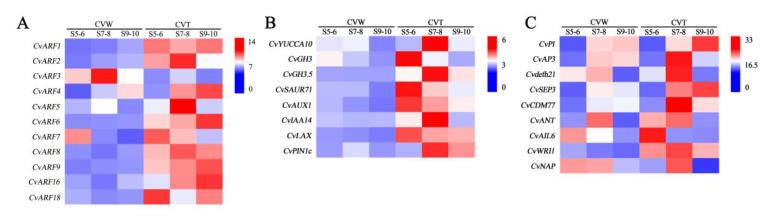
The formation mechanism of different ray floret shapes of chrysanthemum ( × ) remains elusive due to its complex genetic background. , with the basic ray floret shapes of the flat, spoon, and tubular types, is considered a model material for studying ray floret morphogenesis. In this study, the flat and tubular type lines of at specific stages were used to investigate the key genes that regulate morphological differences in ray florets. We found that the expression levels of genes related to auxin synthesis, transport, and response were generally higher in the tubular type than in the flat type. was highly expressed in the flat type, while and were highly expressed in the tubular type. Additionally, the transcription levels of Class B and E genes closely related to petal development, including , , , , and , were expressed at higher levels in the tubular type than the flat type. Based on the results, it is proposed that auxin plays a key role in the development of ray florets, and auxin-related genes, especially , may be key genes to control the morphological difference of ray florets. Simultaneously, MADS-box genes are involved in the co-regulation of ray floret morphogenesis. The results provide novel insights into the molecular mechanism of different petal type formation and lay a theoretical foundation for the directional breeding of petal type in chrysanthemums.
菊花( × )不同射线花瓣形状的形成机制由于其复杂的遗传背景而难以捉摸。 ,具有平瓣、匙瓣和管状三种基本射线花瓣形状,被认为是研究射线花瓣形态发生的模式材料。在这项研究中,使用特定阶段的平瓣和管状型系来研究调节射线花瓣形态差异的关键基因。我们发现,与生长素合成、运输和响应相关的基因的表达水平在管状型中通常高于平瓣型。 在平瓣型中高度表达,而 在管状型中高度表达。此外,与花瓣发育密切相关的 B 类和 E 类基因(包括 、 、 、 、和 )的转录水平在管状型中高于平瓣型。基于这些结果,提出生长素在射线花瓣发育中起关键作用,生长素相关基因,特别是 ,可能是控制射线花瓣形态差异的关键基因。同时,MADS 框基因参与射线花瓣形态发生的共同调控。该结果为不同花瓣类型形成的分子机制提供了新的见解,并为菊花花瓣类型的定向培育奠定了理论基础。


 Zotero 插件