von Elling-Tammen Lisa, Stark Christina, Wloka Kim Ramona, Alberg Evelyn, Schoenau Eckhard, Duran Ibrahim
Center of Prevention and Rehabilitation, University Hospital, Medical Faculty, University of Cologne, 50931 Cologne, Germany.
Department of Neurology, University Hospital, Medical Faculty, University of Cologne, 50931 Cologne, Germany.
J Clin Med. 2023 Mar 13;12(6):2228. doi: 10.3390/jcm12062228.
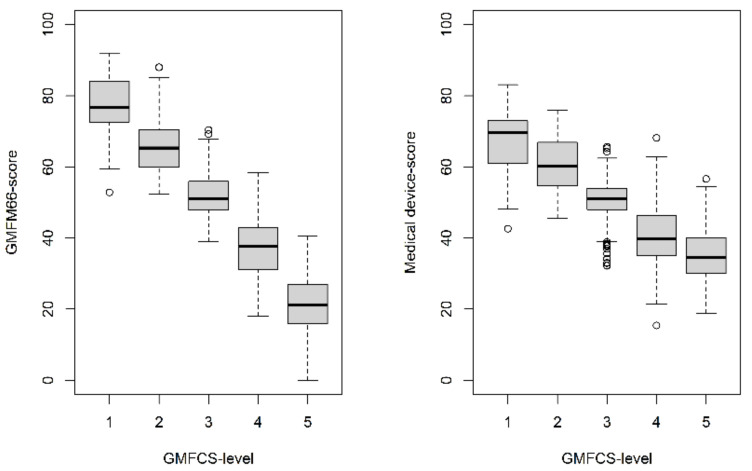
Data obtained from routine clinical care find increasing use in a scientific context. Many routine databases, e.g., from health insurance providers, include records of medical devices and therapies, but not on motor function, such as the frequently used Gross Motor Function Measure-66 (GMFM-66) score for children and adolescents with cerebral palsy (CP). However, motor function is the most common outcome of therapeutic efforts. In order to increase the usability of available records, the aim of this study was to predict the GMFM-66 score from the medical devices used by a patient with CP. For this purpose, we developed the Medical Device Score Calculator (MDSC) based on the analysis of a population of 1581 children and adolescents with CP. Several machine learning algorithms were compared for predicting the GMFM-66 score. The random forest algorithm proved to be the most accurate with a concordance correlation coefficient (Lin) of 0.75 (0.71; 0.78) with a mean absolute error of 7.74 (7.15; 8.33) and a root mean square error of 10.1 (9.51; 10.8). Our findings suggest that the MDSC is appropriate for estimating the GMFM-66 score in sufficiently large patient groups for scientific purposes, such as comparison or efficacy of different therapies. The MDSC is not suitable for the individual assessment of a child or adolescent with CP.
从常规临床护理中获取的数据在科学背景下的应用越来越广泛。许多常规数据库,例如来自健康保险提供商的数据库,包含医疗设备和治疗记录,但不包括运动功能记录,如常用于脑瘫(CP)儿童和青少年的粗大运动功能测量-66(GMFM-66)评分。然而,运动功能是治疗努力的最常见结果。为了提高现有记录的可用性,本研究的目的是根据CP患者使用的医疗设备预测GMFM-66评分。为此,我们基于对1581名CP儿童和青少年的分析开发了医疗设备评分计算器(MDSC)。比较了几种机器学习算法来预测GMFM-66评分。随机森林算法被证明是最准确的,一致性相关系数(Lin)为0.75(0.71;0.78),平均绝对误差为7.74(7.15;8.33),均方根误差为10.1(9.51;10.8)。我们的研究结果表明,MDSC适用于在足够大的患者群体中为科学目的(如不同疗法的比较或疗效)估计GMFM-66评分。MDSC不适用于对CP儿童或青少年进行个体评估。