Lehrnbecher Thomas, Bochennek Konrad, Groll Andreas H
Division of Pediatric Hematology and Oncology, Hospital for Children and Adolescents, University Hospital, Johann Wolfgang Goethe University, 60589 Frankfurt am Main, Germany.
Infectious Disease Research Program, Center for Bone Marrow Transplantation, Department of Pediatric Hematology/Oncology, University Children's Hospital, 48149 Muenster, Germany.
J Fungi (Basel). 2023 Mar 22;9(3):387. doi: 10.3390/jof9030387.
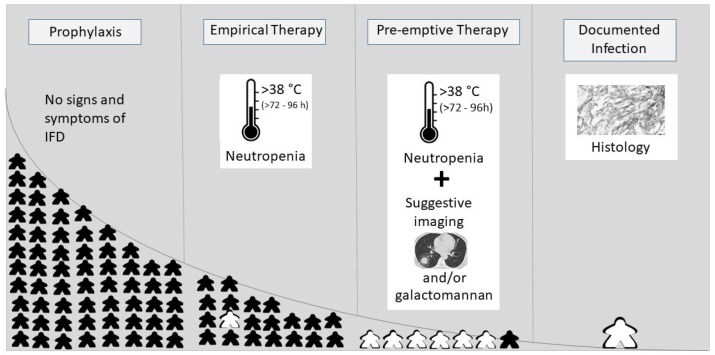
Invasive fungal diseases (IFDs), in particular invasive mold infections, still pose considerable problems in the care of children and adolescents treated for cancer or undergoing hematopoietic cell transplantation. As these infections are difficult to diagnose, and the outcomes for IFDs are still unsatisfactory, antifungal prophylaxis has become an important strategy in the clinical setting. Antifungal prophylaxis is indicated in patients at high risk for IFD, which is commonly defined as a natural incidence of at least 10%. As there is a growing interest in pediatric-specific clinical trials and pediatric-specific guidelines, this review focuses on the available data of mold-active antifungal prophylaxis in children and adolescents. The data demonstrate that a major effort is needed to characterize the pediatric patient population in which the net effect of prophylactic antifungals will be beneficial as well as to find the optimal prophylactic antifungal compound and dosage.
侵袭性真菌病(IFDs),尤其是侵袭性霉菌感染,在接受癌症治疗或进行造血细胞移植的儿童和青少年护理中仍然构成相当大的问题。由于这些感染难以诊断,且IFDs的治疗效果仍不尽人意,抗真菌预防已成为临床环境中的一项重要策略。IFD高危患者需要进行抗真菌预防,其通常定义为自然发病率至少为10%。鉴于对儿科特定临床试验和儿科特定指南的兴趣日益浓厚,本综述重点关注儿童和青少年中具有抗霉菌活性的抗真菌预防的现有数据。数据表明,需要做出重大努力来确定预防性抗真菌药物净效应有益的儿科患者群体,并找到最佳的预防性抗真菌化合物和剂量。