Department of Medical Oncology, University of Health Sciences, Kartal Dr. Lutfi Kirdar City Hospital, Istanbul 34865, Turkey.
Department of Medical Oncology, University of Health Sciences, Umraniye Training and Research Hospital, Istanbul 34764, Turkey.
Medicina (Kaunas). 2023 Mar 12;59(3):557. doi: 10.3390/medicina59030557.
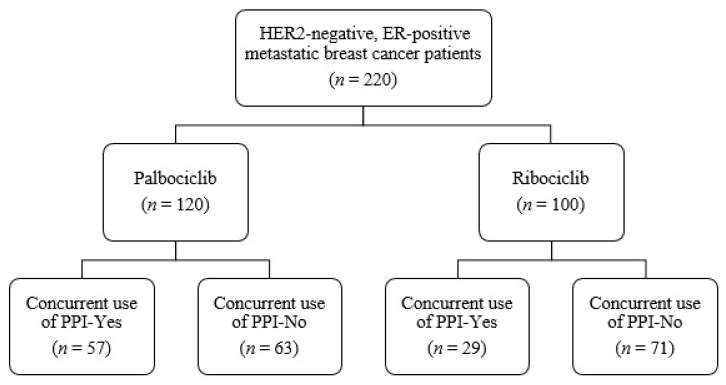
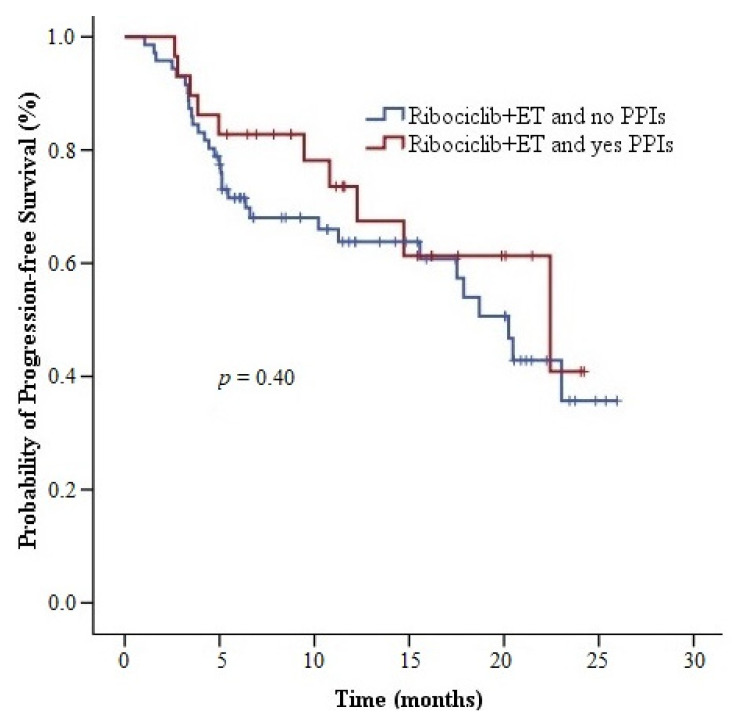
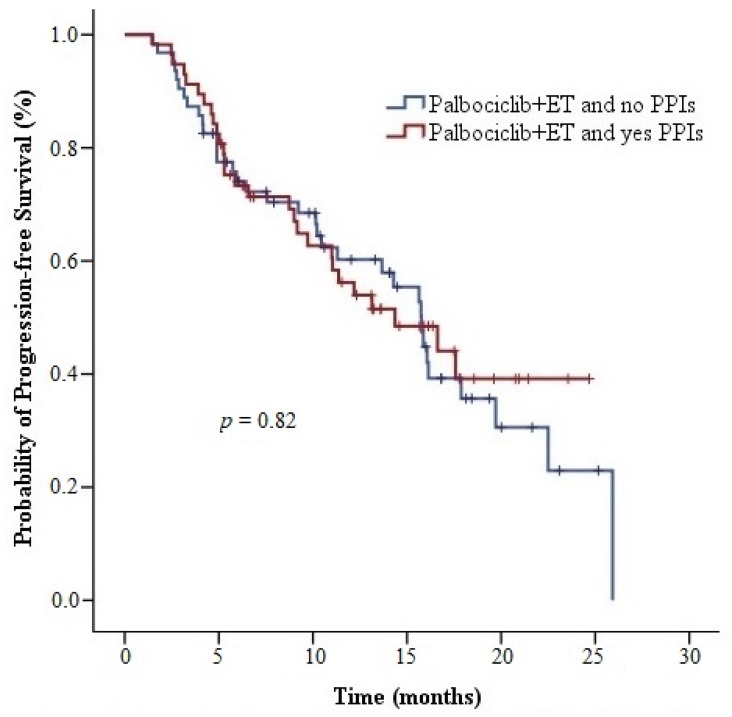
This investigation aimed to determine the impacts of concurrent proton pump inhibitors (PPIs) on progression-free survival (PFS) in patients with hormone receptor-positive and HER2-negative metastatic breast cancer managed with palbociclib or ribociclib as either the initial or subsequent line of therapy option. In this retrospective study, patients were classified as "concurrent PPIs" if PPIs were given for at least two-thirds of the palbociclib or ribociclib therapy period, and "no concurrent PPIs" if no PPIs were given during the period of palbociclib or ribociclib therapy. Each patient was also classified as endocrine-sensitive or endocrine-resistant according to the duration of previous endocrine responses. "Concurrent PPIs" and "no concurrent PPIs" groups were compared with each other in terms of PFS. This comparison was performed for both ribociclib and palbociclib groups. : The research included 220 patients in total. The PFS of 57 patients on palbociclib using concomitant PPIs was 14.4 months. Among 63 patients using palbociclib without concomitant PPIs, the PFS was 15.8 months. No statistically significant difference was found with PPI use ( = 0.82). Among 29 patients using ribociclib concurrently with PPIs, the PFS was 22.4 months. Among 71 patients using ribociclib without PPIs, the PFS was 20.2 months. No statistically significant difference was found with PPI use ( = 0.40). : The results of our investigation showed that concomitant use of the most commonly used PPIs in the study (lansoprazole, pantoprazole, and esomeprazole) with palbociclib or ribociclib did not have any detrimental effects on PFS. Where appropriate, PPIs can be used concurrently with palbociclib and ribociclib. However, the effect of PPIs on cycling-dependent kinase 4/6 inhibitors deserves further investigation.
这项研究旨在确定质子泵抑制剂(PPIs)与激素受体阳性和 HER2 阴性转移性乳腺癌患者的无进展生存期(PFS)之间的关系,这些患者接受 palbociclib 或 ribociclib 作为初始或后续治疗选择。在这项回顾性研究中,如果患者在 palbociclib 或 ribociclib 治疗期间至少有三分之二的时间接受了 PPI 治疗,则将其归类为“同时使用 PPI”,否则如果在 palbociclib 或 ribociclib 治疗期间未使用 PPI,则将其归类为“未同时使用 PPI”。根据先前内分泌反应的持续时间,每位患者还被归类为内分泌敏感或内分泌抵抗。在 PFS 方面,将“同时使用 PPI”和“未同时使用 PPI”组进行了比较。这一比较针对 ribociclib 和 palbociclib 两组均进行了。:研究共纳入 220 例患者。使用伴随 PPI 的 palbociclib 的 57 例患者的 PFS 为 14.4 个月。在未使用伴随 PPI 的 palbociclib 的 63 例患者中,PFS 为 15.8 个月。使用 PPI 与 PFS 之间无统计学差异( = 0.82)。使用伴随 PPI 的 ribociclib 的 29 例患者的 PFS 为 22.4 个月。在未使用伴随 PPI 的 ribociclib 的 71 例患者中,PFS 为 20.2 个月。使用 PPI 与 PFS 之间无统计学差异( = 0.40)。:我们的研究结果表明,在 palbociclib 或 ribociclib 中同时使用研究中最常用的 PPIs(兰索拉唑、泮托拉唑和埃索美拉唑)对 PFS 没有任何不利影响。在适当的情况下,可以同时使用 PPI 与 palbociclib 和 ribociclib。然而,PPIs 对细胞周期依赖性激酶 4/6 抑制剂的影响值得进一步研究。