Li Jiaqian, Liu Xiuping, Xie Ningdong, Bai Mohan, Liu Lu, Sen Biswarup, Wang Guangyi
Center for Marine Environmental Ecology, School of Environmental Science and Engineering, Tianjin University, Tianjin 300072, China.
Key Laboratory of Systems Bioengineering (Ministry of Education), Tianjin University, Tianjin 300072, China.
Microorganisms. 2023 Feb 26;11(3):592. doi: 10.3390/microorganisms11030592.
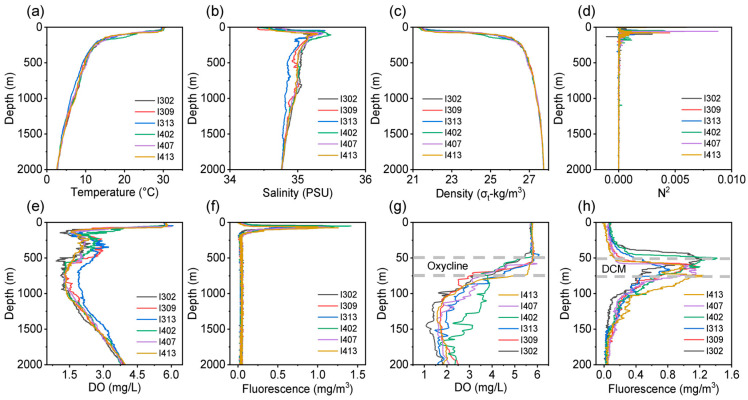
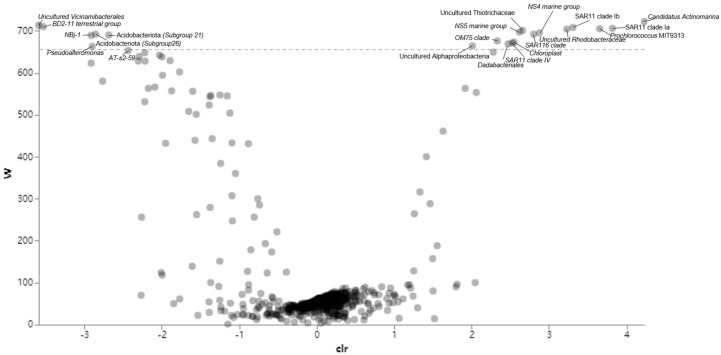
The consequences of climate change may directly or indirectly impact the marine biosphere. Although ocean stratification has been recognized as one of the crucial consequences of ocean warming, its impacts on several critical aspects of marine microbes remain largely unknown in the Indian Ocean. Here, we investigate the effects of water stratification, in both surface and subsurface layers, on hydrogeographic parameters and bacterioplankton diversity within the equatorial eastern Indian Ocean (EIO). Strong stratification in the upper 200 m of equatorial EIO was detected with evidential low primary productivity. The vertical bacterioplankton diversity of the whole water columns displayed noticeable variation, with lower diversity occurring in the surface layer than in the subsurface layers. Horizontal heterogeneity of bacterioplankton communities was also in the well-mixed layer among different stations. SAR11 and Prochlorococcus displayed uncharacteristic low abundance in the surface water. Some amplicon sequence variants (ASVs) were identified as potential biomarkers for their specific depths in strongly-stratified water columns. Thus, barriers resulting from stratification are proposed to function as an 'ASV filter' to regulate the vertical bacterioplankton community diversity along the water columns. Overall, our results suggest that the effects of stratification on the structure and diversity of bacterioplankton can extend up to the bathypelagic zone in the strongly-stratified waters of the equatorial EIO. This study provides the first insight into the effect of stratification on the subsurface microbial communities in the equatorial eastern Indian Ocean.
气候变化的后果可能直接或间接地影响海洋生物圈。尽管海洋分层已被认为是海洋变暖的关键后果之一,但其对海洋微生物几个关键方面的影响在印度洋仍 largely unknown。在此,我们研究了赤道东印度洋(EIO)表层和次表层水层分层对水文地理参数和浮游细菌多样性的影响。在赤道EIO上层200米处检测到强烈分层,伴有明显较低的初级生产力。整个水柱的垂直浮游细菌多样性呈现出显著变化,表层的多样性低于次表层。浮游细菌群落的水平异质性在不同站点的充分混合层中也存在。SAR11和原绿球藻在表层水中呈现出异常低的丰度。一些扩增子序列变体(ASVs)因其在强烈分层水柱中的特定深度而被确定为潜在的生物标志物。因此,分层导致的屏障被认为起到“ASV过滤器”的作用,以调节沿水柱的垂直浮游细菌群落多样性。总体而言,我们的结果表明,分层对浮游细菌结构和多样性的影响可以延伸到赤道EIO强烈分层水域的深海层。本研究首次深入了解了分层对赤道东印度洋次表层微生物群落的影响。