Rajasegaran Thiviyadarshini, How Chee Wun, Saud Anoosha, Ali Azhar, Lim Jonathan Chee Woei
Department of Medicine, Faculty of Medicine and Health Sciences, Universiti Putra Malaysia, Serdang 43400, Selangor, Malaysia.
School of Pharmacy, Monash University Malaysia, Bandar Sunway, Subang Jaya 47500, Selangor, Malaysia.
Pharmaceuticals (Basel). 2023 Mar 16;16(3):451. doi: 10.3390/ph16030451.
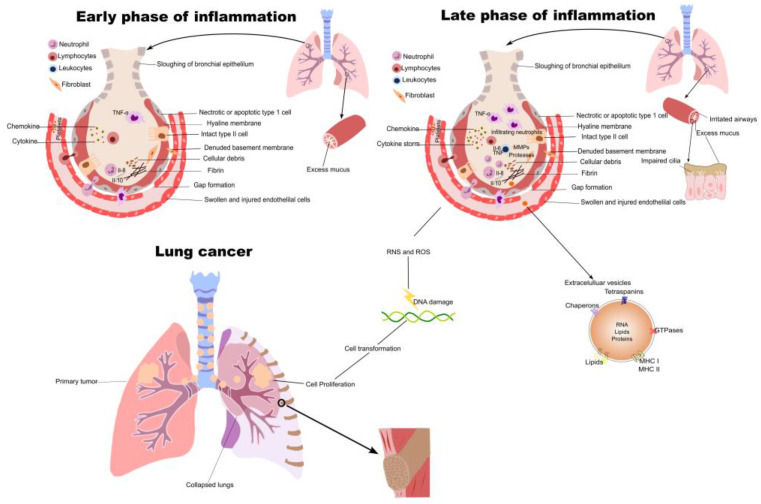
Lung cancer is the most common cause of cancer-related deaths. Lung cancers can be classified as small-cell (SCLC) or non-small cell (NSCLC). About 84% of all lung cancers are NSCLC and about 16% are SCLC. For the past few years, there have been a lot of new advances in the management of NSCLC in terms of screening, diagnosis and treatment. Unfortunately, most of the NSCLCs are resistant to current treatments and eventually progress to advanced stages. In this perspective, we discuss some of the drugs that can be repurposed to specifically target the inflammatory pathway of NSCLC utilizing its well-defined inflammatory tumor microenvironment. Continuous inflammatory conditions are responsible to induce DNA damage and enhance cell division rate in lung tissues. There are existing anti-inflammatory drugs which were found suitable for repurposing in non-small cell lung carcinoma (NSCLC) treatment and drug modification for delivery via inhalation. Repurposing anti-inflammatory drugs and their delivery through the airway is a promising strategy to treat NSCLC. In this review, suitable drug candidates that can be repurposed to treat inflammation-mediated NSCLC will be comprehensively discussed together with their administration via inhalation from physico-chemical and nanocarrier perspectives.
肺癌是癌症相关死亡的最常见原因。肺癌可分为小细胞肺癌(SCLC)或非小细胞肺癌(NSCLC)。所有肺癌中约84%为NSCLC,约16%为SCLC。在过去几年中,NSCLC在筛查、诊断和治疗方面有了许多新进展。不幸的是,大多数NSCLC对当前治疗有抗性,最终发展到晚期。从这个角度来看,我们讨论一些可以重新利用的药物,利用其明确的炎性肿瘤微环境来特异性靶向NSCLC的炎症途径。持续的炎症状态会导致肺组织中的DNA损伤并提高细胞分裂率。现有的抗炎药物被发现适合重新用于非小细胞肺癌(NSCLC)治疗以及通过吸入进行药物递送的修饰。重新利用抗炎药物并通过气道给药是治疗NSCLC的一种有前景的策略。在这篇综述中,将从物理化学和纳米载体的角度,全面讨论可重新用于治疗炎症介导的NSCLC的合适候选药物及其吸入给药方式。