Center for Virology, Medical University of Vienna, Vienna, Austria.
Medizinische Klinik und Poliklinik III, Universitätsklinikum, Carl Gustav Carus, Technische Universität Dresden, Dresden, Germany; KfH-Nierenzentrum Dresden, Dresden, Germany.
J Clin Virol. 2023 May;162:105428. doi: 10.1016/j.jcv.2023.105428. Epub 2023 Mar 24.
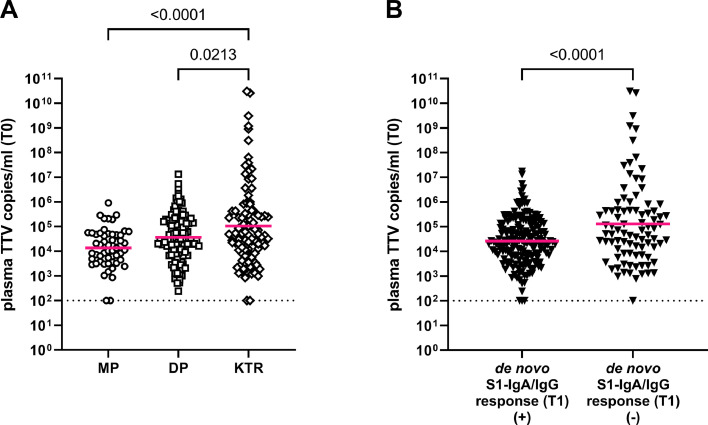
Immunosuppressed individuals such as kidney transplant recipients (KTR) and hemodialysis patients (DP) show impaired immune responses to COVID-19 vaccination. Plasma Torque Teno Virus (TTV) DNA load is used as surrogate for the individual degree of immunosuppression. We now assessed the association of TTV load at time of COVID-19 vaccination with humoral and cellular immune response rates to vaccination in KTR, DP, and healthy medical personnel (MP).
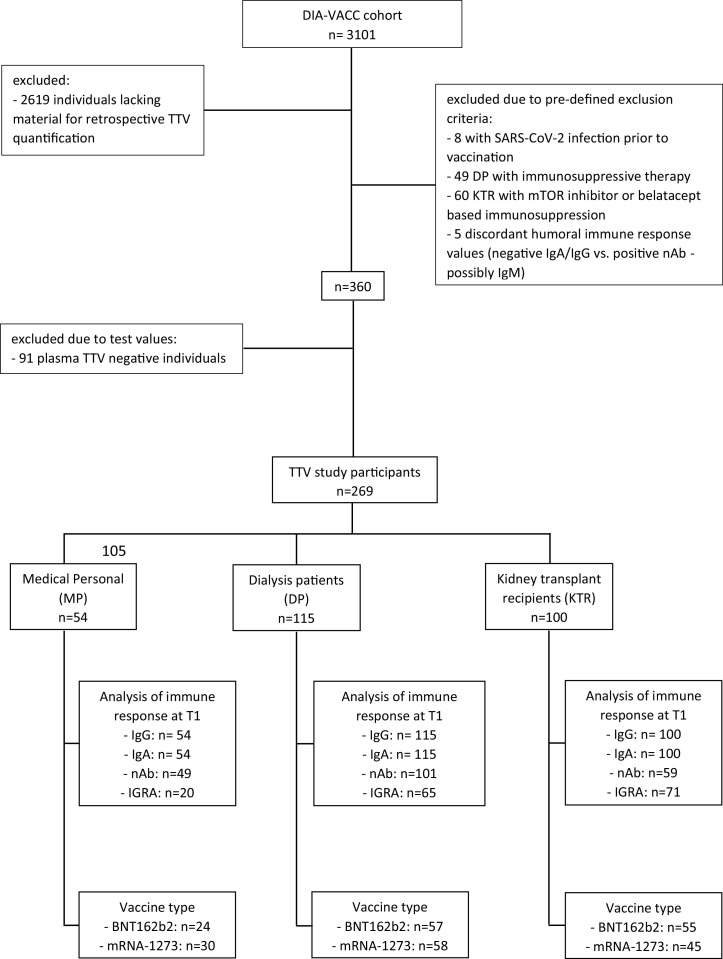
A total of 100 KTR, 115 DP and 54 MP were included. All were SARS-CoV-2 seronegative at the time of vaccination with either BNT162b2 or mRNA-1273. Plasma TTV loads were assessed at the time of first vaccination. After two-dose vaccination, seroconversion (de novo detection of SARS-CoV-2 S1-IgA and/or IgG) was determined. In addition, cellular responses as assessed by interferon γ release and neutralizing antibodies were assessed in a subset of participants. ROC analyses were performed to define TTV load cut-offs predicting specific immune responses to vaccination.
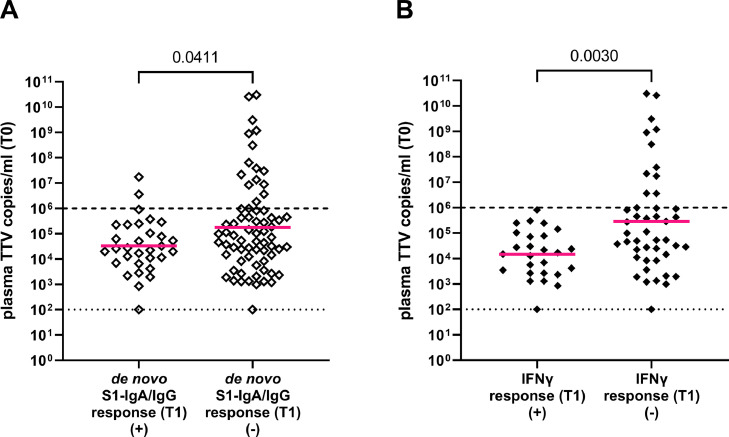
Plasma TTV loads at the time of first vaccination were negatively associated with seroconversion after two-dose vaccination in KTR (OR 0.87, 95% CI 0.76-0.99). TTV loads were significantly lower in KTR who developed humoral and cellular immune responses to vaccination compared to non-responders (p = 0.0411 and 0.0030, respectively). Of patients with TTV loads above 10 copies/ml, none developed cellular immune responses against SARS-CoV-2, and only 2 of 17 (12%) seroconverted in response to vaccination.
Plasma TTV loads at the time of first vaccination in immunosuppressed individuals may be useful to predict individual vaccine-specific immune responses.
免疫抑制个体,如肾移植受者(KTR)和血液透析患者(DP),对 COVID-19 疫苗接种的免疫反应受损。血浆 Torque Teno 病毒(TTV)DNA 载量可作为个体免疫抑制程度的替代指标。我们现在评估了 COVID-19 疫苗接种时 TTV 载量与 KTR、DP 和健康医务人员(MP)接种疫苗后的体液和细胞免疫反应率之间的相关性。
共纳入 100 名 KTR、115 名 DP 和 54 名 MP。所有参与者在接种 BNT162b2 或 mRNA-1273 疫苗时均为 SARS-CoV-2 血清阴性。在首次接种疫苗时评估血浆 TTV 载量。接种两剂疫苗后,确定血清转换(新检测到 SARS-CoV-2 S1-IgA 和/或 IgG)。此外,还在一部分参与者中评估了细胞反应,即通过干扰素 γ 释放和中和抗体来评估。进行 ROC 分析以确定预测接种疫苗后特定免疫反应的 TTV 载量截止值。
首次接种疫苗时的血浆 TTV 载量与 KTR 两剂疫苗接种后的血清转换呈负相关(OR 0.87,95%CI 0.76-0.99)。与未产生体液和细胞免疫反应的 KTR 相比,产生体液和细胞免疫反应的 KTR 的 TTV 载量显著更低(分别为 p=0.0411 和 0.0030)。在 TTV 载量超过 10 拷贝/ml 的患者中,无一例对 SARS-CoV-2 产生细胞免疫反应,仅 17 例中有 2 例(12%)对疫苗接种产生血清转换。
免疫抑制个体首次接种疫苗时的血浆 TTV 载量可能有助于预测个体疫苗特异性免疫反应。