Division of Concrete Structures, KTH Royal Institute of Technology, Brinellvägen 23, 114 28 Stockholm, Sweden.
Geodesy and Geomatics Division, Department of Civil, Constructional and Environmental Engineering (DICEA), Sapienza University of Rome, 00184 Rome, Italy.
Sensors (Basel). 2023 Mar 16;23(6):3189. doi: 10.3390/s23063189.
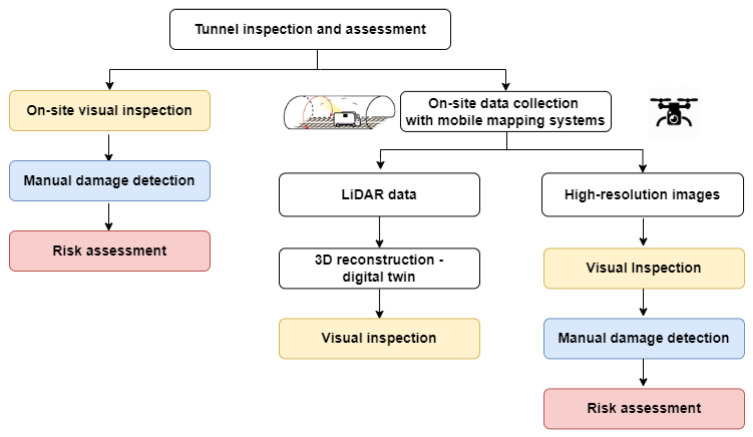
In recent decades, many cities have become densely populated due to increased urbanization, and the transportation infrastructure system has been heavily used. The downtime of important parts of the infrastructure, such as tunnels and bridges, seriously affects the transportation system's efficiency. For this reason, a safe and reliable infrastructure network is necessary for the economic growth and functionality of cities. At the same time, the infrastructure is ageing in many countries, and continuous inspection and maintenance are necessary. Nowadays, detailed inspections of large infrastructure are almost exclusively performed by inspectors on site, which is both time-consuming and subject to human errors. However, the recent technological advancements in computer vision, artificial intelligence (AI), and robotics have opened up the possibilities of automated inspections. Today, semiautomatic systems such as drones and other mobile mapping systems are available to collect data and reconstruct 3D digital models of infrastructure. This significantly decreases the downtime of the infrastructure, but both damage detection and assessments of the structural condition are still manually performed, with a high impact on the efficiency and accuracy of the procedure. Ongoing research has shown that deep-learning methods, especially convolutional neural networks (CNNs) combined with other image processing techniques, can automatically detect cracks on concrete surfaces and measure their metrics (e.g., length and width). However, these techniques are still under investigation. Additionally, to use these data for automatically assessing the structure, a clear link between the metrics of the cracks and the structural condition must be established. This paper presents a review of the damage of tunnel concrete lining that is detectable with optical instruments. Thereafter, state-of-the-art autonomous tunnel inspection methods are presented with a focus on innovative mobile mapping systems for optimizing data collection. Finally, the paper presents an in-depth review of how the risk associated with cracks is assessed today in concrete tunnel lining.
近几十年来,由于城市化进程的加快,许多城市人口变得密集,交通基础设施系统也被大量使用。基础设施的重要部分(如隧道和桥梁)的停机时间会严重影响交通系统的效率。出于这个原因,安全可靠的基础设施网络对于城市的经济增长和功能至关重要。同时,许多国家的基础设施正在老化,需要进行持续的检查和维护。如今,大型基础设施的详细检查几乎完全由现场检查员进行,这既费时又容易出错。然而,计算机视觉、人工智能 (AI) 和机器人技术的最新技术进步为自动化检查开辟了可能性。如今,半自动化系统(如无人机和其他移动测绘系统)可用于收集数据并重建基础设施的 3D 数字模型。这大大减少了基础设施的停机时间,但损坏检测和结构状况评估仍然是手动进行的,这对程序的效率和准确性有很大影响。正在进行的研究表明,深度学习方法,尤其是卷积神经网络 (CNN) 与其他图像处理技术相结合,可以自动检测混凝土表面的裂缝并测量其度量(例如,长度和宽度)。然而,这些技术仍在研究中。此外,为了使用这些数据自动评估结构,必须在裂缝的度量与结构状况之间建立明确的联系。本文综述了可通过光学仪器检测到的隧道混凝土衬砌损坏。此后,介绍了最先进的自主隧道检查方法,重点介绍了用于优化数据采集的创新型移动测绘系统。最后,本文深入回顾了目前如何评估混凝土隧道衬砌中裂缝相关的风险。