Postgraduate Program of Health Sciences, School of Medicine and Life Sciences, Pontifícia Universidade Católica do Paraná-PUCPR, R. Imaculada Conceição, 1155-Prado Velho, Curitiba 80215-901, PR, Brazil.
Laboratory of Experimental Pathology, School of Medicine and Life Sciences, Pontifícia Universidade Católica do Paraná-PUCPR, R. Imaculada Conceição, 1155-Prado Velho, Curitiba 80215-901, PR, Brazil.
Viruses. 2023 Mar 8;15(3):706. doi: 10.3390/v15030706.
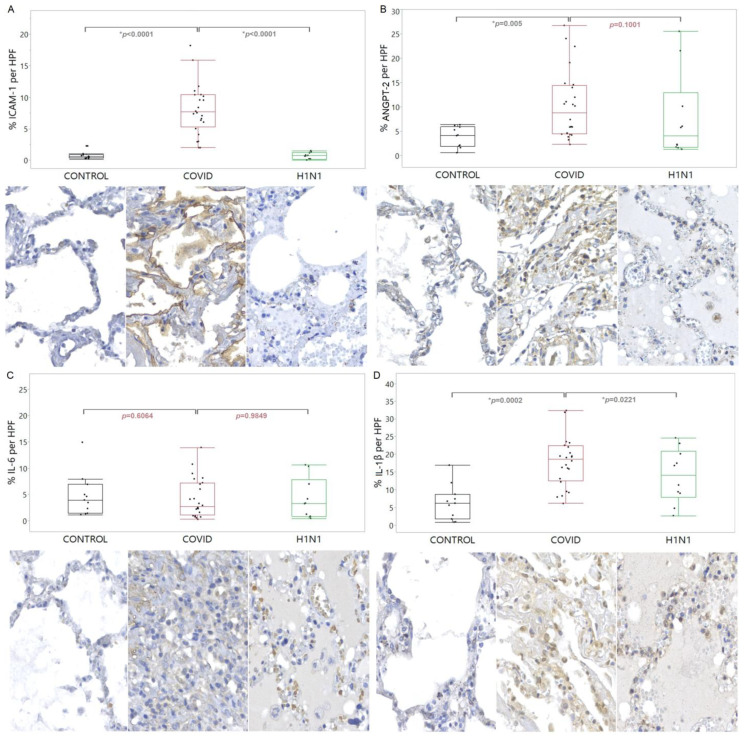
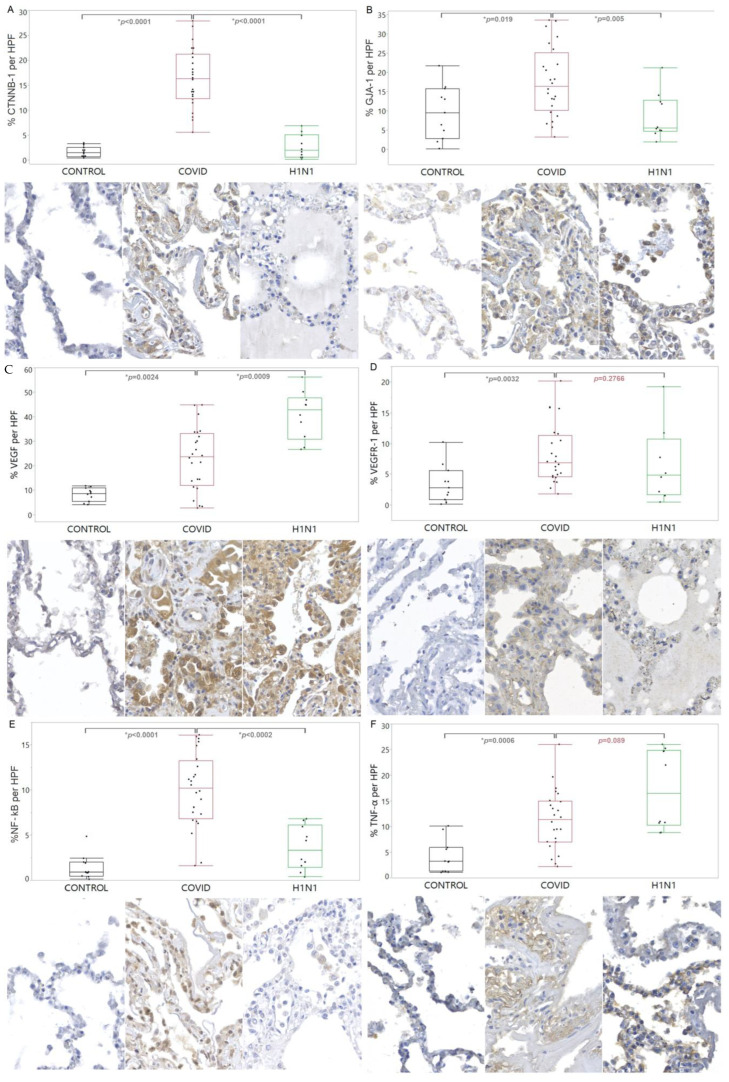
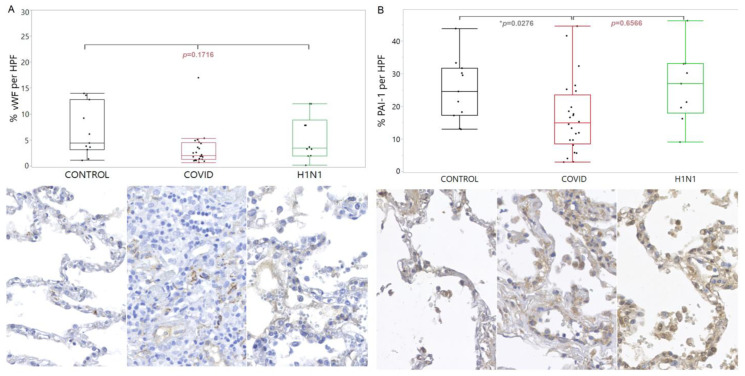
COVID-19 has been considered a vascular disease, and inflammation, intravascular coagulation, and consequent thrombosis may be associated with endothelial dysfunction. These changes, in addition to hypoxia, may be responsible for pathological angiogenesis. This research investigated the impact of COVID-19 on vascular function by analyzing post-mortem lung samples from 24 COVID-19 patients, 10 H1N1pdm09 patients, and 11 controls. We evaluated, through the immunohistochemistry technique, the tissue immunoexpressions of biomarkers involved in endothelial dysfunction, microthrombosis, and angiogenesis (ICAM-1, ANGPT-2, and IL-6, IL-1β, vWF, PAI-1, CTNNB-1, GJA-1, VEGF, VEGFR-1, NF-kB, TNF-α and HIF-1α), along with the histopathological presence of microthrombosis, endothelial activation, and vascular layer hypertrophy. Clinical data from patients were also observed. The results showed that COVID-19 was associated with increased immunoexpression of biomarkers involved in endothelial dysfunction, microthrombosis, and angiogenesis compared to the H1N1 and CONTROL groups. Microthrombosis and vascular layer hypertrophy were found to be more prevalent in COVID-19 patients. This study concluded that immunothrombosis and angiogenesis might play a key role in COVID-19 progression and outcome, particularly in patients who die from the disease.
COVID-19 被认为是一种血管疾病,炎症、血管内凝血和随之而来的血栓形成可能与内皮功能障碍有关。这些变化,加上缺氧,可能是病理性血管生成的原因。本研究通过分析 24 例 COVID-19 患者、10 例 H1N1pdm09 患者和 11 例对照的尸检肺样本,研究了 COVID-19 对血管功能的影响。我们通过免疫组织化学技术评估了参与内皮功能障碍、微血栓形成和血管生成的生物标志物(ICAM-1、ANGPT-2 和 IL-6、IL-1β、vWF、PAI-1、CTNNB-1、GJA-1、VEGF、VEGFR-1、NF-kB、TNF-α 和 HIF-1α)的组织免疫表达,以及微血栓形成、内皮激活和血管层肥大的组织病理学表现。还观察了患者的临床数据。结果表明,与 H1N1 组和对照组相比,COVID-19 患者与参与内皮功能障碍、微血栓形成和血管生成的生物标志物的免疫表达增加有关。微血栓形成和血管层肥大在 COVID-19 患者中更为常见。本研究得出结论,免疫血栓形成和血管生成可能在 COVID-19 的进展和结局中发挥关键作用,特别是在因该疾病而死亡的患者中。