Tashjian Tommy F, Zeinert Rilee D, Eyles Stephen J, Chien Peter
Department of Biochemistry and Molecular Biology, University of Massachusetts Amherst, Amherst, MA, USA.
bioRxiv. 2023 Jun 30:2023.03.24.534141. doi: 10.1101/2023.03.24.534141.
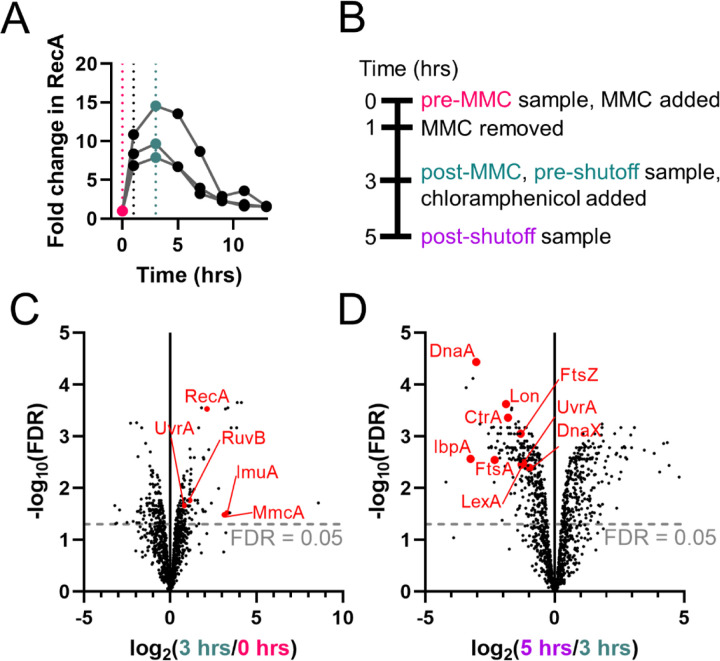
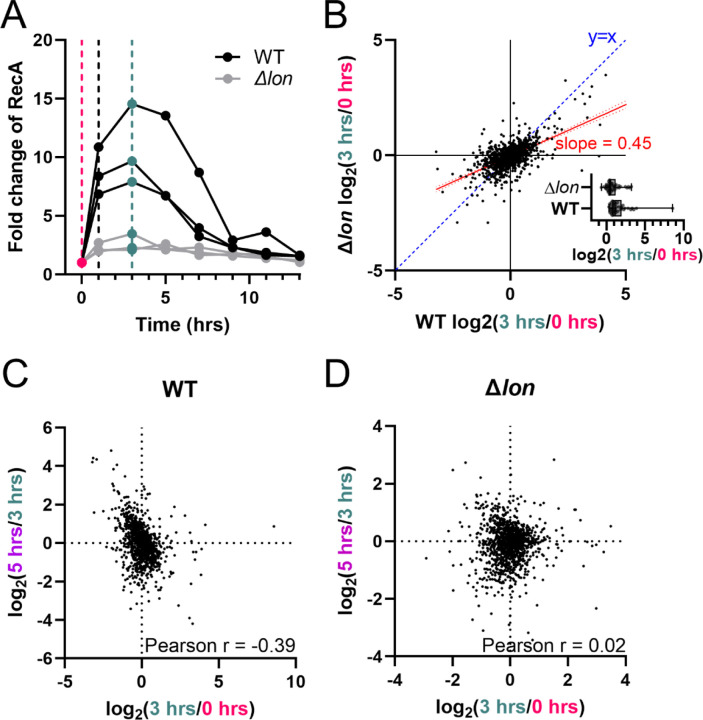
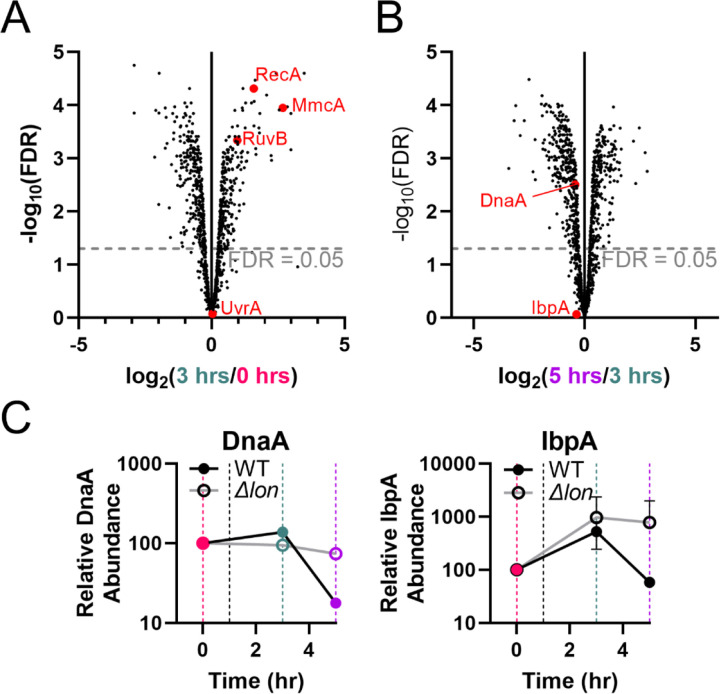
The bacterial DNA damage response is a critical, coordinated response to endogenous and exogenous sources of DNA damage. Response dynamics are dependent on coordinated synthesis and loss of relevant proteins. While much is known about its global transcriptional control, changes in protein abundance that occur upon DNA damage are less well characterized at the system level. Here, we perform a proteome-wide survey of the DNA damage response in . We find that while most protein abundance changes upon DNA damage are readily explained by changes in transcription, there are exceptions. The survey also allowed us to identify the novel DNA damage response factor, YaaA, which has been overlooked by previously published, transcription- focused studies. A similar survey in a Δ strain was performed to explore role in DNA damage survival. The Δ strain had a smaller dynamic range of protein abundance changes in general upon DNA damage compared to the wild type strain. This system-wide change to the dynamics of the response may explain this strain's sensitivity to DNA damage. Our proteome survey of the DNA damage response provides additional insight into the complex regulation of stress response and nominates a novel response factor that was overlooked in prior studies.
The DNA damage response helps bacteria to react to and potentially survive DNA damage. The mutagenesis induced during this stress response contributes to the development of antibiotic resistance. Understanding how bacteria coordinate their response to DNA damage could help us to combat this growing threat to human health. While the transcriptional regulation of the bacterial DNA damage response has been characterized, this study is the first to our knowledge to assess the proteomic response to DNA damage in .
细菌DNA损伤反应是对DNA损伤的内源性和外源性来源的关键、协调反应。反应动力学取决于相关蛋白质的协调合成和损失。虽然对其全局转录控制了解很多,但DNA损伤时发生的蛋白质丰度变化在系统水平上的特征尚不明确。在这里,我们对[具体物种或菌株]的DNA损伤反应进行了全蛋白质组调查。我们发现,虽然DNA损伤时大多数蛋白质丰度变化很容易通过转录变化来解释,但也有例外。该调查还使我们能够鉴定出新型DNA损伤反应因子YaaA,它在以前发表的以转录为重点的研究中被忽视了。在Δ[具体基因缺失]菌株中进行了类似的调查,以探索[该基因]在DNA损伤存活中的作用。与野生型菌株相比,Δ[具体基因缺失]菌株在DNA损伤时蛋白质丰度变化的动态范围总体上较小。这种反应动力学的全系统变化可能解释了该菌株对DNA损伤的敏感性。我们对DNA损伤反应的蛋白质组调查为应激反应的复杂调控提供了更多见解,并提名了一个在先前研究中被忽视的新型反应因子。
DNA损伤反应帮助细菌对DNA损伤做出反应并可能在DNA损伤中存活。这种应激反应期间诱导的诱变有助于抗生素抗性的发展。了解细菌如何协调其对DNA损伤的反应有助于我们应对这一日益严重的对人类健康的威胁。虽然细菌DNA损伤反应的转录调控已经得到表征,但据我们所知,这项研究是首次评估[具体物种或菌株]对DNA损伤的蛋白质组反应。