Houlahan Kathleen E, Khan Aziz, Greenwald Noah F, West Robert B, Angelo Michael, Curtis Christina
Stanford Cancer Institute, Stanford University School of Medicine, Stanford, CA, USA.
Cancer Biology Program, Stanford University School of Medicine, Stanford, CA, USA.
bioRxiv. 2023 Mar 16:2023.03.15.532870. doi: 10.1101/2023.03.15.532870.
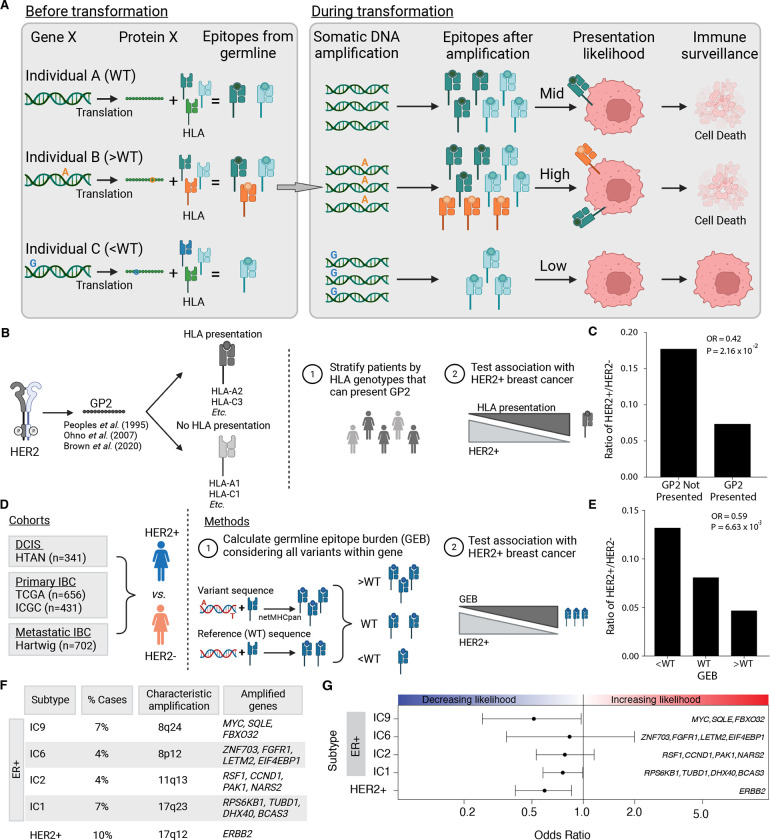
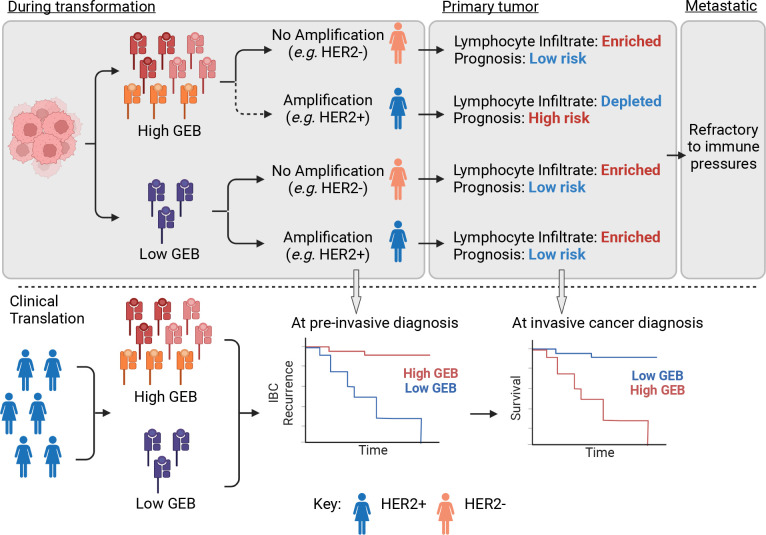
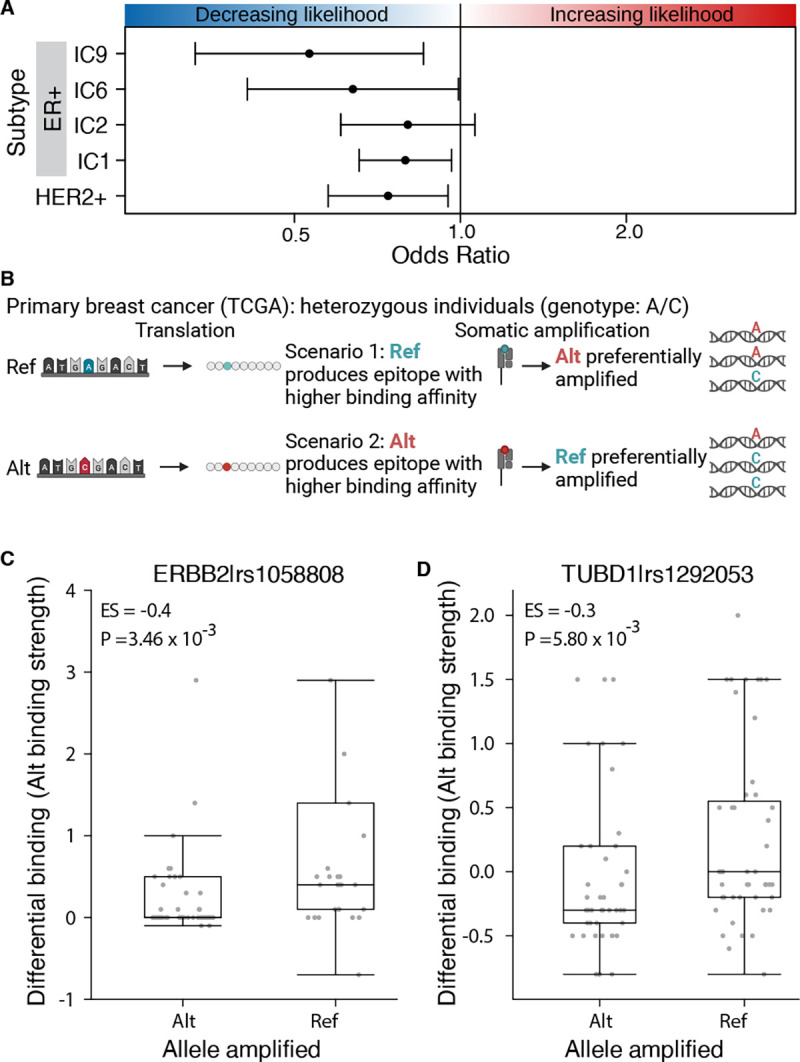
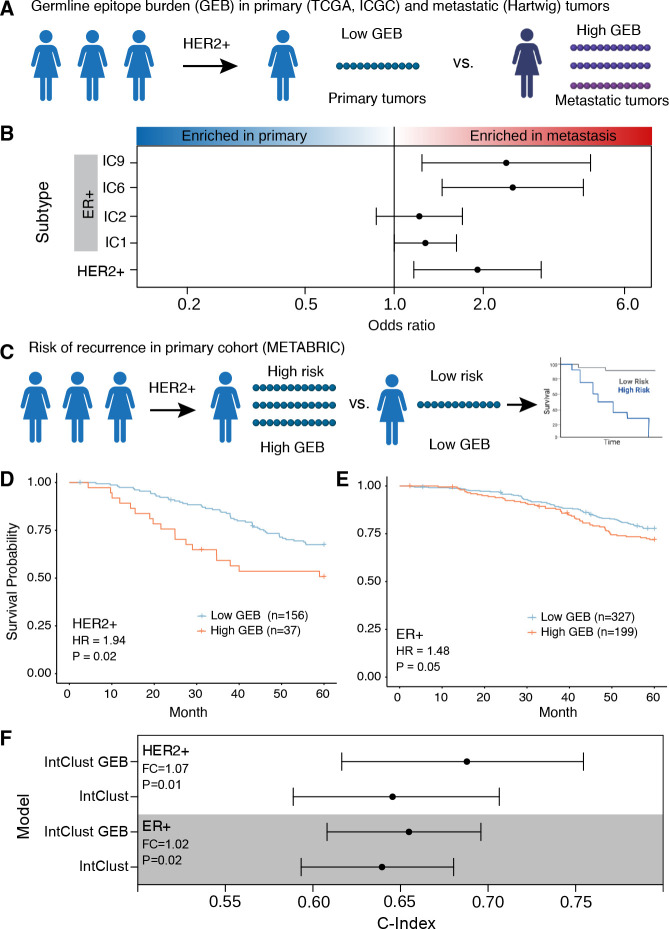
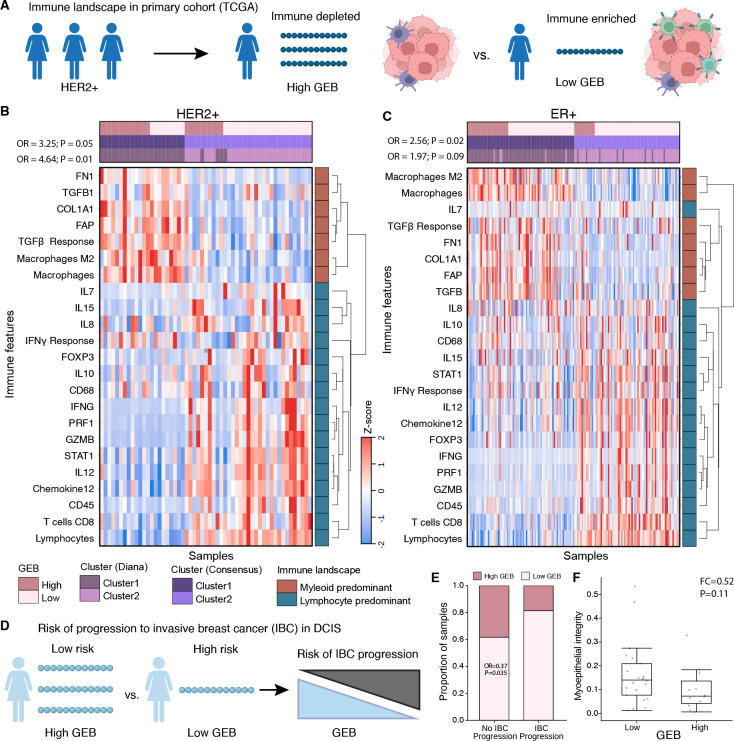
Cancer represents a broad spectrum of molecularly and morphologically diverse diseases. Individuals with the same clinical diagnosis can have tumors with drastically different molecular profiles and clinical response to treatment. It remains unclear when these differences arise during disease course and why some tumors are addicted to one oncogenic pathway over another. Somatic genomic aberrations occur within the context of an individual's germline genome, which can vary across millions of polymorphic sites. An open question is whether germline differences influence somatic tumor evolution. Interrogating 3,855 breast cancer lesions, spanning pre-invasive to metastatic disease, we demonstrate that germline variants in highly expressed and amplified genes influence somatic evolution by modulating immunoediting at early stages of tumor development. Specifically, we show that the burden of germline-derived epitopes in recurrently amplified genes selects against somatic gene amplification in breast cancer. For example, individuals with a high burden of germline-derived epitopes in encoding human epidermal growth factor receptor 2 (HER2), are significantly less likely to develop HER2-positive breast cancer compared to other subtypes. The same holds true for recurrent amplicons that define four subgroups of ER-positive breast cancers at high risk of distant relapse. High epitope burden in these recurrently amplified regions is associated with decreased likelihood of developing high risk ER-positive cancer. Tumors that overcome such immune-mediated negative selection are more aggressive and demonstrate an "immune cold" phenotype. These data show the germline genome plays a previously unappreciated role in dictating somatic evolution. Exploiting germline-mediated immunoediting may inform the development of biomarkers that refine risk stratification within breast cancer subtypes.
癌症代表了一系列分子和形态各异的疾病。具有相同临床诊断的个体,其肿瘤可能具有截然不同的分子特征和对治疗的临床反应。目前尚不清楚这些差异在疾病进程中何时出现,以及为何有些肿瘤对一种致癌途径的依赖甚于另一种。体细胞基因组畸变发生在个体的种系基因组背景下,而种系基因组在数百万个多态性位点上可能存在差异。一个悬而未决的问题是,种系差异是否会影响体细胞肿瘤的进化。通过对3855个乳腺癌病灶(涵盖从癌前病变到转移性疾病)进行研究,我们证明,高表达和扩增基因中的种系变异通过在肿瘤发展早期调节免疫编辑来影响体细胞进化。具体而言,我们发现,反复扩增基因中种系衍生表位的负担会在乳腺癌中对体细胞基因扩增产生负选择。例如,与其他亚型相比,编码人表皮生长因子受体2(HER2)的基因中种系衍生表位负担高的个体,发生HER2阳性乳腺癌的可能性显著降低。对于定义远处复发高风险的雌激素受体阳性乳腺癌四个亚组的反复扩增子来说也是如此。这些反复扩增区域中的高表位负担与发生高风险雌激素受体阳性癌症的可能性降低相关。克服这种免疫介导负选择的肿瘤更具侵袭性,并表现出“免疫冷”表型。这些数据表明,种系基因组在决定体细胞进化方面发挥了此前未被认识到的作用。利用种系介导的免疫编辑可能为开发生物标志物提供信息,从而优化乳腺癌亚型内的风险分层。