Moyo-Gwete Thandeka, Richardson Simone I, Keeton Roanne, Hermanus Tandile, Spencer Holly, Manamela Nelia P, Ayres Frances, Makhado Zanele, Motlou Thopisang, Tincho Marius B, Benede Ntombi, Ngomti Amkele, Baguma Richard, Chauke Masego V, Mennen Mathilda, Adriaanse Marguerite, Skelem Sango, Goga Ameena, Garrett Nigel, Bekker Linda-Gail, Gray Glenda, Ntusi Ntobeko A B, Riou Catherine, Burgers Wendy A, Moore Penny L
National Institute for Communicable Diseases of the National Health Laboratory Services, Johannesburg, South Africa.
MRC Antibody Immunity Research Unit, School of Pathology, University of the Witwatersrand, Johannesburg, South Africa.
medRxiv. 2023 Mar 15:2023.03.15.23287288. doi: 10.1101/2023.03.15.23287288.
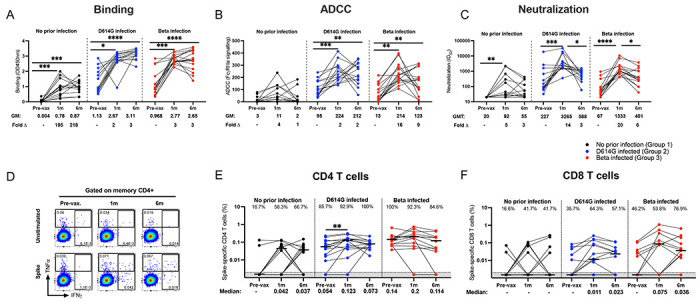
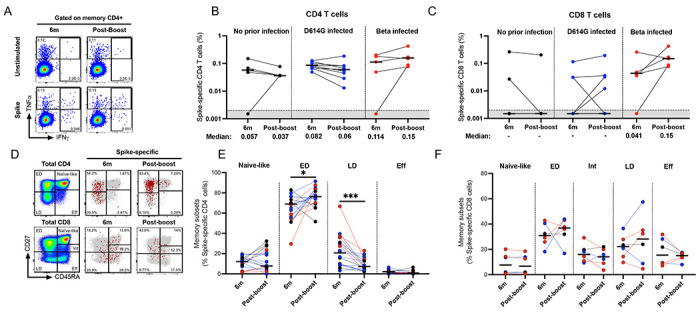
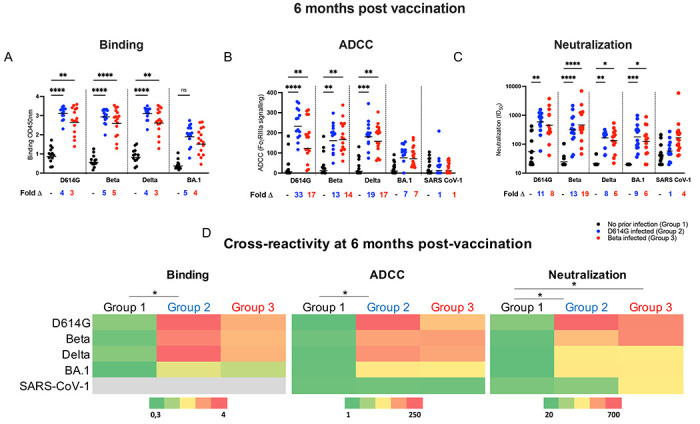
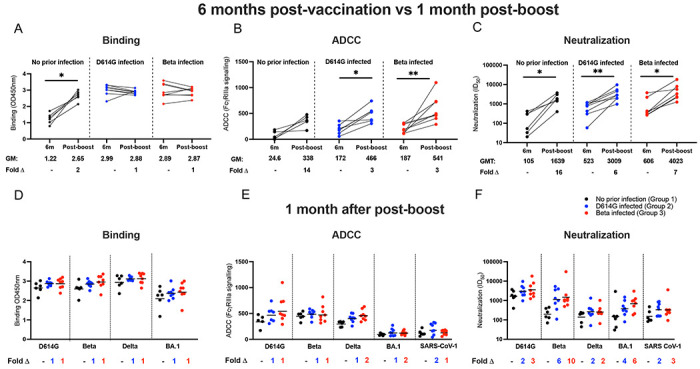
The impact of previous SARS-CoV-2 infection on the durability of Ad26.COV2.S vaccine-elicited responses, and the effect of homologous boosting has not been well explored. We followed a cohort of healthcare workers for 6 months after receiving the Ad26.COV2.S vaccine and a further one month after they received an Ad26.COV2.S booster dose. We assessed longitudinal spike-specific antibody and T cell responses in individuals who had never had SARS-CoV-2 infection, compared to those who were infected with either the D614G or Beta variants prior to vaccination. Antibody and T cell responses elicited by the primary dose were durable against several variants of concern over the 6 month follow-up period, regardless of infection history. However, at 6 months after first vaccination, antibody binding, neutralization and ADCC were as much as 33-fold higher in individuals with hybrid immunity compared to those with no prior infection. Antibody cross-reactivity profiles of the previously infected groups were similar at 6 months, unlike at earlier time points suggesting that the effect of immune imprinting diminishes by 6 months. Importantly, an Ad26.COV2.S booster dose increased the magnitude of the antibody response in individuals with no prior infection to similar levels as those with previous infection. The magnitude of spike T cell responses and proportion of T cell responders remained stable after homologous boosting, concomitant with a significant increase in long-lived early differentiated CD4 memory T cells. Thus, these data highlight that multiple antigen exposures, whether through infection and vaccination or vaccination alone, result in similar boosts after Ad26.COV2.S vaccination.
既往SARS-CoV-2感染对Ad26.COV2.S疫苗诱导的免疫反应持久性的影响以及同源加强免疫的效果尚未得到充分研究。我们对一组医护人员在接种Ad26.COV2.S疫苗后随访了6个月,并在他们接受Ad26.COV2.S加强剂量后又随访了1个月。我们评估了从未感染过SARS-CoV-2的个体与在接种疫苗前感染过D614G或Beta变体的个体的纵向刺突特异性抗体和T细胞反应。在6个月的随访期内,无论感染史如何,初次剂量诱导的抗体和T细胞反应对几种关注变体都具有持久性。然而,在首次接种疫苗6个月后,具有混合免疫的个体的抗体结合、中和和ADCC水平比未感染过的个体高出33倍之多。与早期时间点不同,既往感染组在6个月时的抗体交叉反应谱相似,这表明免疫印记的影响在6个月时减弱。重要的是,Ad26.COV2.S加强剂量使未感染过的个体的抗体反应幅度增加到与既往感染个体相似的水平。同源加强免疫后,刺突T细胞反应的幅度和T细胞反应者的比例保持稳定,同时长寿的早期分化CD4记忆T细胞显著增加。因此,这些数据表明,多次抗原暴露,无论是通过感染和接种疫苗还是仅通过接种疫苗,在Ad26.COV2.S疫苗接种后都会产生类似的增强效果。