Division of Cardiology, Department of Medicine, Montefiore Medical Center, Bronx, NY, USA.
School of Medicine, University of Crete, Heraklion, Greece.
J Int Med Res. 2023 Mar;51(3):3000605231164548. doi: 10.1177/03000605231164548.
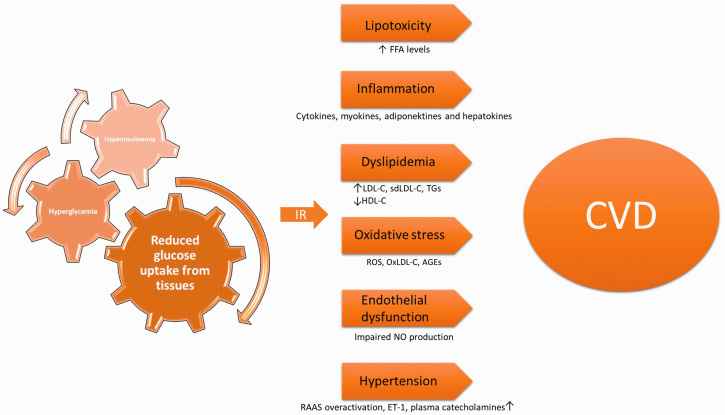
Insulin resistance (IR) and cardiovascular disease (CVD) represent two universal public health hazards, especially in today's Western societies. A causal-effect relationship has been established that links IR with CVD. The mediating mechanisms are perplexing, under ongoing, rigorous investigation and remain to be fully elucidated. IR is a condition encompassing hyperglycemia and compensatory hyperinsulinemia. It occurs when insulin is not capable of exerting its maximum effects on target tissues, including skeletal muscles, liver and adipose tissue. This alteration of insulin signaling pathways results in the development of cardiometabolic disorders, including obesity, dyslipidemia, low-grade inflammation, endothelial dysfunction and hypertension, all of which are predisposing factors for atherosclerosis and CVD. The management of IR can be achieved through dietary modifications, the inclusion of regular exercise routines in everyday life, pharmacological agents and other interventions tailored to each individual patient's needs. It is important to underline though that, although various antidiabetic drugs that may improve IR are available, no medications are as yet specifically approved for the treatment of IR. This narrative review will focus on the current scientific and clinical evidence pertaining to IR, the mechanisms connecting IR with CVD, as well as plausible strategies for a holistic, personalized approach for IR management.
胰岛素抵抗(IR)和心血管疾病(CVD)是两种普遍存在的公共健康危害,尤其是在当今的西方社会。IR 与 CVD 之间存在因果关系,这一关系已经得到确立。其中的中介机制错综复杂,目前仍在进行严格的研究,但尚未完全阐明。IR 是一种包括高血糖和代偿性高胰岛素血症的病症。当胰岛素无法在包括骨骼肌、肝脏和脂肪组织在内的靶组织中发挥最大作用时,就会出现这种情况。这种胰岛素信号通路的改变会导致代谢紊乱,包括肥胖、血脂异常、低度炎症、内皮功能障碍和高血压,所有这些都是动脉粥样硬化和 CVD 的诱发因素。IR 的管理可以通过饮食改变、日常生活中定期进行运动、药物治疗以及针对每个患者需求的其他干预措施来实现。然而需要强调的是,尽管有各种可能改善 IR 的抗糖尿病药物,但目前尚无专门批准用于治疗 IR 的药物。本综述将重点关注与 IR 相关的当前科学和临床证据、IR 与 CVD 之间的关联机制,以及针对 IR 管理的整体、个性化方法的合理策略。