Research and Evaluation Department, Kaiser Permanente Southern California,100 S Los Robles Ave, 2nd Floor, Pasadena, CA 91101, USA.
Department of Cardiology, Kaiser Permanente Los Angeles Medical Center, Los Angeles, CA 90027, USA.
Eur Heart J Qual Care Clin Outcomes. 2024 Jan 12;10(1):77-88. doi: 10.1093/ehjqcco/qcad021.
This study aimed to develop and apply natural language processing (NLP) algorithms to identify recurrent atrial fibrillation (AF) episodes following rhythm control therapy initiation using electronic health records (EHRs).
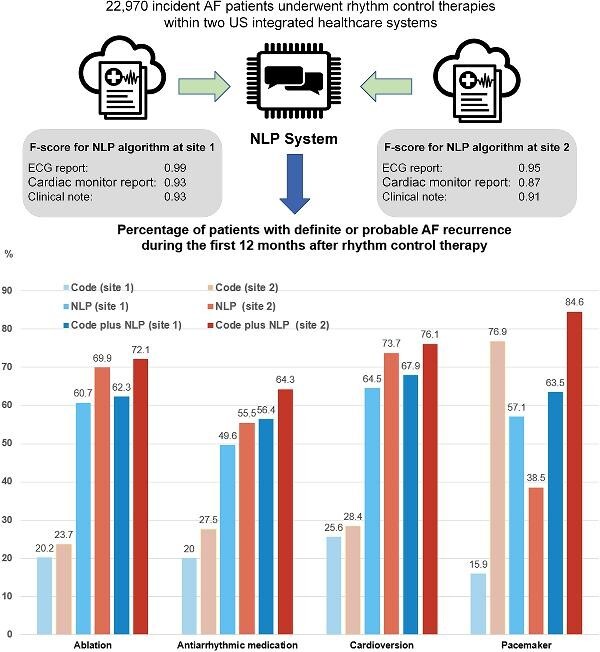
We included adults with new-onset AF who initiated rhythm control therapies (ablation, cardioversion, or antiarrhythmic medication) within two US integrated healthcare delivery systems. A code-based algorithm identified potential AF recurrence using diagnosis and procedure codes. An automated NLP algorithm was developed and validated to capture AF recurrence from electrocardiograms, cardiac monitor reports, and clinical notes. Compared with the reference standard cases confirmed by physicians' adjudication, the F-scores, sensitivity, and specificity were all above 0.90 for the NLP algorithms at both sites. We applied the NLP and code-based algorithms to patients with incident AF (n = 22 970) during the 12 months after initiating rhythm control therapy. Applying the NLP algorithms, the percentages of patients with AF recurrence for sites 1 and 2 were 60.7% and 69.9% (ablation), 64.5% and 73.7% (cardioversion), and 49.6% and 55.5% (antiarrhythmic medication), respectively. In comparison, the percentages of patients with code-identified AF recurrence for sites 1 and 2 were 20.2% and 23.7% for ablation, 25.6% and 28.4% for cardioversion, and 20.0% and 27.5% for antiarrhythmic medication, respectively.
When compared with a code-based approach alone, this study's high-performing automated NLP method identified significantly more patients with recurrent AF. The NLP algorithms could enable efficient evaluation of treatment effectiveness of AF therapies in large populations and help develop tailored interventions.
本研究旨在开发并应用自然语言处理(NLP)算法,通过电子健康记录(EHR)识别节律控制治疗启动后复发性心房颤动(AF)的发作。
我们纳入了在两个美国综合医疗服务系统中开始节律控制治疗(消融、转复或抗心律失常药物)的新发 AF 成人患者。基于代码的算法使用诊断和程序代码识别潜在的 AF 复发。开发并验证了一种自动 NLP 算法,以从心电图、心脏监测报告和临床记录中捕获 AF 复发。与经医生裁决确认的参考标准病例相比,两个地点的 NLP 算法的 F 分数、敏感性和特异性均高于 0.90。我们将 NLP 和基于代码的算法应用于开始节律控制治疗后 12 个月内发生 AF 的患者(n=22970)。应用 NLP 算法,站点 1 和 2 的 AF 复发患者比例分别为 60.7%和 69.9%(消融)、64.5%和 73.7%(转复)以及 49.6%和 55.5%(抗心律失常药物)。相比之下,站点 1 和 2 的基于代码识别的 AF 复发患者比例分别为消融的 20.2%和 23.7%、转复的 25.6%和 28.4%以及抗心律失常药物的 20.0%和 27.5%。
与单独基于代码的方法相比,本研究高性能的自动 NLP 方法显著识别出更多的复发性 AF 患者。NLP 算法可以在大量人群中有效评估 AF 治疗的效果,并有助于制定有针对性的干预措施。