Wilkie Johnston Laura, Bergami Elisa, Rowlands Emily, Manno Clara
British Antarctic Survey, Natural Environment Research Council, High Cross, Madingley Road, Cambridge CB3 0ET, UK.
University of St Andrews, St Andrews, Scotland KY16 9AJ, UK.
R Soc Open Sci. 2023 Mar 29;10(3):221421. doi: 10.1098/rsos.221421. eCollection 2023 Mar.
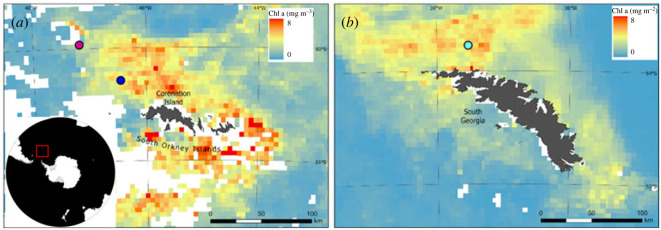
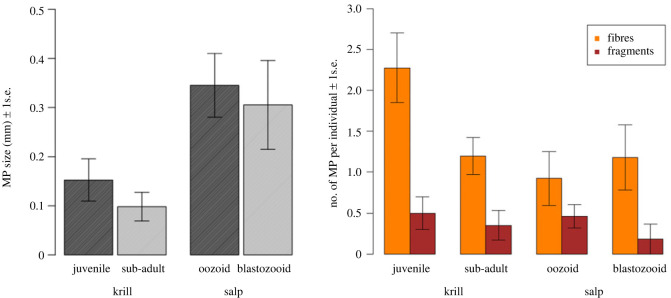
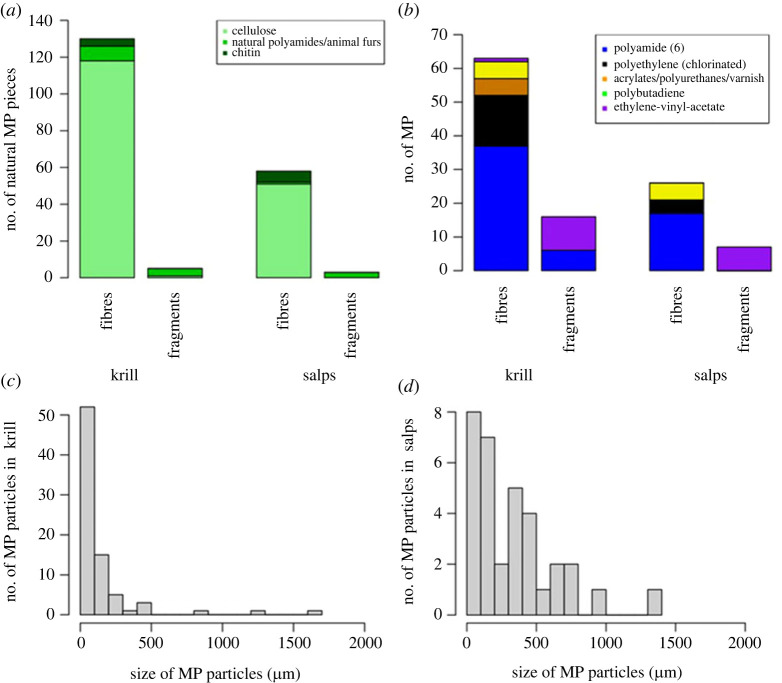
Microplastics (MP) have been reported in Southern Ocean (SO), where they are likely to encounter Antarctic zooplankton and enter pelagic food webs. Here we assess the presence of MP within Antarctic krill () and salps () and quantify their abundance and type by micro-Fourier transform infrared microscopy. MP were found in both species, with fibres being more abundant than fragments (krill: 56.25% and salps: 22.32% of the total MP). Polymer identification indicated MP originated from both local and distant sources. Our findings prove how MP ingestion from these organisms is a real and ongoing process in the SO. MP amount was higher in krill (2.13 ± 0.26 MP ind) than salps (1.38 ± 0.42 MP ind), while MP size extracted from krill (130 ± 30 µm) was significantly lower than MP size from salps (330 ± 50 µm). We suggest that differences between abundance and size of MP ingested by these two species may be related to their food strategies, their ability to fragment MP as well as different human pressures within the collection areas of the study region. First comparative field-based evidence of MP in both krill and salps, two emblematic zooplankton species of the SO marine ecosystems, underlines that Antarctic marine ecosystems may be particularly sensitive to plastic pollution.
据报道,南大洋存在微塑料(MP),在那里微塑料很可能会接触到南极浮游动物并进入远洋食物网。在此,我们评估了南极磷虾()和樽海鞘()体内微塑料的存在情况,并通过显微傅里叶变换红外显微镜对其丰度和类型进行了量化。在这两个物种中均发现了微塑料,其中纤维的数量比碎片更多(磷虾:占微塑料总数的56.25%,樽海鞘:占22.32%)。聚合物鉴定表明,微塑料的来源既有本地的,也有来自远处的。我们的研究结果证明,在南大洋,这些生物摄入微塑料是一个真实且持续存在的过程。磷虾体内的微塑料数量(2.13±0.26个/个体)高于樽海鞘(1.38±0.42个/个体),而从磷虾中提取的微塑料尺寸(130±30微米)明显小于从樽海鞘中提取的微塑料尺寸(330±50微米)。我们认为,这两个物种摄入微塑料的丰度和尺寸差异可能与其食物策略、破碎微塑料的能力以及研究区域采集地点内不同的人类压力有关。在磷虾和樽海鞘这两种南大洋海洋生态系统中具有代表性的浮游动物物种体内首次发现微塑料的基于实地的比较证据,突显了南极海洋生态系统可能对塑料污染特别敏感。