
双脉冲种子技术使得同步辐射光源在极紫外到软 X 射线谱区能够实现泵浦探测功能。
Twin-pulse seeding enables pump-probe capabilities in the EUV to soft X-ray spectrum at synchrotron light sources.
机构信息
National Synchrotron Light Source II, Brookhaven National Laboratory, Upton, NY, 11973, USA.
Lawrence Berkeley National Laboratory, Berkeley, CA, 94720, USA.
出版信息
Sci Rep. 2023 Mar 31;13(1):5261. doi: 10.1038/s41598-023-32496-6.
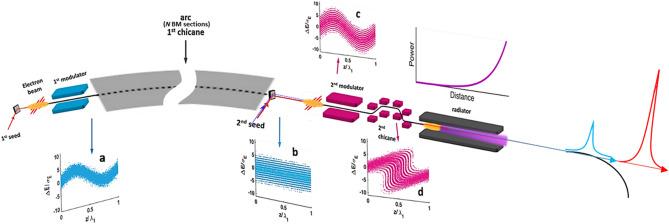
Having previously reported that separating the two stages of echo-enabled harmonic generation (EEHG) with one or more bending magnet (BM) sections allows the BMs to serve as the desired source of momentum compaction, here we demonstrate that this arrangement can greatly reduce the total energy modulation required by any 4th generation synchrotron light source, leading to higher repetition rates as well as stronger coherent radiation output power, with significant benefits. Since the EEHG beamline performance is mainly determined by the momentum compaction, beam emittances and beta functions of a storage ring lattice, allowing for different separations between the two stages is a straightforward way to increase the momentum compaction of chicane 1. This also enables pump-probe capabilities in a novel context, where twin-pulse seeding on the same electron bunch would allow two distinct radiation pulses with an adjustable delay in the range of 0.1 to 10 ps. In the twin-pulse seeding scheme, the same electron bunch could undergo modulation from two distinct laser pulses. Later stages would produce independent harmonics in subsequent straight sections. There are two variations of this twin-pulse seeding scheme, supporting different scientific applications. With a common modulation in stage 1, the first option allows simultaneously two independent radiation sources, with a full coverage of the EUV (2.5 to 50 nm) to soft X-ray (1.25 to 2.5 nm) spectrum; for the second option, the same stage 2 undulator could generate two coherent pulses both fitting within the FEL bandwidth, or at distinct harmonics. We present particle tracking simulation studies based on the APS-U lattice, including quantum excitation and radiation damping. These simulations indicate that there is no degradation of the modulated longitudinal phase space even when the two stages are separated by as many as 10 BM sections.
先前我们曾报道过,通过一个或多个弯曲磁铁(BM)段将回声增强谐波产生(EEHG)的两个阶段分离,可以使 BM 成为所需的动量压缩源。在这里,我们证明了这种布置可以大大减少任何第四代同步加速器光源所需的总能量调制,从而提高重复率以及更强的相干辐射输出功率,带来显著的好处。由于 EEHG 光束线的性能主要取决于存储环晶格的动量压缩、束发射度和β函数,因此允许两个阶段之间有不同的分离是增加回旋加速器 1 的动量压缩的一种直接方法。这也使新型的泵浦-探测功能成为可能,在这种情况下,同一电子束上的双脉冲种子可以允许两个具有可调节延迟(0.1 到 10 ps 之间)的独特辐射脉冲。在双脉冲种子方案中,同一电子束可以经历两个不同激光脉冲的调制。后续阶段将在后续直段中产生独立的谐波。这种双脉冲种子方案有两种变体,支持不同的科学应用。在第一阶段有共同调制的情况下,第一种方案允许同时使用两个独立的辐射源,覆盖 EUV(2.5 到 50nm)到软 X 射线(1.25 到 2.5nm)的光谱;对于第二种方案,相同的第二阶段波荡器可以产生两个相干脉冲,它们都在 FEL 带宽内,或者在不同的谐波上。我们根据 APS-U 晶格进行了粒子跟踪模拟研究,包括量子激发和辐射阻尼。这些模拟表明,即使两个阶段之间相隔多达 10 个 BM 段,调制的纵向相空间也不会退化。




 Zotero 插件