Sheng Wei, Xia Wei, Niu Zhaozhuo, Yang Haiqin
Department of Cardiovascular Surgery, Qingdao Municipal Hospital, Medical College of Qingdao University, Qingdao, Shandong, China.
Department of Cardiology, Qingdao Municipal Hospital, Medical College of Qingdao University, Qingdao, Shandong, China.
Ann Thorac Cardiovasc Surg. 2023 Oct 20;29(5):249-255. doi: 10.5761/atcs.oa.22-00242. Epub 2023 Apr 1.
We aimed to investigate the prognosis and impact of postoperative acute kidney injury (AKI) in acute Stanford type A aortic dissection (ATAAD) patients, and to analyze the predictors of short- and medium-term survival.
A total of 192 patients who underwent ATAAD surgery were included between May 2014 and May 2019. Perioperative data of these patients were analyzed. All of the discharged patients were followed up for 2 years.
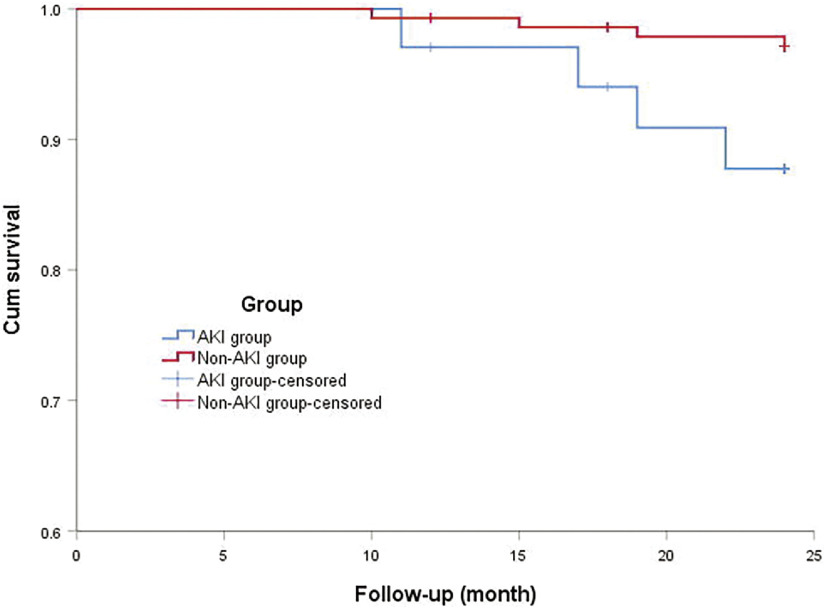
Postoperative AKI was identified in 43 of 192 patients (22.4%). The two-year survival rate of patients with AKI after discharge was 88.2% and that without AKI was 97.2%.The difference was statistically significant (χ = 5.355, log-rank P = 0.021). Cox hazards regression showed that age (hazard ratio [HR], 1.070; P = 0.002), cardiopulmonary bypass (CPB) time (HR, 1.026; P = 0.026), postoperative AKI (HR, 3.681; P = 0.003), and red blood cell transfusion (HR, 1.548; P = 0.001) were independent risk factors for the short- and medium-term total mortality of ATAAD patients.
The incidence of postoperative AKI is high in ATAAD, and the mortality of patients with AKI increases significantly within 2 years. Age, CPB time, and red blood cell transfusion were also independent risk factors for short-and medium-term prognoses.
我们旨在研究急性斯坦福A型主动脉夹层(ATAAD)患者术后急性肾损伤(AKI)的预后及影响,并分析短期和中期生存的预测因素。
纳入2014年5月至2019年5月期间接受ATAAD手术的192例患者。分析这些患者的围手术期数据。所有出院患者均随访2年。
192例患者中有43例(22.4%)发生术后AKI。出院后AKI患者的两年生存率为88.2%,无AKI患者为97.2%。差异具有统计学意义(χ = 5.355,对数秩检验P = 0.021)。Cox风险回归显示,年龄(风险比[HR],1.070;P = 0.002)、体外循环(CPB)时间(HR,1.026;P = 0.026)、术后AKI(HR,3.681;P = 0.003)和红细胞输血(HR,1.548;P = 0.001)是ATAAD患者短期和中期总死亡率的独立危险因素。
ATAAD患者术后AKI的发生率较高,AKI患者在2年内死亡率显著增加。年龄、CPB时间和红细胞输血也是短期和中期预后的独立危险因素。