Azami Masato, Fushiki Hiroaki, Tsunoda Reiko, Kamo Tomohiko, Ogihara Hirofumi, Tanaka Ryozo, Kato Takumi
Otolaryngology, Mejiro University Ear Institute Clinic, Saitama, Japan.
Department of Physical Therapy, Faculty of Health Sciences, Japan University of Health Sciences, Satte, Japan.
Front Neurol. 2023 Mar 16;14:1129569. doi: 10.3389/fneur.2023.1129569. eCollection 2023.
Persistent postural-perceptual dizziness (PPPD) is a relatively new disease entity, with diagnostic criteria published by the Bárány Society. PPPD is often preceded by a peripheral or central vestibular disorder. It is not clear how coexisting deficits due to preceding vestibular disorders affect PPPD symptoms.
This study aimed to characterize the clinical features of PPPD with or without isolated otolith dysfunction using vestibular function tests.
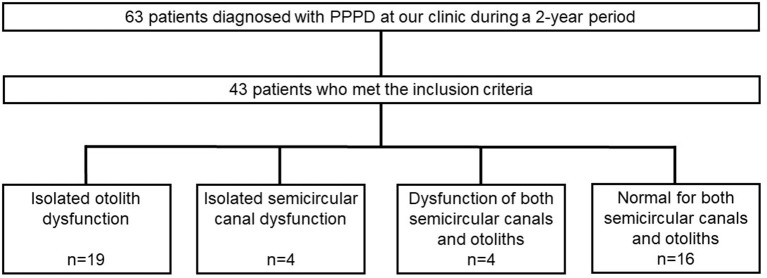
The study included 43 patients (12 males and 31 females) who were diagnosed with PPPD and completed oculomotor-vestibular function tests. The Dizziness Handicap Inventory (DHI), Hospital Anxiety and Depression Scale (HADS), Niigata PPPD Questionnaire (NPQ), and Romberg test for stabilometry were examined. The 43 patients with PPPD were classified into four categories based on vestibular evoked myogenic potential (VEMP) and video head impulse test (vHIT) results: normal function for both semicircular canals and otoliths (normal), isolated otolith dysfunction (iOtoDys), isolated semicircular canal dysfunction (iCanalDys), and dysfunction of both otoliths and semicircular canals (OtoCanalDys).
Among the 43 patients with PPPD, the iOtoDys group was the largest (44.2%), followed by the normal group (37.2%), iCanalDys group (9.3%), and OtoCanalDys group (9.3%). Eight of the 19 iOtoDys patients showed both abnormal cVEMP and oVEMP responses unilaterally or bilaterally (both sacculus and utriculus damage type), whereas 11 showed either an abnormal cVEMP or an abnormal oVEMP response (either sacculus or utriculus damage type). In a three-group comparison of the both sacculus and utriculus damage type, the either sacculus or utriculus damage type, and the normal group, the mean total, functional, and emotional DHI scores were significantly higher for the both sacculus and utriculus damage type than for the either sacculus or utriculus damage type. The Romberg ratio, a measure of stabilometry, was significantly higher for the normal group than for the both sacculus and utriculus damage type and the sacculus or utriculus damage type in the iOtoDys group.
The coexistence of sacculus and utriculus damage may exacerbate dizziness symptoms in patients with PPPD. Determining the presence and extent of otolith damage in PPPD may provide useful information on the pathophysiology and treatment strategies of PPPD.
持续性姿势 - 知觉性头晕(PPPD)是一种相对较新的疾病实体,其诊断标准由巴兰尼协会发布。PPPD通常 preceded by a peripheral or central vestibular disorder。目前尚不清楚先前前庭疾病导致的共存缺陷如何影响PPPD症状。
本研究旨在通过前庭功能测试来描述伴或不伴孤立性耳石功能障碍的PPPD的临床特征。
该研究纳入了43例被诊断为PPPD并完成眼动 - 前庭功能测试的患者(12例男性和31例女性)。对头晕残障量表(DHI)、医院焦虑抑郁量表(HADS)、新潟PPPD问卷(NPQ)以及用于稳定测量的罗姆伯格测试进行了检查。根据前庭诱发肌源性电位(VEMP)和视频头脉冲测试(vHIT)结果,将43例PPPD患者分为四类:半规管和耳石功能均正常(正常)、孤立性耳石功能障碍(iOtoDys)、孤立性半规管功能障碍(iCanalDys)以及耳石和半规管均功能障碍(OtoCanalDys)。
在43例PPPD患者中,iOtoDys组人数最多(44.2%),其次是正常组(37.2%)、iCanalDys组(9.3%)和OtoCanalDys组(9.3%)。19例iOtoDys患者中有8例单侧或双侧cVEMP和oVEMP反应均异常(球囊和椭圆囊均受损类型),而11例表现为cVEMP或oVEMP反应异常(球囊或椭圆囊受损类型)。在球囊和椭圆囊均受损类型、球囊或椭圆囊受损类型以及正常组的三组比较中,球囊和椭圆囊均受损类型的DHI总评分、功能评分和情感评分均显著高于球囊或椭圆囊受损类型。在iOtoDys组中,用于稳定测量的罗姆伯格比率,正常组显著高于球囊和椭圆囊均受损类型以及球囊或椭圆囊受损类型。
球囊和椭圆囊损伤的共存可能会加重PPPD患者的头晕症状。确定PPPD中耳石损伤的存在和程度可能为PPPD的病理生理学和治疗策略提供有用信息。
原文中“preceded by a peripheral or central vestibular disorder”表述不太完整准确,可能影响理解,推测完整意思可能是“PPPD通常先于外周或中枢前庭疾病出现” 。