Ashby Ben, Smith Cameron A, Thompson Robin N
Department of Mathematics, Simon Fraser University, Burnaby, British Columbia, Canada.
Department of Mathematical Sciences, University of Bath, Bath, UK.
Evol Med Public Health. 2022 Dec 19;11(1):80-89. doi: 10.1093/emph/eoac043. eCollection 2023.
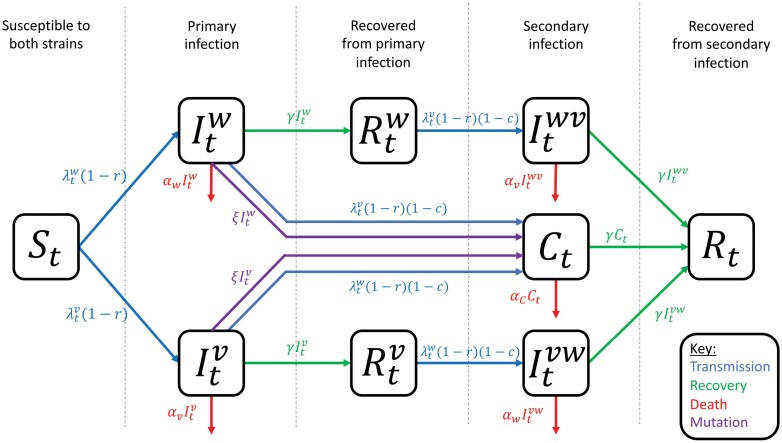
Non-pharmaceutical interventions (NPIs), such as social distancing and contact tracing, are important public health measures that can reduce pathogen transmission. In addition to playing a crucial role in suppressing transmission, NPIs influence pathogen evolution by mediating mutation supply, restricting the availability of susceptible hosts, and altering the strength of selection for novel variants. Yet it is unclear how NPIs might affect the emergence of novel variants that are able to escape pre-existing immunity (partially or fully), are more transmissible or cause greater mortality. We analyse a stochastic two-strain epidemiological model to determine how the strength and timing of NPIs affect the emergence of variants with similar or contrasting life-history characteristics to the wild type. We show that, while stronger and timelier NPIs generally reduce the likelihood of variant emergence, it is possible for more transmissible variants with high cross-immunity to have a greater probability of emerging at intermediate levels of NPIs. This is because intermediate levels of NPIs allow an epidemic of the wild type that is neither too small (facilitating high mutation supply), nor too large (leaving a large pool of susceptible hosts), to prevent a novel variant from becoming established in the host population. However, since one cannot predict the characteristics of a variant, the best strategy to prevent emergence is likely to be an implementation of strong, timely NPIs.
非药物干预措施(NPIs),如社交距离和接触者追踪,是重要的公共卫生措施,可减少病原体传播。除了在抑制传播方面发挥关键作用外,非药物干预措施还通过介导突变供应、限制易感宿主的可及性以及改变对新变体的选择强度来影响病原体进化。然而,尚不清楚非药物干预措施如何影响能够逃避现有免疫力(部分或完全逃避)、更具传播性或导致更高死亡率的新变体的出现。我们分析了一个随机双毒株流行病学模型,以确定非药物干预措施的强度和时机如何影响具有与野生型相似或相反生活史特征的变体的出现。我们表明,虽然更强有力和更及时的非药物干预措施通常会降低变体出现的可能性,但对于具有高交叉免疫力的更具传播性的变体来说,在中等水平的非药物干预措施下出现的概率可能更高。这是因为中等水平的非药物干预措施允许野生型疫情既不会太小(便于高突变供应),也不会太大(留下大量易感宿主),从而防止新变体在宿主群体中立足。然而,由于无法预测变体的特征,预防变体出现的最佳策略可能是实施强有力、及时的非药物干预措施。