Abazid Rami M, Romsa Jonathan G, Warrington James C, Akincioglu Cigdem, Smettei Osama A, Bureau Yves, Tzemos Nikolaos, Vezina William C
Division of Nuclear Medicine, London Health Sciences Centre, Victoria Hospital, London, ON, Canada.
Medical Biophysics, Western University, London, ON, Canada.
Front Cardiovasc Med. 2023 Mar 17;10:1087113. doi: 10.3389/fcvm.2023.1087113. eCollection 2023.
The aim of this study is to compare the prognostic value of coronary computed tomography angiography (CCTA) with single-photon emission computed tomography (SPECT) in predicting cardiovascular events in patients with stents.
Retrospective analysis.
University Hospital, London, Ontario Canada
Between January 2007 and December 2018, 119 patients post-percutaneous coronary intervention (PCI) who were referred for hybrid imaging with CTA and 2-day rest/stress SPECT were enrolled.
Patients were followed for any major adverse cardiovascular event (MACE) including: All-cause mortality, Non-fatal myocardial infarction (MI), Unplanned revascularization, Cerebrovascular accident and hospitalization for arrhythmia or heart failure. We define hard cardiac events (HCE) as: cardiac death, non-fatal MI or unplanned revascularization. We used two cut-off values to define obstructive lesions with CCTA ≥50% and ≥70% in any coronary segment. SPECT scan defined as abnormal in the presence of >5% reversible myocardial perfusion defect.
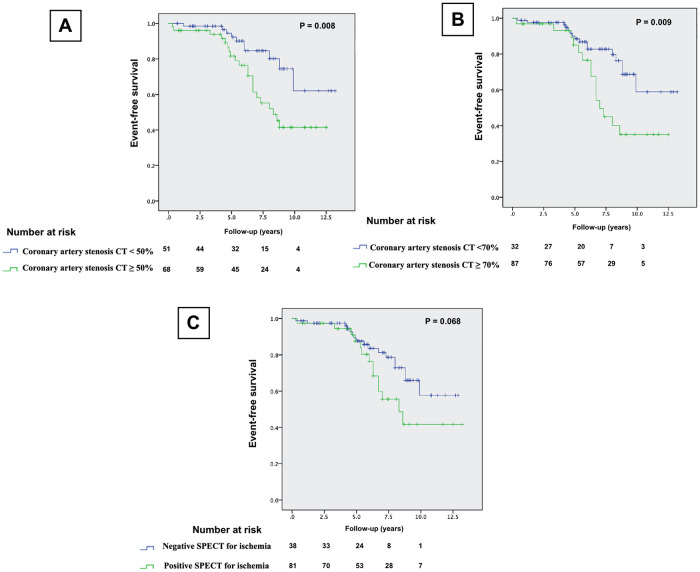
During the follow-up period of 7.2 ± 3.4 years. 45/119 (37.8%) patients experienced 57 MACE: Ten deaths (2 cardiac deaths and 8 of non-cardiac deaths), 29 acute coronary syndrome including non-fatal MI (25 required revascularization), 7 hospitalizations for heart failure, 6 cerebrovascular accidents and 5 new atrial fibrillation. 31 HCEs were reported. Cox regression analysis showed that obstructive coronary stenosis (≥50% and ≥70%) and abnormal SPECT were associated of MACE ( 0.037, 0.018 and 0.026), respectively. In contrast, HCEs were significantly associated with obstructive coronary stenosis of ≥50% and ≥70% with = 0.004 and = 0.007, respectively. In contrast, abnormal SPECT was a nonsignificant predictor of HCEs = 0.062).
Obstructive coronary artery stenosis on CCTA can predict MACE and HCE. However, abnormal SPECT can only predict MACE but not HCE in patients post-PCI with a follow-up period of approximately 7 years.
本研究旨在比较冠状动脉计算机断层扫描血管造影(CCTA)与单光子发射计算机断层扫描(SPECT)在预测支架置入患者心血管事件方面的预后价值。
回顾性分析。
加拿大安大略省伦敦市大学医院
2007年1月至2018年12月期间,119例接受经皮冠状动脉介入治疗(PCI)后转诊进行CTA与2天静息/负荷SPECT混合成像的患者被纳入研究。
对患者进行随访,观察任何主要不良心血管事件(MACE),包括:全因死亡率、非致命性心肌梗死(MI)、非计划血管重建、脑血管意外以及因心律失常或心力衰竭住院。我们将严重心脏事件(HCE)定义为:心源性死亡、非致命性MI或非计划血管重建。我们使用两个截断值来定义CCTA在任何冠状动脉节段中≥50%和≥70%的阻塞性病变。SPECT扫描在存在>5%可逆性心肌灌注缺损时定义为异常。
在7.2±3.4年的随访期内。45/119(37.8%)例患者发生了57次MACE:10例死亡(2例心源性死亡和8例非心源性死亡)、29例急性冠状动脉综合征包括非致命性MI(25例需要血管重建)、7例因心力衰竭住院、6例脑血管意外和5例新发房颤。报告了31次HCE。Cox回归分析显示,阻塞性冠状动脉狭窄(≥50%和≥70%)和异常SPECT分别与MACE相关(P = 0.037、0.018和0.026)。相比之下,HCE与≥50%和≥70%的阻塞性冠状动脉狭窄显著相关,P分别为0.004和0.007。相比之下,异常SPECT是HCE的非显著预测因素(P = 0.062)。
CCTA上的阻塞性冠状动脉狭窄可预测MACE和HCE。然而,在随访期约7年的PCI术后患者中,异常SPECT只能预测MACE,而不能预测HCE。