Meneghesso Davide, Bertazza Partigiani Nicola, Spagnol Rachele, Brazzale Alessandra Rosalba, Morlacco Alessandro, Vidal Enrico
Pediatric Nephrology, Department of Womens's and Children's Health, University Hospital of Padua, Padua, Italy.
Department of Statistical Sciences, University of Padua, Padua, Italy.
Front Pediatr. 2023 Mar 15;11:1085143. doi: 10.3389/fped.2023.1085143. eCollection 2023.
Posterior urethral valves (PUVs) represent the most severe pediatric obstructive uropathy, responsible for chronic renal failure in up to 65% of cases and progression to end-stage kidney disease (ESKD) in about 8%-21% of patients. Unfortunately, renal outcomes have poorly improved over time. The key point is to identify patients at risk; thus, several prenatal and postnatal prognostic factors have been analyzed to improve clinical outcomes. Postnatal nadir creatinine seems to accurately predict long-term renal prognosis, but there is no definitive evidence to support this finding.
We performed a systematic review with meta-analysis to analyze the predictive value of nadir creatinine on long-term renal function in infants with PUVs.
We conducted this systematic review according to the Preferred Reporting Items for Systematic Reviews and Meta-Analyses (PRISMA) guidelines. PubMed and Cochrane Library were systematically searched for studies published from January 2008 to June 2022. All the articles were checked independently by two reviewers in two steps.
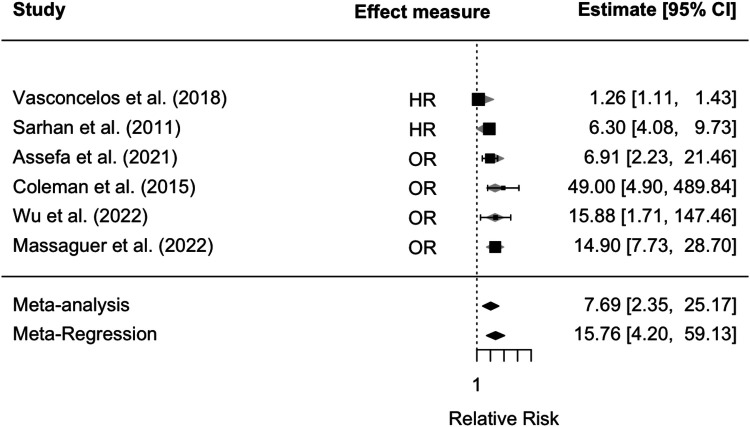
A total of 24 articles were screened, and 13 were included for data extraction. Data from 1,731 patients with PUVs were analyzed, with a mean follow-up of 5.5 years; of these, on average, 37.9% developed chronic kidney disease (CKD) and 13.6% developed ESKD. All the articles evaluated nadir creatinine as a predictor of CKD, most using a level of 1 mg/dL, with statistical significance at the 5% level. The relative risk of developing CKD in patients with creatinine values higher than the nadir cutoff considered was 7.69 (95% CI: 2.35-25.17, = 92.20%, < 0.001).
Nadir creatinine is the best prognostic factor for long-term renal function in patients affected by PUV. A value above the cutoff of 1 mg/dL should be considered a significant predictor for the risk of CKD and ESKD. Further studies are needed to define different nadir creatinine cutoffs for better stratification of the different CKD stages and for the development of reliable scores, which include the association of several variables.
后尿道瓣膜(PUV)是最严重的小儿梗阻性泌尿系统疾病,高达65%的病例会导致慢性肾衰竭,约8%-21%的患者会进展至终末期肾病(ESKD)。不幸的是,随着时间的推移,肾脏预后改善甚微。关键在于识别有风险的患者;因此,人们分析了多种产前和产后的预后因素以改善临床结局。产后肌酐最低点似乎能准确预测长期肾脏预后,但尚无确凿证据支持这一发现。
我们进行了一项系统评价并荟萃分析,以分析肌酐最低点对PUV患儿长期肾功能的预测价值。
我们按照系统评价和荟萃分析的首选报告项目(PRISMA)指南进行了这项系统评价。系统检索了PubMed和Cochrane图书馆中2008年1月至2022年6月发表的研究。所有文章由两名审阅者分两步独立检查。
共筛选出24篇文章,纳入13篇进行数据提取。分析了1731例PUV患者的数据,平均随访5.5年;其中,平均37.9%的患者发展为慢性肾脏病(CKD),13.6%的患者发展为ESKD。所有文章均将肌酐最低点作为CKD的预测指标,多数采用1 mg/dL 的水平,在5%水平具有统计学意义。肌酐值高于所考虑的最低点临界值的患者发生CKD的相对风险为7.69(95%可信区间:2.35-25.17, = 92.20%,<0.001)。
肌酐最低点是PUV患者长期肾功能的最佳预后因素。高于1 mg/dL的临界值应被视为CKD和ESKD风险的重要预测指标。需要进一步研究来确定不同的肌酐最低点临界值,以便更好地对不同的CKD阶段进行分层,并开发可靠的评分系统,其中包括多个变量的关联。