Zhang Bin, Zhang Cheng, Wang YuYe, Chen LeiAn, Qiao YaNan, Wang Yu, Peng DanTao
Department of Neurology, China-Japan Friendship Hospital, Chinese Academy of Medical Sciences and Peking Union Medical College, Beijing, China.
School of Acupuncture, Moxibustion and Tuina, International Acupuncture and Moxibustion Innovation Institute, Beijing University of Chinese Medicine, Beijing, China.
Front Aging Neurosci. 2023 Mar 15;15:1150510. doi: 10.3389/fnagi.2023.1150510. eCollection 2023.
Several blood-based biomarkers are promising to be used in the diagnosis of Alzheimer's disease (AD) including Aβ42/40, p-tau181, and neurofilament light (NfL). The kidney is associated with the clearance of proteins. It is crucial to evaluate the effect of renal function on the diagnostic performance of these biomarkers before clinical implementation, which is important for the establishment of reference ranges and the interpretation of results.
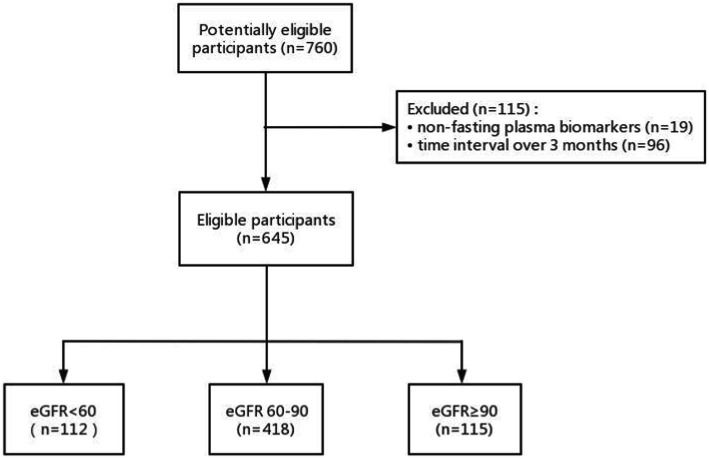
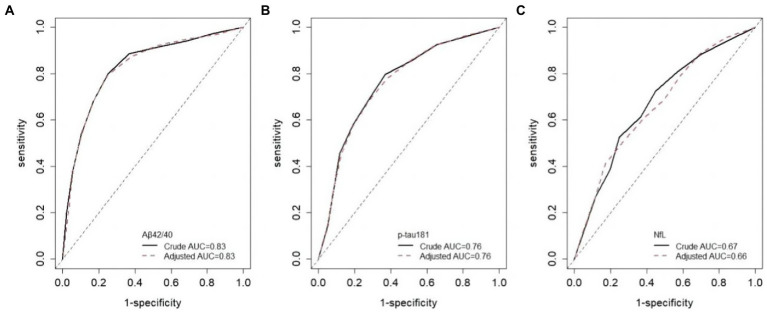
This study is a cross-sectional analysis based on ADNI cohort. Renal function was determined by the estimated glomerular filtration rate (eGFR). Plasma Aβ42/40 was measured by liquid chromatography-tandem mass spectrometry (LC-MS/MS). Plasma p-tau181 and NfL were analyzed by Single Molecule array (Simoa) technique. [18F] florbetapir-PET (Aβ-PET) was used as a reference standard to estimate the brain amyloid load. The cutoff of Aβ-PET positivity was defined as ≥1.11. Linear regression models were used to investigate the associations of continuous eGFR with each plasma biomarker separately. The diagnostic accuracies of plasma biomarkers for positive brain amyloid across different renal function groups were analyzed by Receiver operating characteristic (ROC) curve. Youden-Index was used to determine the cutoff levels.
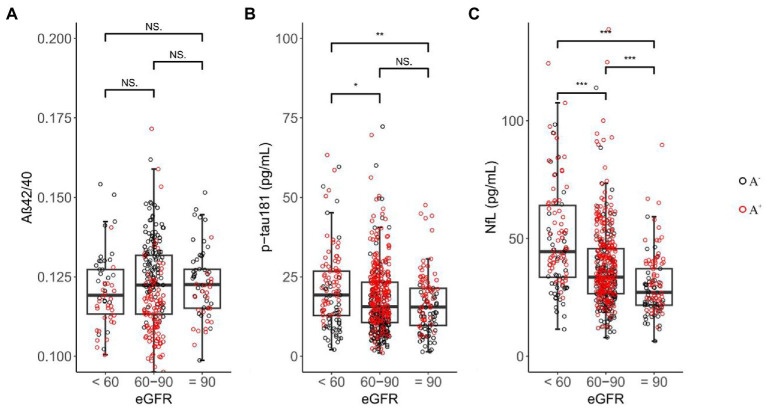
A total of 645 participants were included in this study. The levels and diagnostic performance of Aβ42/40 were not affected by renal function. eGFR was only found negatively associated with p-tau181 levels in Aβ-PET negetive sample ( = -0.09, = 0.039). eGFR was found negatively associated with NfL levels both in whole sample and Aβ-PET stratified groups ( = -0.27, < 0.001 in whole sample; = -0.28, = 0.004 in A; = -0.27, < 0.001 in A). The diagnostic accuracies of p-tau181 and NfL were not affected by renal function. But the cutoff values of p-tau181 and NfL changed in participants with mild to moderate eGFR decline compared to participants with normal eGFR.
Plasma Aβ42/40 was a robust biomarker for AD which was not affected by renal function. Plasma p-tau181 and NfL levels were affected by renal function, specific reference values of them should be considered in populations with different renal function stages.
几种血液生物标志物有望用于阿尔茨海默病(AD)的诊断,包括Aβ42/40、p-tau181和神经丝轻链(NfL)。肾脏与蛋白质清除有关。在临床应用前评估肾功能对这些生物标志物诊断性能的影响至关重要,这对于建立参考范围和结果解读很重要。
本研究是基于ADNI队列的横断面分析。通过估算肾小球滤过率(eGFR)来确定肾功能。采用液相色谱-串联质谱法(LC-MS/MS)测定血浆Aβ42/40。采用单分子阵列(Simoa)技术分析血浆p-tau181和NfL。使用[18F]氟代贝他吡正电子发射断层扫描(Aβ-PET)作为参考标准来估计脑淀粉样蛋白负荷。Aβ-PET阳性的临界值定义为≥1.11。使用线性回归模型分别研究连续eGFR与每种血浆生物标志物的关联。通过受试者工作特征(ROC)曲线分析不同肾功能组中血浆生物标志物对脑淀粉样蛋白阳性的诊断准确性。使用约登指数确定临界水平。
本研究共纳入645名参与者。Aβ42/40的水平和诊断性能不受肾功能影响。仅在Aβ-PET阴性样本中发现eGFR与p-tau181水平呈负相关(=-0.09,=0.039)。在整个样本以及Aβ-PET分层组中均发现eGFR与NfL水平呈负相关(整个样本中=-0.27,<0.001;A组中=-0.28,=0.004;A组中=-0.27,<0.001)。p-tau181和NfL的诊断准确性不受肾功能影响。但与eGFR正常的参与者相比,轻度至中度eGFR下降的参与者中p-tau181和NfL的临界值发生了变化。
血浆Aβ42/40是一种不受肾功能影响的可靠AD生物标志物。血浆p-tau181和NfL水平受肾功能影响,在不同肾功能阶段的人群中应考虑其特定的参考值。